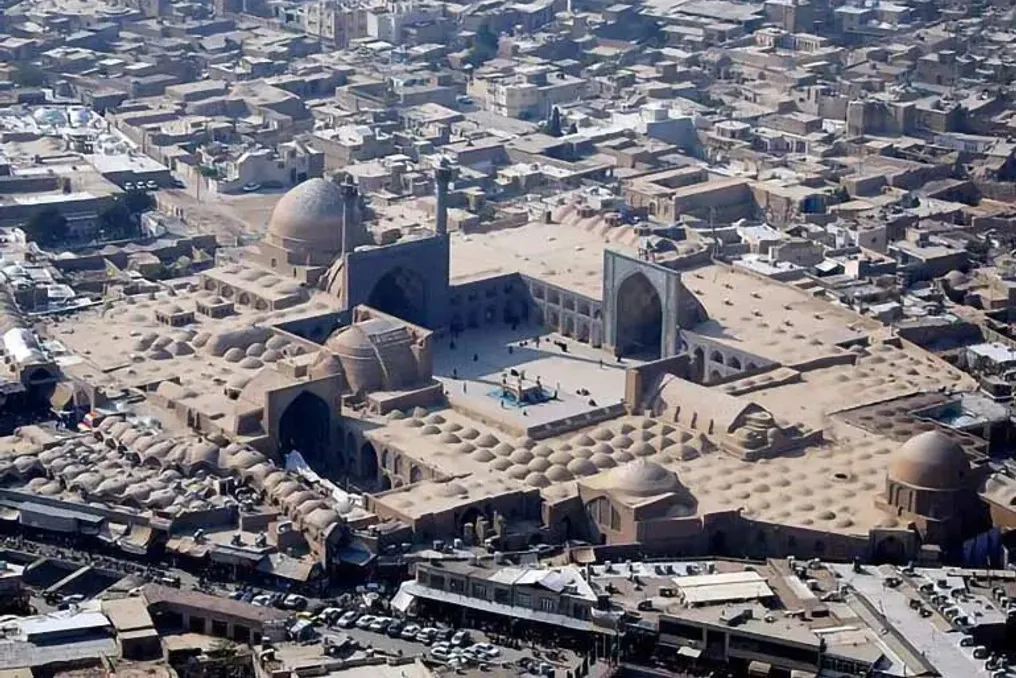
The director of the UNESCO World Heritage site announced that archaeological remains discovered by Italian archaeologists in the historic Jameh Mosque in Isfahan about six decades ago will undergo a new examination.
Omid Ali Sadeghi stated that this survey is being conducted to re-examine the results of the Italian archaeological excavations in the Jameh Mosque of Isfahan, with support from the Provincial Department of Cultural Heritage, Tourism, and Crafts.
The importance of this plan increased after a water pipe burst, which led to prolonged water infiltration into parts of the historic mosque. Moisture reached subsurface layers and archaeological remains in some areas, necessitating a reassessment of their condition.
According to Sadeghi, water infiltrated parts of the mosque approximately 80–90 days after the incident. Subsequent assessments showed that moisture saturation reached about 75 percent at a depth of 50 centimeters and approximately 95 percent at a depth of 85 centimeters.
Measures were taken for drying and humidity control. Sadeghi noted that in damp areas, the humidity level decreased, falling to 30–40 percent in some places and around 50 percent in others. Nevertheless, some parts of the mosque remain affected by moisture and are under observation.
The re-examination will include certain remains previously identified as evidence of the pre-Islamic period, as well as remains related to the earliest phase of the mosque. Specialists will assess their current state of preservation and determine whether the prolonged water infiltration damaged any elements.
Sadeghi emphasized that the project does not involve new or large-scale archaeological excavations; the initial focus will be on analyzing and assessing the remains found during previous work.
He added that if any new or special evidence is discovered during the inspection, it may be studied within the scope of permits and specialized research.
He also mentioned that the mosque complex, including the areas around the Nizam al-Mulk dome, contains archaeological and architectural evidence from different historical eras, such as columns, mihrabs, and architectural elements. These remains together provide important information about the formation and subsequent development of the Jameh Mosque.
The site director stated that the goal of the project is also to increase public access to the archaeological findings, rather than just displaying individual artifacts. After assessing conservation and restoration, some remains are planned to be exhibited to the public for a limited time so that visitors can see the archaeological evidence of the early development of the mosque in its original setting.
Sadeghi described the Jameh Mosque as a potential 'living museum,' where visitors can encounter various historical and architectural layers within the historic structure itself.