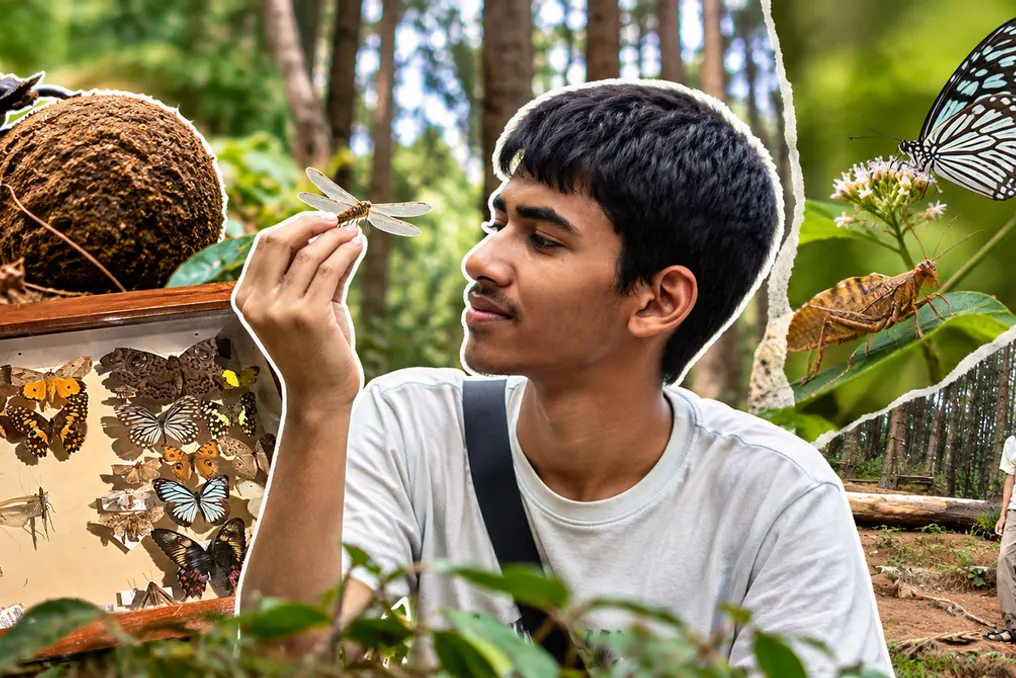
Ethan Xavier discovered his calling while observing the civilizations crawling beneath his feet. He noticed a beetle carrying a load many times its own weight; a moth that appears only after dark; and an anthill organized with astonishing precision. Most people tend to ignore these creatures, but for Ethan, they are neighbors, engineers, farmers, architects, and survivors.
He shares his thoughts: 'I feel calm when I look at insects. They make me realize how insignificant we are.'
Currently, Ethan is studying in the 12th grade at Don Bosco School in Goa, following a period of homeschooling. His daily routine includes completing school assignments, rehearsing with a music group, and maintaining an insect collection which he documents with every specimen encountered.
When he was five years old, his pets were garden snails. While many children collect toys or play football, Ethan preferred to crouch near plants, watching caterpillars feed or beetles disappear into the soil. Soon, his family realized the easiest way to make him happy was to buy him books about insects.
Birthdays and Christmases gradually filled the shelf he read from cover to cover. Television became his classroom, where he watched programs like National Geographic Wild and Animal Planet, as well as documentaries featuring the recognizable voice of Sir David Attenborough. These programs expanded a universe that already seemed incredibly vast, deepening his interest further.
Worms that turned out to be weavers
This patience paid off. One of his favorite discoveries was a group of about a dozen orb-weavers—rare and elusive insects that spin silky, web-like structures for nesting. He recalls: 'Even though I had read about them, when I first saw them, I was absolutely sure it was some kind of worm.' He notes that they produce silk from special glands on their front legs.
Another instance involves a creature that is technically not an insect. During a walk with his mother, he came across a millipede. He says: 'Although I knew it would curl up, seeing it before me for the first time was amazing.' More memorable was how the millipede rolled down the slope they were walking on, and how he chased after it.
Recently, during a trip to Kerala, he saw both dragonflies and tiger beetles in the wild in one day, which was a first for him.
Over time, he understood that insects are among the most successful life forms on Earth. Bees, butterflies, and moths pollinate crops that feed humanity. Countless insects decompose fallen leaves, dead wood, and food waste, returning nutrients to the soil. Others aerate the ground, disperse seeds, regulate pests, and occupy almost every link in the food chain. We depend on them. If insects were removed, entire ecosystems would begin to collapse.
Nevertheless, Ethan objects to measuring their value solely by what they do for us. He expresses frustration with how people try to find 'usefulness' in everything: 'It really annoys me how we humans try to find some 'use' in everything. If we cannot find an application for something, we label it useless. Not everything needs human application to be useful in nature and deserve to exist.'
He admires how human civilization has borrowed ideas from insects. Observing paper wasps chewing wood to build nests prompted an 18th-century French scientist to suggest that paper could be made from wood pulp. Engineers studying ants and bees developed decentralized communication models now used in robotics. Researchers continue to seek breakthroughs in waste management, biomaterials, and medicine in insects. However, although millions of insect species share the planet with us, science has only documented a small fraction of them.
What the insects of Goa tell us
Goa reinforced Ethan's conviction that insects tell stories bigger than themselves. Every year, parts of the Western Ghats become galaxies due to synchronized firefly flashes. On pasture fields, dung beetles perform one of nature's least recognized miracles, rolling and burying animal waste in a way that enriches the soil, suppresses disease carriers, and sustains ecosystems.
In streams and swamps, larvae of caddisflies, mayflies, and dragonflies quietly monitor the condition of freshwater. Their disappearance signals pollution long before laboratory reports arrive.
The problem is that while scientific research is becoming richer, public attention is becoming shorter. Ethan recognizes this paradox. In an era shaped by artificial intelligence and endless scrolling, few people are willing to sit down and read environmental journals.
Instead of resisting this, Ethan wants to work with it. Many lessons he learned today were gained from instructors on digital platforms that showed him that knowledge and engaging storytelling can coexist. For Ethan, film is where research, education, and activism meet. The camera can turn an inconspicuous insect into a main character, replacing fear with wonder, and indifference with delight.
'Like Sir David Attenborough, my dream is to travel the world, documenting insects and bringing the wonders of the insect world into the homes of many people,' he says.
He envisions cities learning from insects. Organic waste could disappear in colonies of black soldier fly larvae, producing nutrient-rich feed for animals. Buildings could take cues from termites to regulate temperature, reducing reliance on air conditioning. Artificial lighting could become more thoughtful, preserving the dark sky so nocturnal insects can navigate without confusion.
Urban architecture should incorporate spaces where insects can nest. Gardens should welcome fallen leaves, fallen logs, and patches of bare earth instead of removing every sign of wilderness. Roofs could become habitats. Schools should teach ecology to children. Governments should invest more seriously in insect research, recognizing that the smallest organisms may hold the biggest solutions.
For now, the path forward is clear. Ethan is not yet part of a conservation organization but hopes to join one after finishing 12th grade. He plans to study entomology and possibly specialize later.
Perhaps the future of nature conservation will be led by young people carrying cameras into the forests, reminding us that humanity is inseparable from the creatures surrounding it.
By teaching others to see them, Ethan offers more than just knowledge. He offers hope that the generation raised amidst artificial intelligence can still grasp the oldest lesson: every living being has its place in the story of our shared planet.