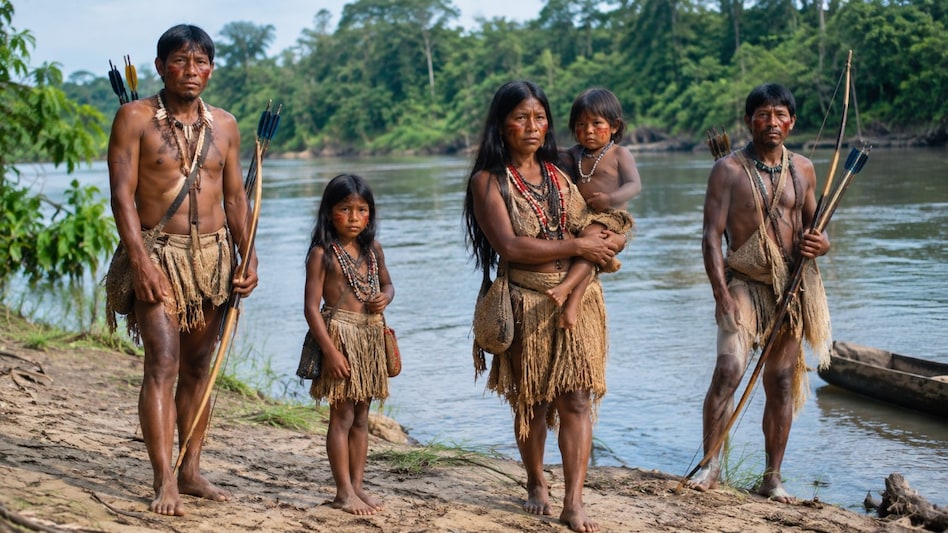
There is a tribe that lives far from the modern world, spending their lives in the forests. They have no access to mobile communication, the internet, or urban infrastructure. These people inhabit the dense Amazon jungle in southeastern Peru and consciously keep away from outsiders.
They are called Mashkopiro. They are considered the largest tribe without contact with the outside world. Estimates suggest their population exceeds 750 people, but due to the lack of regular contact, conducting an accurate census among them is extremely difficult.
The most notable feature is the use of whistles and bird sounds to signal each other and those around them. However, it cannot be claimed that their entire language consists only of whistling; they sometimes imitate bird sounds, which may serve as a warning to nearby people.
The decision of the Mashkopiro to live away from humanity is not a mystery, but is related to their history. According to Survival International, in the late 19th century, demand for rubber sharply increased in the Amazon region. As a result, outsiders arrived who began enslaving these indigenous people on their own land. They were subjected to killings, beatings, chaining, persecution, as well as violence and robbery of their lands and dwellings. A significant number of indigenous people faced cruel treatment and forced labor.
The ancestors of the Mashkopiro retreated deeper into the forest to escape the violence and slavery of that period. The Mashkopiro dissolved into the forest environment and remain isolated and hidden to this day. Today, their descendants are witnessing a new invasion of their lands.
Following this, they maintained distance from the outside world, settling in the upper parts of rivers deep in the forest, relying on hunting, fishing, and resources gathered from the forest. Thus, their current isolation is not a trendy fad or a strange habit, but a centuries-old survival strategy.
People who have observed the behavior of the Mashkopiro when they appear by the river, coming out of the forest, have described a number of specific signs. Residents of the neighboring Yene community note that the Mashkopiro sometimes emit thin and sharp whistling sounds, similar to bird calls. This is linked to warning others or announcing their presence.
There are linguistic and kinship ties between the Yene and the Mashkopiro. Sometimes both groups attempt to communicate with each other from opposite banks of the river. However, Yene residents usually also avoid direct contact, as interaction can be risky for both sides.
In recent years, there has been an increase in instances of the Mashkopiro appearing near Yene river settlements. Sometimes they take bananas, cassava, or other food products from local fields. In some cases, they have also asked for machetes, i.e., large sharp tools, or cooking utensils. Some members of the Yene community assist them by creating a small separate field plot called a 'chakra' where bananas, cassava, and other products are grown. The Mashkopiro then take the necessary items and return to the forest.
The biggest problem for the Mashkopiro today is the growing presence of outsiders in their forests. Logging is taking place in some areas of southeastern Peru, and roads are being built for this purpose. According to Survival International, the construction of logging roads spanning about 200 kilometers in the Mashkopiro area is known. These roads facilitate access to previously inaccessible forests.
For this reason, the presence of the Mashkopiro in the forest has become more noticeable compared to the past. In 2024, a group of more than 50 people was spotted by the river near a Yene village.
The risk of contact with the outside world for the Mashkopiro is not limited to violence. Due to long-term isolation, they may lack immunity to common diseases found in the outside population. Consequently, even a common illness like influenza can pose a serious danger to them. Outbreaks of diseases and mass fatalities have been registered in Peru after contact with other isolated groups. This is why experts and local organizations insist that forced contact should not be established with these people.
The Mashkopiro lead a hunter-gatherer lifestyle and obtain many necessary items from the forest. They use bows and arrows. Sometimes they also place spears or sticks crossed on the ground to signal outsiders to stay away.