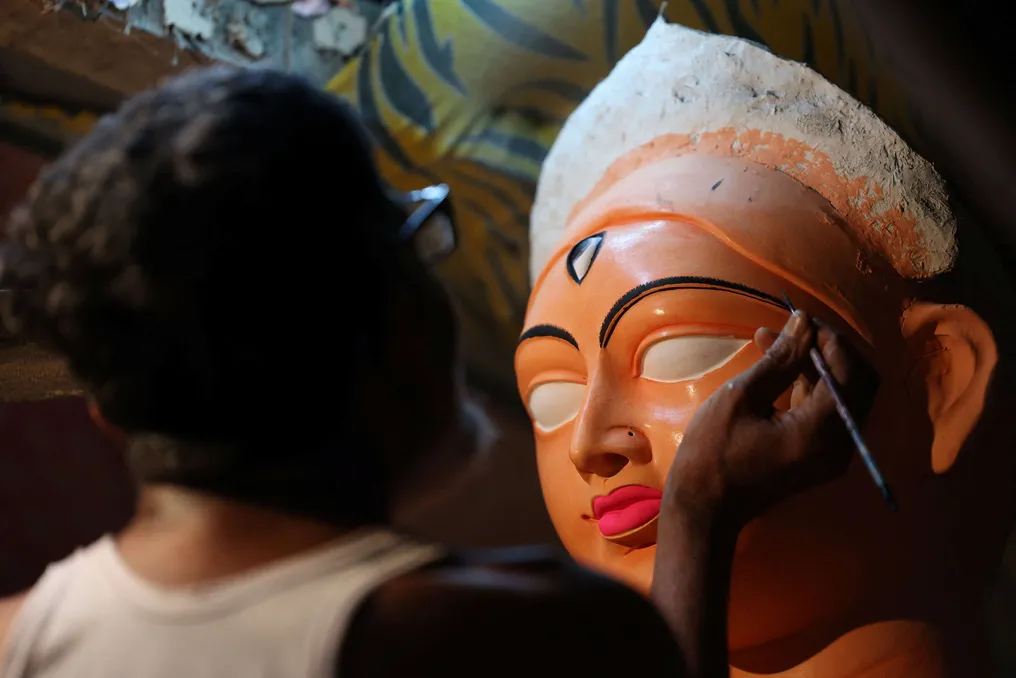
Durga Puja, one of the iconic moments of Mamata Banerjee's era in West Bengal, traditionally presented as a lavish carnival where carefully selected 'baro pujos' (main pujas) paraded through Red Road with thematic processions before the head of government and other high-ranking officials, often concluding with spontaneous dances by Mamata Banerjee with representatives of the Bengali film industry.
After the Bharatiya Janata Party (BJP) took office on May 9th, the first Durga Puja under the new administration took place. Certain changes are already noticeable, raising the question of whether the characteristic style of celebrating Durga Puja in Bengal will change beyond superficial alterations.
On the Sahaj portal, the single window for obtaining permits in Kolkata, 2318 Durga Pujas have been registered, including 270 new applications, with more applications expected. In 2025, the total number of applications reached a record high of 2936. Across Bengal, the state's energy department predicts that the number of community pujas will exceed 65,000 this year, based on the demand for temporary electricity connections.
The tradition of 'barowari,' or community puja, in Bengal generally dates back to the late 18th century in Guptipara, although historians disagree on the exact year and even whether the earliest community festival there was Durga Puja or Jagaddhatri Puja. The term 'barowari' is usually associated with the phrase 'baro yaar,' meaning 'twelve friends.' The format of Durga Puja has constantly transformed, moving from patronage by landowners to influential political leaders, yet it remains a cornerstone of Bengal's annual cultural calendar.
Creative individuals continuously found new ways to express their love and reverence for Goddess Durga: from depicting the divine family within a single image ('ekchalar takur') to multi-part installations; from traditional Sabeki Pratima idols to thematic pujas; from straw decorations ('sholor saaj') to sculptures made from unconventional materials.
In the past, the publication 'Hutam Panchar Naksha' used Durga Puja to mock the culture of 'Babu Calcutta,' its ostentatious luxury, and social pretensions. While the New Town Sanatani Durga Puja, led by Prime Minister's advisor Subrata Gupta and Kartik Maharaj, explores the connection between ancient Indian traditions and modern science, other groups adopted different approaches.
Amar Durgotsav (My Durga Puja), featured in 'Kamalakanter Daftar,' depicts an opium-intoxicated Kamalakanta who sees the image of Durga on the Saptami and ultimately sees Bengal itself (Banga Janani, Mother of Bengal) in her, invoking the Goddess as a symbol of collective strength and awakening. Anandamoyer Agaman used Durga's arrival as an anti-colonial metaphor so explicitly that the British brought charges of sedition against him. However, Nirgunananda advocated for a more overtly religious ownership of the festival. At an August meeting with puja organizers, he rejected the idea that 'religion belongs to individuals, and festivals belong to everyone,' asserting that festivals primarily belong to followers of the faith, although people of other religions are welcome to attend.
The pro-Marxist Kaku, who sold books on Marxist philosophy at Markshyyo Darshan, was easily noticed. Seeing this, the TMC party also started its Jago Bangla tents, although Didi, a skilled politician, never won the approval of Bengalis for her literary endeavors.
The term Sharadotsav, a synonym for Durga Puja, raises questions. Minister Suvendu Adhikari instructed committees not to allow CPI(M) stalls that describe the festival as 'Sharadotsav' instead of 'Durga Puja,' arguing that such terminology weakens its religious identity. Sharadotsav, a festival marking autumn, appeared as early as 1908, and this point was also raised by left-wing leaders in response to the dispute. One puja committee in Kamardanga in Tangra went further, declaring that it would not permit stalls organized by CPI(M), DYFI, SUCI, or other left-wing organizations at its celebration. The committee called on other organizers to follow suit, while CPI(M) criticized this move.
Tarpan, the ritual offering to ancestors, and the reading of Birendra Krishna Bhadra in the Mahishasuramardini radio program, which became associated with Mahalaya since the 1930s, has itself turned into a ritual. Holding such a solemn event on this day gives the new administration a prominent ceremonial role at the beginning of the Puja season in Bengal.
Kash, tall white grass from Kans, associated with the Bengali autumn, can be used as stuffing for pillows in its symbolic 'Chokkhu Daan.'
Some aspects remain outside the government's legislative authority, such as the differences between Shakta and Vaishnava households. In Shakta households, as the author wrote, Durga's lion had a typical lion face, whereas in the houses of Gosain or Vaishnavas, the lion had a horse's face, which apparently marked the distinction between the two traditions. Differences also concerned food. In Brahmin households, guests could be served rice, five vegetable dishes, yogurt, and payesh; in Shakta-Brahmin households, the author noted, fish was permitted, while Kayastha houses served rays (fish).
In Chorbagan Chatterjee Bari, fish is offered during the Puja days. On the other hand, in the house of the descendants of Rani Rashmoni in Yambazar, the Goddess is offered vegetarian bhog, even if guests are served non-vegetarian fare, as previously reported by TOI.