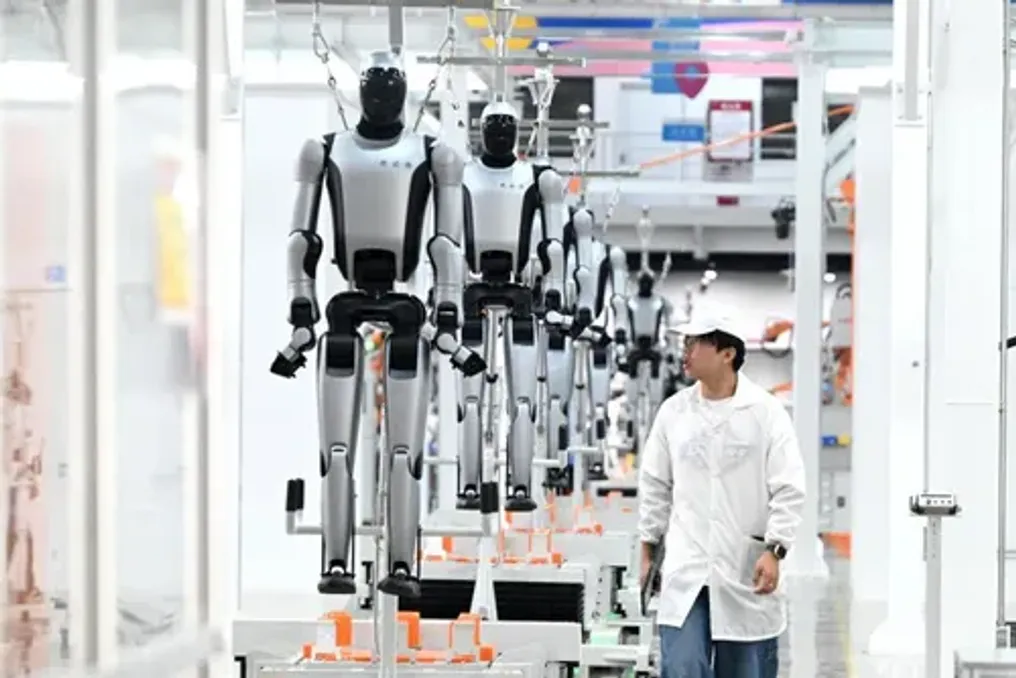
China is actively developing advanced manufacturing, using innovation as its main guide. Thanks to a higher technological level and an accelerated transition to smarter, greener, and more integrated development, the country is striving to modernize production processes by coordinating traditional, new, and future industries.
These coordinated efforts contribute to the comprehensive progress of Chinese manufacturing, establishing advanced manufacturing as a fundamental pillar of the modern industrial system. Innovation plays a central role in this transformation.
In September, the Chinese tech giant Huawei unveiled its second-generation flagship foldable smartphone, while Xiaomi released its first 'semi-foldable' device. Thus, Chinese smartphone manufacturers are engaged in fierce competition in the premium segment.
This confidence is based on domestic breakthroughs. In recent years, China has achieved mass production of ultra-thin flexible glass only 30 micrometers thick, which withstands over a million bends without damage. By the end of July, China registered 5.74 million valid domestic patents, and its number of international Patent Cooperation Treaty applications ranked first globally for seven consecutive years.
To accelerate commercialization, China is strengthening the link between scientific research and industrial application, improving the efficiency of turning innovations into market-ready products. For example, although computed tomography (CT) has been developing for a century, offering increasingly accurate detection, the rapid growth of electric vehicle production created a battery quality control problem. Responding to this challenge, Sunwoda Electronic Co., Ltd., in collaboration with Dalian University of Technology, successfully developed high-speed multimodal CT equipment for online battery inspection. This system allows for non-destructive testing and significantly improves evaluation efficiency.
Since the beginning of this year, China has intensified the development of a comprehensive service system to transform scientific and technological achievements into practical applications. Two new national centers for industrial innovation have been established at the R&D stage. At the pilot stage, the national network includes 21 advanced manufacturing platforms and over 1800 reserve facilities. At the incubation stage, the country recognized the first batch of 14 'excellent' level technology business centers and 402 standard-level centers, which oversee more than 425,000 enterprises and teams.
Reflecting these achievements, according to the World Intellectual Property Organization's 2026 report, China holds 25 out of 100 global innovation clusters, the highest figure in the world for the fourth consecutive year.
How does an advanced manufacturing enterprise differ from a regular factory?
An example is the Lenovo production center in Shenzhen, Guangdong Province, where over 5,000 orders are processed daily, 60% of which are highly individualized across more than 50 product lines and 20,000 configurations. Despite this complexity, the 100-meter production line operates with astonishing flexibility. Equipped with machine vision robotic arms, it performs precise assembly with millimeter accuracy and switches between product models with minimal downtime. Ninety percent of orders are shipped within 24 hours.
What makes advanced manufacturing 'advanced' is the modernization of production methods. Li Yan, deputy head of the department responsible for industrial economics research at the State Council Research Center, stated: 'Compared to traditional manufacturing, advanced manufacturing has generally shifted towards digitized, intelligent, lean, and green production.'
Currently, 35,000 basic 'smart' factories operate in China, over 8,200 advanced-level 'smart' factories, and over 500 'excellent' level 'smart' factories. More than 30% of manufacturing enterprises above a certain size with annual revenues exceeding 20 million yuan (about US$2.98 million) now employ artificial intelligence technologies.
Global industrial competition is no longer limited to production capacity; it now encompasses integrated manufacturing and service ecosystems. For instance, China's leading heavy machinery manufacturer, Xuzhou Construction Machinery Group, has gone beyond selling equipment, offering comprehensive solutions for green mining, securing major contracts with global firms such as BHP.
Similarly, Haier Smart Home provides customized home appliance packages for smart homes, with revenue from application scenarios continuing to grow.
Xin Guobin, Deputy Minister of the Ministry of Industry and Information Technology, noted: 'In the future, we will promote deeper integration of advanced manufacturing and modern services, accelerate the development of new business models and forms, such as platform design and personalized customization, and advance the development of service-oriented manufacturing.'
Ultimately, what makes advanced manufacturing 'advanced' is the optimization of the industrial structure. An embroidery machine can do more than just embroider; it can function as embodied intelligence. The machine weaves sensory and main threads, braiding the glove of embodied intelligence as a whole and ensuring more accurate capture of hand movement data.
Li emphasized: 'The essence of advanced manufacturing lies in comprehensive innovation and modernization across the entire production sector.' Advanced manufacturing includes both manufacturing industries created by new technological breakthroughs and traditional manufacturing industries that have been comprehensively transformed and rethought through the application of advanced technologies, processes, and management methods.
Influenced by this momentum, traditional industries are experiencing a revival. In the first half of this year, sales volume in food production, apparel, and paper industry grew by 11.6%, 9.2%, and 8.9% year-on-year, respectively. Meanwhile, new and future industries are rapidly expanding: China accounts for nearly 70% of global quadruped robot sales; over 400 humanoid robot models have been developed in China, accounting for more than half of the global volume; and the preclinical trial cycle for new drugs, such as targeted cancer therapy, has been reduced by 40%.
As China stimulates advanced manufacturing, it advances its commitments to achieving excellence and accelerates the development of a modern industrial system where this sector serves as its foundation.