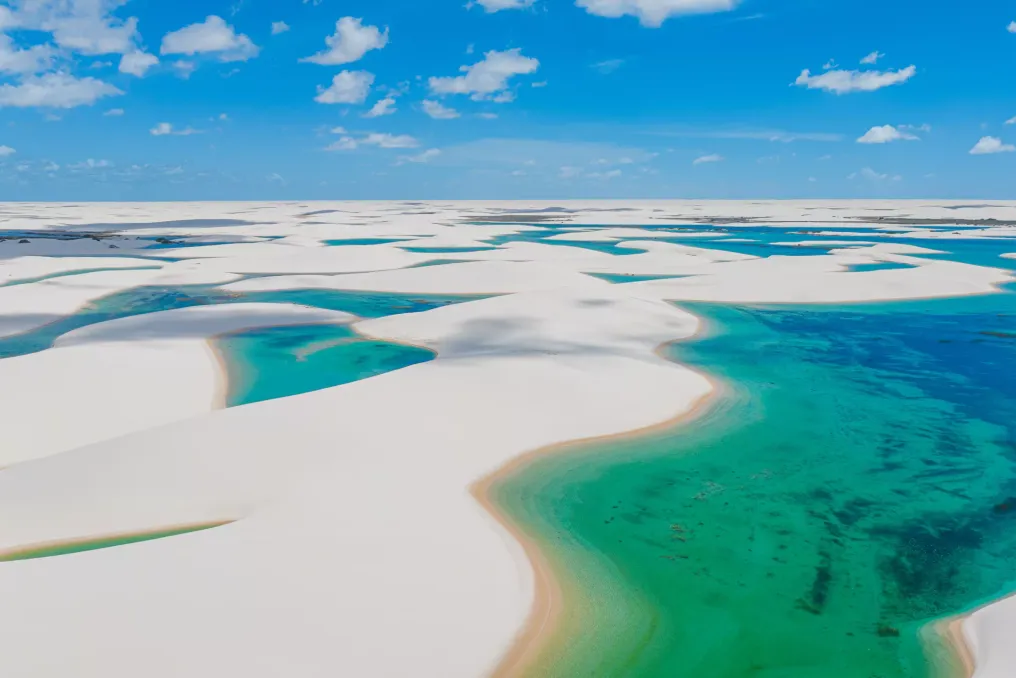
At a glance, Lençóis Maranhenses appears to be a desert that somehow ended up on the Atlantic coast of Brazil. Endless white dunes stretch to the horizon, interrupted only by bright blue and green lagoons.
However, there is an irony in this landscape: it is not a desert at all. Located in the state of Maranhão in northeastern Brazil, Lençóis Maranhenses is an extensive coastal landscape shaped by wind, rain, sand, and the Atlantic Ocean. During the rainy season, fresh water collects between the dunes, transforming the seemingly barren landscape into something almost otherworldly.
Water appears in this area for several months. The name Lençóis Maranhenses translates approximately to 'sheets,' which aptly describes the vast dunes undulating across the landscape. The national park covers an area of over 156,000 hectares, of which about 90,000 hectares are dunes. Some of these reach heights of about 30 meters, and the dune fields extend for tens of kilometers along the coast.
Nevertheless, calling it a desert is inaccurate. The region has a clearly defined rainy season, and abundant rainfall accumulates in the depressions between the dunes. As the groundwater level rises beneath the sand, hundreds of temporary freshwater lagoons begin to form. The result of this process is truly extraordinary: white sand runs everywhere, interspersed with bodies of clear, blue-green water.
These dunes are constantly moving. The wind carries sand from the coast inland, giving it characteristic crescent shapes that define the park's appearance. Some dunes can migrate more than 20 meters per year, slowly changing the surrounding landscape. The lagoons are also temporary; they fill mainly with rainwater and groundwater, not rivers. When the dry season arrives, evaporation causes many of them to shrink and disappear, after which the cycle resumes with the rains.
Perhaps the most fascinating thing about Lençóis Maranhenses is that the landscape visible today might look different next year. The dunes move, the water comes and goes, and nature quietly reshapes this scene.
Although the park looks almost desolate from a distance, a surprisingly diverse ecosystem hides beneath the endless expanse of sand. Lençóis Maranhenses is located at the junction of the Cerrado, Caatinga, and Amazon biomes, creating a mix of dunes, freshwater zones, mangrove swamps, rivers, and coastal habitats. Even the temporary lagoons support life, and the plants growing among the dunes have adapted to an environment where water and sand are constantly changing.
Despite the outward impression that nothing can survive here, the situation is quite the opposite. Among the main entry points to the park are Barreirinhas, Santo Amaro, and Atins. From Barreirinhas, visitors can reach some of the most famous lagoon areas, while Santo Amaro provides access to other parts of the dunes. Atins, once a small fishing village, is located near the mouth of the Preguiças River and has become another popular base for exploring the landscape.
For those wishing for a deeper immersion, the multi-day trek Travessia dos Lençóis crosses the park between Atins and Santo Amaro. This is a different way of experiencing the landscape: instead of simply arriving, taking photos, and leaving, tourists traverse the dunes, swim in the lagoons, and spend nights in the park using local community accommodations along the route.
For such a vast place, slowing down the pace seems the most suitable way to explore it. The landscape undergoes radical changes throughout the year. Lagoons usually reach their maximum volume after the rainy season, with May to September often offering some of the best conditions for observing them filled with water. Exact conditions vary depending on the amount of rainfall each year. By the end of the dry season, some lagoons may recede or completely disappear, and paradoxically, this makes the landscape even more attractive.
What is depicted in the photograph is just one moment in the life of Lençóis Maranhenses. The park was declared a national park in 1981 and was included in the UNESCO World Heritage List in 2024 due to its exceptional natural beauty and geological significance. The park is carefully managed, with visitor access and vehicle use regulated to protect the fragile dune and lagoon ecosystems.
The reason for such regulation is easy to understand. It is a landscape not created for stillness. It is shaped by rain and wind, constantly shifting underfoot and changing with the seasons. There is something wonderfully strange about Lençóis Maranhenses: a dry appearance is brought to life by rain, seemingly permanent dunes are constantly moving, and freshwater lagoons appear among the sand for a time and then vanish. Nothing here is as fixed as it first seems, and perhaps that is what makes this corner of Brazil so captivating. It is an unusual reminder that nature does not always follow our expectations.