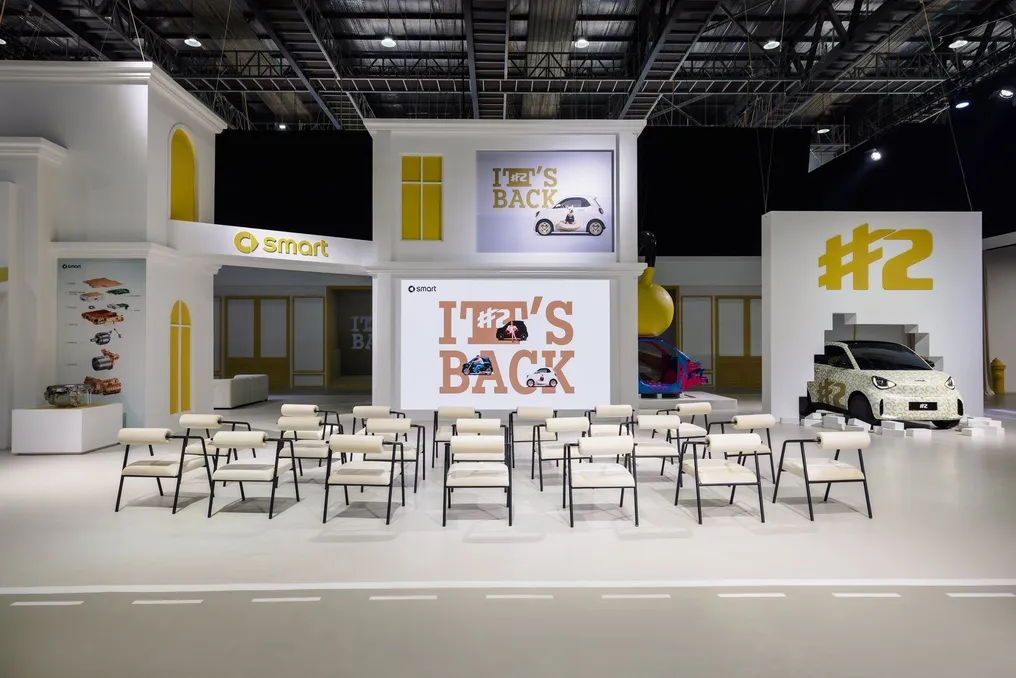
Smart, a joint venture between Mercedes-Benz and Zhejiang Geely Holding Group, shared detailed engineering specifications of its upcoming smart #2 during a technical seminar held in Beijing. This two-seater all-electric vehicle marks the brand's return to the ultra-compact city car segment it pioneered in the 1990s. The global debut of the car is scheduled for the Paris Motor Show on October 12th.
The vehicle is built on the Electric Compact Architecture (ECA) platform, specifically developed by Smart's global engineering team for vehicles under three meters in length. According to the company, the ECA is equipped with a 35.8 kWh battery pack using CATL cells, and the target range according to the WLTP cycle is approximately 300 km. DC fast charging from 10% to 80% takes 20 minutes. The platform also utilizes an 11-in-1 electric motor unit, which integrates drive, power electronics, and control functions into one housing to save space.
Safety concerns were a central theme of the seminar. The new Tridion Cell Evo body structure uses high-strength steel for over 78% of the body, featuring a three-layer steel configuration and materials rated for tensile strength up to 1800 MPa. Smart points to a torsional rigidity of 39,000 Nm per degree and a roof load capacity exceeding 4 tons. The cabin is equipped with seven airbags and a seatbelt system with pyrotechnic pretensioning and a locking latch designed to restrict the longitudinal movement of the passenger's pelvis and legs in a collision. The battery is located inside a multi-layered protective structure.
During stability tests, the smart #2 successfully passed the 'deer' test at 78 km/h and demonstrated a static rollover angle of 45.9 degrees, the company reported. For urban driving, the vehicle has a curb-to-curb turning diameter of 6.95 meters. Smart claims that #2 is the only vehicle under three meters in length equipped with a five-link independent rear suspension. This system is combined with rear-wheel drive, a 50:50 weight distribution, and staggered tires—narrower in the front and wider in the rear—on all trims.
The vehicle's design was developed by a global team of Mercedes-Benz designers and maintains the wheel-at-the-corners proportions and short overhangs characteristic of early two-seater Smart models. Kan Yi, Smart's Global Marketing Director, stated: 'With smart #2, we are not just looking back; we are rethinking it for the future.' Smart notes that the presented specifications are preliminary and subject to homologation, and the range figure has not yet been certified. Model #2 is one of two new developments, alongside the smart #6, which the brand plans to introduce in 2026 as part of its expansion into new markets.