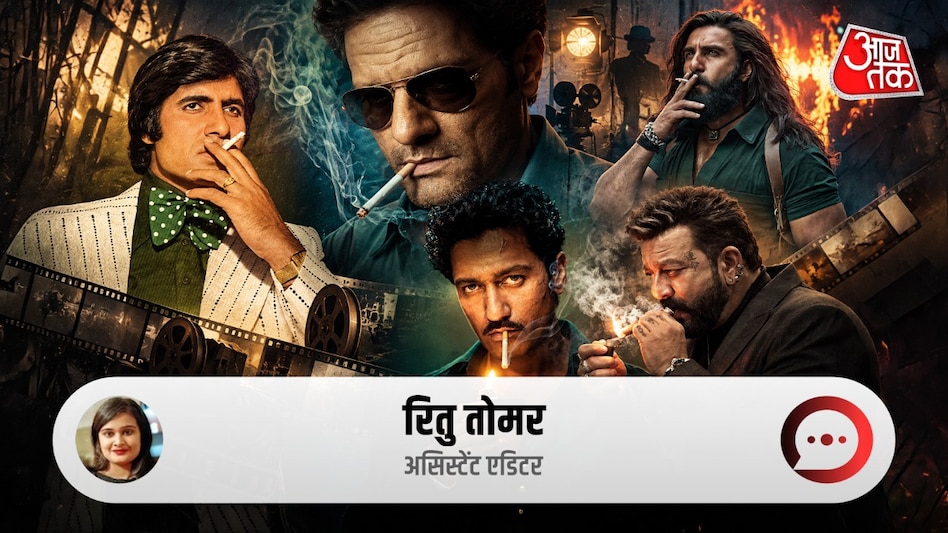
In the new posters for the film 'Love and War,' Sanjay Leela Bhansali's portrayal of Vicky Kaushal draws attention not so much through his appearance or clothing, but through the cigarette he holds in his hand. His intense gaze directly into the camera, combined with a lighter and a cigarette between his lips, creates a visual image that is simultaneously rugged and mysterious. A similar visual motif was previously seen in Ranbir Kapoor's 'Animal' and Ranveer Singh's 'Dhurandhar,' despite differences in characters and projects; the common thread is a major star with a cigarette and a distinct mood.
This raises the question not only of why cigarettes are romanticized in cinema but also why they have become such a potent tool capable of revealing half of a character's personality on screen. The use of cigarettes in the Hindi film industry is not a new phenomenon, but an established cinematic language whose meaning has changed over time.
The cigarette served as an indicator of masculinity, rebellion, loneliness, or tension. Even without dialogue, a close-up of a character with a burning cigarette and smoke often signaled to the viewer that this was not an ordinary person. This effect is particularly noticeable in the images of anti-heroes who live by their own rules, ignoring social norms, for whom the cigarette becomes part of the visual language of their identity.
In the early period of Hindi cinema, the connection between the hero and smoking was not obvious. For a long time, smoking was depicted as a character's weakness, a negative trait, or a sign of a certain social class. However, as the hero evolved, the cigarette followed suit. Heroes ceased to be exclusively virtuous or protectors of the family; they began to express anger, break rules, and confront the system. The cigarette became a convenient cinematic device because it could convey a person's inner pain or irritation without a single word.
In the seventies, with the emergence of the 'angry young man' in Hindi cinema, the structure of the hero's masculinity changed radically. In many roles played by Amitabh Bachchan, cigarettes, alcohol, and feelings of isolation were associated with the anxiety and rebellion of men of that era. Vijay from 'Deewaar' is a prime example, where the cigarette accompanies life, social ascent, and personal transformation. Furthermore, the cigarette was used to demonstrate status: from the cheap bidi of a poor person to the cigar of an influential figure.
Later, the cigarette began to symbolize pain. In the case of Devdas, his suffering and guilt were shown through cigarettes and alcohol. When Shah Rukh Khan played Devdas, his smoking demonstrated not just the expulsion of smoke, but a reflection of internal decay. Thus, the same object could acquire completely different meanings: in 'Devdas,' a symbol of self-destruction and separation; in a gangster film, a sign of danger and power; and in a romantic drama, an element of mystery and coolness.
The link between the cigarette and masculinity has strengthened because Hindi cinema has long used specific elements to portray a strong male character: a glass of alcohol, a loud voice, a fast car, a weapon, a suit, a cigar, or a cigarette. Among these elements, the cigarette proved to be the most accessible. This is why the trend of displaying cigarettes in movie posters has intensified. There is a big difference between when a character smokes in the plot and when they are depicted with a cigarette in promotional materials. A film might need a cigarette for the narrative, but a poster requires a deliberate choice to instantly evoke in the viewer questions about this person's identity, character, and darkness, and the cigarette becomes a simple way to answer all these questions in one frame.
This union of the cigarette and its 'cool' image is evident not only in the films themselves but also in their promotion. A poster cannot tell a two-minute story; it must sell the mood, style, and character of the protagonist in one frame. In this context, the cigarette becomes a very simple cinematic symbol. It can make a hero in a suit mysterious, and a cigarette in the hands of a bloody villain even more threatening. That is, here the cigarette functions as a visual code.
The film 'Animal' serves as an interesting example: the entire world of the character Ranvijay, played by Ranbir Kapoor, is built around aggression, violence, power, and masculinity, and the cigarette in his hands is not just a habit, but part of the packaging of his personality. Similarly, Ranveer Singh's portrayal in 'Dhurandhar' utilizes a similar visual language.
However, there is another side to cinema: sometimes smoking is used to depict weakness, stress, or the dark side of a personality. The problem arises when...