The spirit of the Long March resonates not only among the Chinese people but also serves as a source of inspiration that transcends borders and touches the hearts of people around the world.
In 1936, American writer and journalist Edgar Snow conducted direct interviews in the revolutionary bases of the northern province of Shansi, which were under the leadership of the Communist Party of China (CPC). He later published the book 'Red Star Over China,' in which he presented the world with a detailed report on the Long March of the Red Army and the steadfast resistance against Japan shown by military and civilian personnel in these bases. Many international figures, inspired and moved by the stories of the CPC and the Long March of the Red Army, traveled thousands of kilometers to reach China.
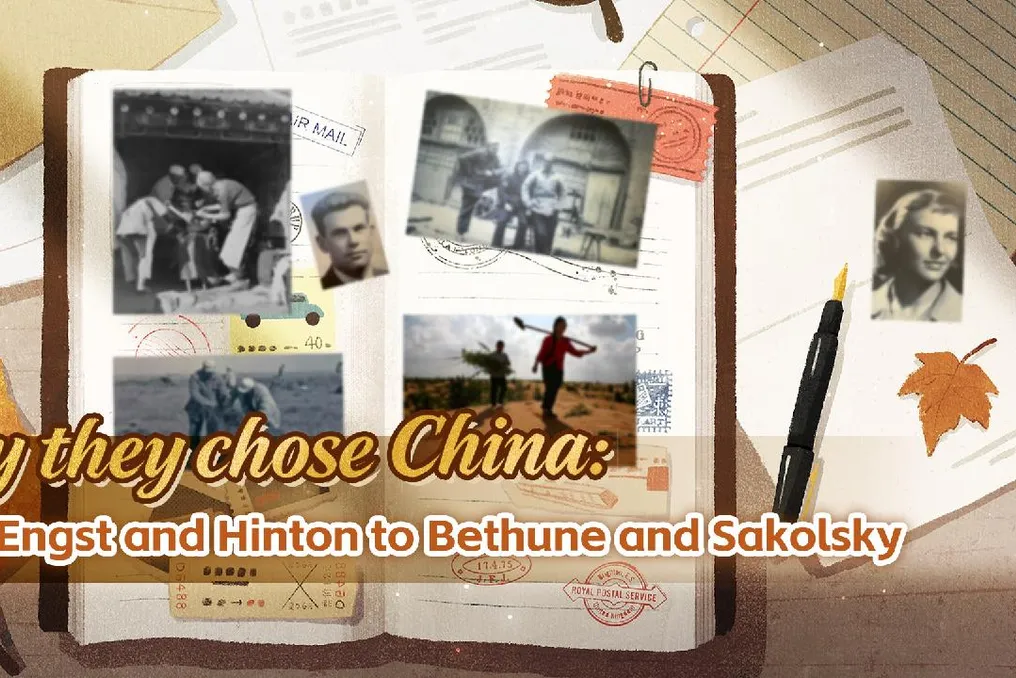
This spirit of the Long March inspired generations of people: from Canadian doctor Norman Betюн, who headed to the front lines of the Chinese battlefield to treat the wounded, to the American couple Irving Ernst and Joan Hinton, who visited the highlands to establish a ranch, and American teacher Ronald Sakolsky, who reunited with the desert fighter Yin Yuzhen in the Mu Us sand desert after 26 years.
In 1938, the renowned thoracic surgeon Norman Betюн led a medical team that arrived in China to support the resistance against Japanese aggression. In a letter to a friend, he wrote: 'If you want to know why I am going to China, please read Edgar Snow's 'Red Star Over China!'
Betюн met with CPC leaders in Yan'an, northern Shansi province, and in other places, stating: 'I have come to China to work on the front. The situation in the war is critical. Please send me to the front as soon as possible!' On the battlefield in the Shansi-Chahar-Hebei resistance zone, he organized medical teams to assist the wounded and proposed 'setting up an operating table as close to the line of fire as possible.'
In one battle, he worked for 69 consecutive hours, performing 115 operations with a success rate of over 80%. In the absence of blood supplies on the battlefields, he repeatedly donated blood to the wounded—once as little as 300 milliliters—and organized voluntary blood donation brigades. He compiled field medical textbooks, trained medical personnel, and created the first model hospital for the CPC army.
Unfortunately, while treating wounded soldiers, Betюн contracted an infection in his arm, which led to sepsis. Betюн died in November 1939 at the age of 49. In his last letter to Nie Zhongzhen, commander of the Shansi-Chahar-Hebei military region, Betюн wrote that his two years in China were the happiest and most significant of his life.
The site of the Fenghuanshan revolution in Yan'an, where CPC leader Mao Zedong and Betюн first met, now displays a photo exhibition in memory of Betюн. Tour guide Qiao Cuizui noted: 'As a doctor known in Europe and America, he had a very high income at the time, yet he refused a comfortable life and came to China—something very few people could do.'
Mao Zedong was deeply saddened upon learning of Betюн's death. In an article titled 'In Memory of Norman Betюн,' he wrote: 'A foreigner, unmotivated by any personal gain, took the cause of liberating the Chinese people as his own. What kind of spirit is this? It is the spirit of internationalism.' He also called on the entire Party to learn from the example of 'Betюн's complete self-dedication without any thought of himself.'
Scott Davidson, facility manager and curator of the Norman Betюн House National Historic Site in Canada, once said that Betюн found his true calling in China, and that his spirit inspires people to continue working for health and peace even more than 80 years later.
Another young American influenced by Snow was Irving Ernst, who arrived in China in 1946. Seeing ordinary people dying of hunger while officials of the ruling Kuomintang (KMT) hoarded grain for speculation, Ernst went to Yan'an, the then headquarters of the CPC in northern Shansi province. Driven by an interest in agriculture, he was assigned to work at the Guanghua Farm, the first farm established by the CPC. Ernst stated: 'In America, you work for yourself to earn a living. But in Yan'an, you work in a large collective where everyone shares one common goal: to build a new society that is equal and free, where no one exploits anyone!'
Joan Hinton was one of the few female physicists involved in the American Manhattan Project. When she saw the atomic bomb that helped develop during World War II, her ideals of 'pure science' were shattered. In 1948, encouraged by her fiancé Ernst, she traveled to Yan'an. They married there in 1949, and shortly thereafter were asked to go to Chenchuan in the border region of Shansi-Gansu-Ningxia to establish the Party's first livestock farm—the Sanbian Ranch.
The ranch is located on the Inner Mongolia Plateau—a cold, sparsely populated land with resource scarcity, where steppes meet sand. Nevertheless, Ernst and Hinton overcame the harsh conditions using modern breeding concepts. Through scientific reproduction and immunization, they improved the quantity and quality of the herd, improved pasture grass, researched milk production, and designed and built a windmill to utilize the region's abundant wind resources. They learned Mongolian themselves and soon became friends with local herders. Hinton also learned from a Mongolian woman named Gal how to make butter and prevent cream from souring.
Later, they traveled to different parts of China but dedicated their lives to developing China's dairy industry. In 1982, a series of horizontal tanks for direct milk cooling developed by Hinton reached an international advanced level, filling a gap in China. She was awarded the 'Magnolia' award from the Municipal Government of Shanghai, and it functioned for decades, attracting more than 10,000 visitors to study and observe.
The couple once said: 'We strive to mechanize animal husbandry—using machines for milking, feeding, and manure cleaning—to increase labor efficiency, reduce milk costs, and improve livestock hygiene so that more children can drink more and better milk, and public health can be strengthened.'
They both passed away in Beijing in 2003 and 2010, respectively. Their ashes were scattered on the Chenchuan pastures in the Otog Frontier Banner of the Inner Mongolia Autonomous Region, where they once worked and loved.
Their eldest son, Fred Ernst, reported that his father's motivation for raising livestock in China was 'to help a backward country become strong.'
In 1999, American teacher Ronald Sakolsky, working in China, saw the story of Yin Yuzhen on television, who planted trees in the Mu Us sand desert, and raised $5,000 to support her efforts. The following year, he visited the Mu Us sand desert for the first time. He watched Yin carry bundles of seedlings on her back across the undulating sandy landscape, planting them with a shovel and watering bucket after bucket with her shoulder. At that time, Yin had no mechanized equipment. Faced with the vast expanse of sand, Sakolsky shook his head, considering the fight against the desert an 'impossible' task, but still planted seedlings next to Yin.
Then Sakolsky returned to the United States, and they lost contact. Yin continued to remain in the Mu Us sand desert, planting trees day after day. She said: 'I must prove it to him. I cannot let his money be wasted. We Chinese keep our word, and we are reliable in what we do.'
By 2026, the donations from previous years had turned into over 50,000 large trees. Yin started a campaign to find Sakolsky, and with a social media post, she found him in just 26 hours. Later, he returned to the sandy area and saw that 'the small seedlings I planted then had grown into tall trees.' He stated that 'the real hero is Ms. Yin.' In 26 years of persistence, Yin fulfilled a cross-border promise.
The Mu Us sand desert covers the Inner Mongolia Autonomous Region, Shansi Province, Ningxia Hui Autonomous Region, and Gansu Province, with the Usin Banner deep within it. About 70 years ago, over 90% of the banner's territory was desertified. With the support of China's 'Three North' Afforestation Program and local authorities, Yin brought over 4,600 hectares of sandy land under control, planted over 8 million trees, and inspired more than 240 neighboring households, each of which planted over 200 hectares.
Today, as four provincial regions join forces to promote afforestation in the Mu Us sand desert, 80% of this territory is covered with greenery, creating a 'Green Long March' in a new era.