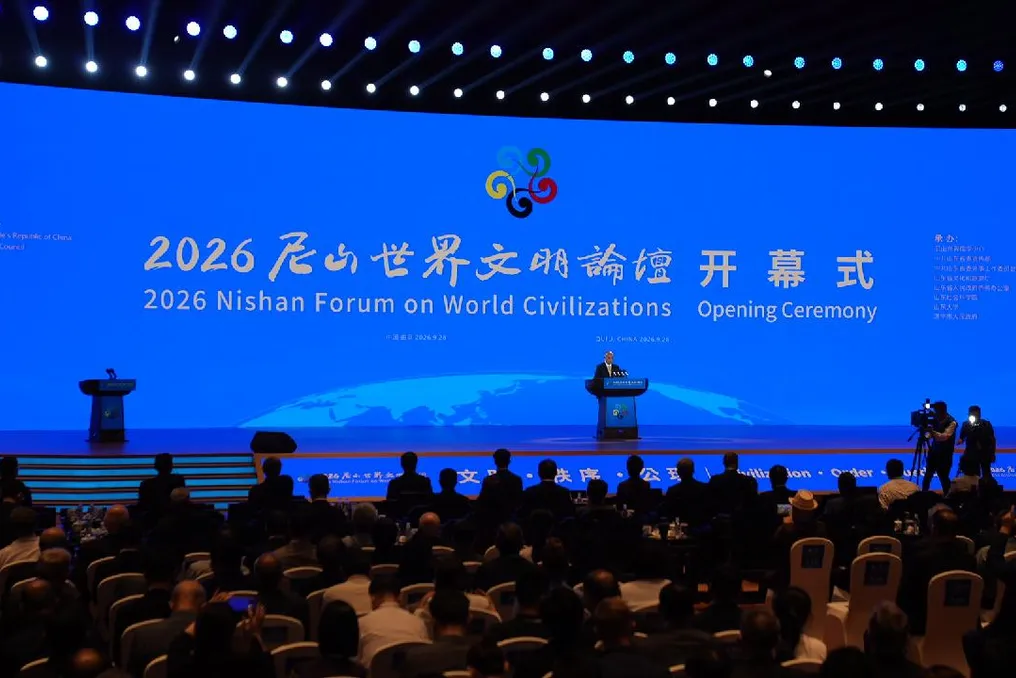
The 12th Nishan Forum on World Civilizations began on September 28, 2026, in Qufu City, Shandong Province, Eastern China. This city, the birthplace of Confucius, once again became a venue for global dialogue, where scholars, officials, and cultural representatives from around the world discussed issues of coexistence and cooperation among civilizations in a changing world.
The forum, held in Nishan, where Confucius was born more than two and a half thousand years ago, was dedicated to the theme of 'Civilization, Order, and Justice.' It brought together representatives from various circles to discuss the future of human civilization, paying special attention to contemporary meanings of Confucianism, global governance, intercivilizational dialogue, and the role of artificial intelligence in shaping the future of humanity.
Discussions are taking place against the backdrop of growing global questions about how different civilizations can coexist, how global governance can achieve broader consensus, and how humanity can preserve shared values amidst rapid technological progress.
At the opening ceremony, Suos Ya, Deputy Chairman of the Foreign Relations Commission of the Central Committee of the Cambodian People's Party, emphasized the close relationship between civilization, order, and justice. According to him, these three concepts are not isolated problems; civilization endows humanity with wisdom and self-awareness, order creates conditions for peaceful coexistence, and justice upholds that order.
Suos noted that the Nishan Forum serves as a platform for transforming the principles of civilization, order, and justice into substantive dialogue and searching for ways to build a common future for all humanity.
The importance of intercivilizational dialogue was also highlighted by Yusuf Raza Gilani, President of the Senate of Pakistan. In a video address, Gilani stated that great civilizations are capable of transcending boundaries and time by engaging in dialogue with all of humanity, characterizing Confucius as a thinker whose ideas extend beyond his era.
Referring to the Confucian concept of 'harmony without uniformity,' Gilani stressed that civilizations must respect each other while maintaining their unique characteristics. He added: 'May the wisdom of Confucius continue to inspire us. The most enduring bridges are built not only of brick and steel, but also of knowledge, friendship, and the hearts of people.'
As the cradle of Confucianism, Nishan has long served as a platform for studying how traditional ideas can contribute to modern discussions. Confucius developed a philosophy based on values such as benevolence, righteousness, propriety, wisdom, and trustworthiness, while concepts like 'harmony without uniformity' and 'world as a community' continue to influence discussions on social relations and global cooperation.
Jin Mingxin, a member of the Leading Group of the Chinese Academy of Social Sciences and Director of the Institute of Modern China Studies, stated that Confucian ideas have spread across time and space, offering an understanding of how different civilizations can interact. In Jin's view, the forum's focus on 'Civilization, Order, and Justice' addresses the main challenges of modernity and holds significant theoretical and practical value.
The link between Confucian thought and modern exchange was also noted by Thomas Bach, ninth president and lifetime honorary president of the International Olympic Committee. In his video address, Bach recalled his visit to Confucius's hometown several years ago, noting the similarity between Confucian philosophy and Olympic ideals. Bach said that this visit allowed him to see that Confucian thought and Olympic ideals share much in common.
He also pointed out that Confucius valued the comprehensive development of both body and mind, which, in his words, resonates with the ancient Roman idea that 'a sound mind dwells in a sound body.' Bach concluded that the forum provides an opportunity for dialogue between Confucian wisdom and the Olympic spirit, creating a bridge for further exchange.