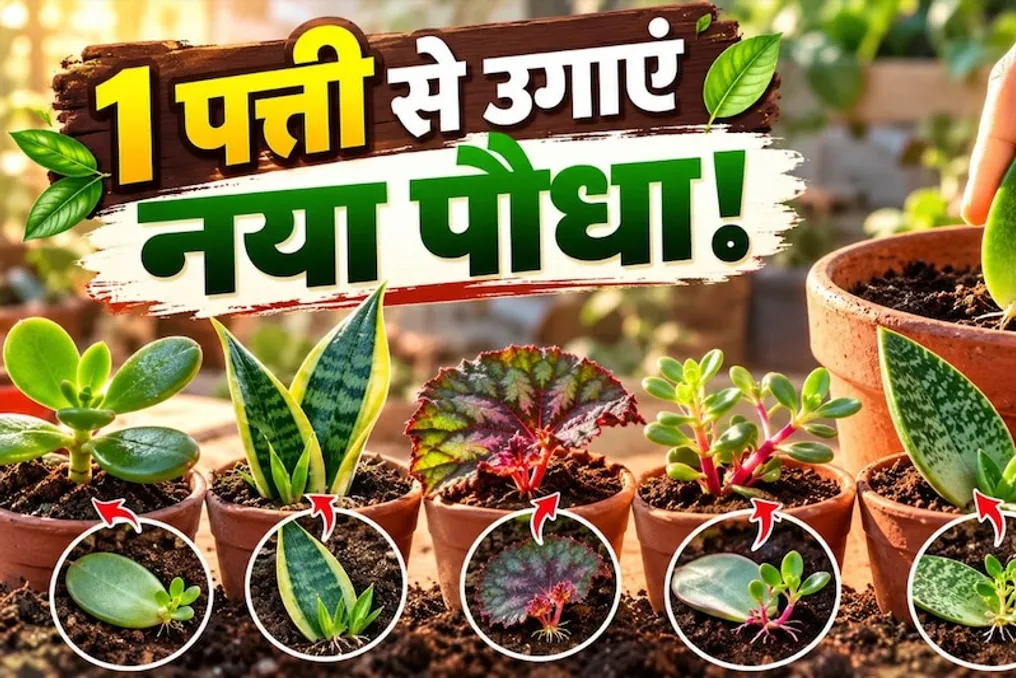
Many people enjoy gardening and decorating their homes, but buying new plants from nurseries can often put a strain on the budget. If financial costs become an issue, this information may be useful. There are plants that can be grown not from seeds or cut stems, but by using just one leaf.
This method is called Leaf Propagation. It allows you to increase the number of plants at home without significant expense. However, it is important to understand that not every plant can be propagated from a leaf, and attention must be paid to the correct humidity level, soil type, and lighting.
1. Jade Plant: The Jade Plant does not require a large amount of water because the water accumulates in its thick leaves, making it relatively easy to propagate from a leaf. To start the process, take a healthy branch, let it dry out for about 1-2 days, and then place it on slightly moist soil. Roots may appear in 2-4 weeks. Once the roots are well developed, the plant can be transplanted into a pot.
2. Snake Plant: Snake Plants are often used indoors, and they can be propagated using leaf fragments. A healthy leaf needs to be cut into pieces approximately 3x3 inches. These fragments can either be placed in water or planted in a mixture of coco coir and perlite. Roots will begin to form within a few weeks, after which the plant should be moved to a soil pot.
3. Begonia: If you like flowering plants, the Begonia will be a good choice. It can also be propagated from a leaf. Take a healthy stem and cut it in half. Place it on moist soil or coco coir, ensuring that water does not stagnate. With proper humidity, roots can develop within 2-4 weeks. When roots start growing and new leaves appear, the plant can be transplanted into a separate pot.
4. Portulaca: Portulaca, known for its colorful flowers, is a low-maintenance plant that can be prepared using a leaf. Take a healthy stem and plant it in well-draining soil. It is important that the leaf is moist when planted, and it should not be buried deeply. Roots may appear in about 7-14 days. After this, allow the plant time to establish; it can fully develop within 3-4 weeks.
5. Gasteria: Gasteria is a very beautiful ornamental plant that can be placed both on a balcony and indoors, and it does not require excessive care. For leaf propagation, first take a healthy leaf and let it dry out for 1-2 days. Then, place it on a light soil mix, such as coco coir and perlite, avoiding burying the leaf completely in the ground. Roots may appear in 3-6 weeks. When the roots reach a size of 2-3 inches and new leaves start appearing, the plant can be transplanted into a pot.
The most important thing when creating a plant from a leaf is patience and controlling the moisture level. The plant should be placed in soil that does not retain water. Overwatering can lead to leaf rot, and excessive sunlight can negatively affect growth.