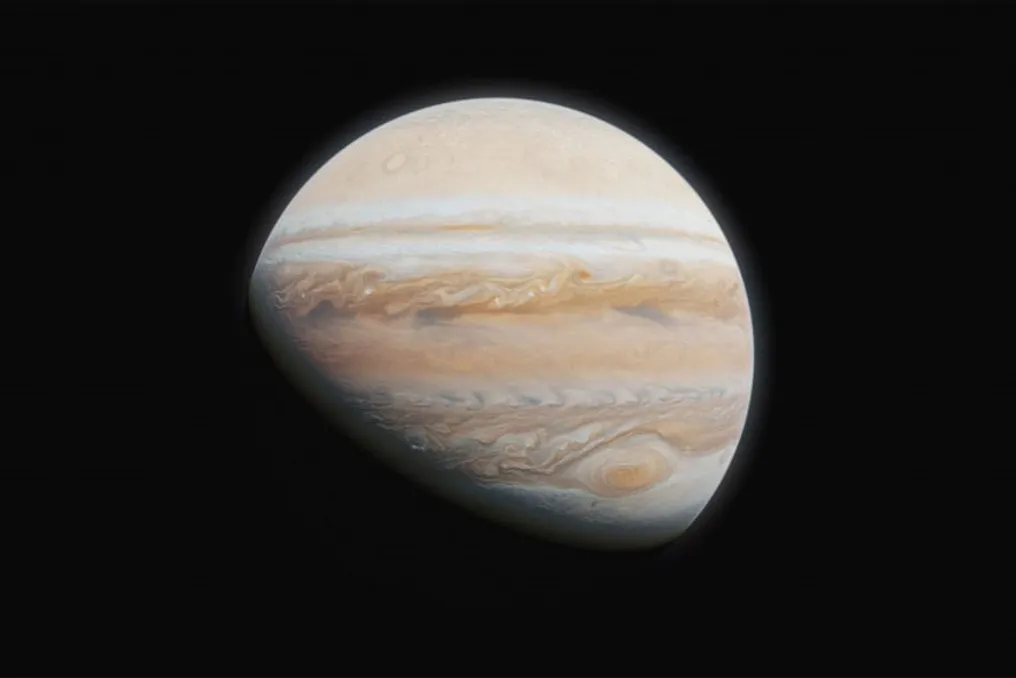
The Juice probe, belonging to the European Space Agency (ESA), executed a gravitational assist maneuver on Monday, the 28th, utilizing Earth's gravitational pull to alter its trajectory toward Jupiter.
This operation allowed for the modification of the spacecraft's path by approximately 20 degrees and an increase in speed of about 3.5 km/s, all without needing to consume large amounts of fuel.
The procedure brought Juice to a distance of only 8,640 kilometers from the Earth's surface during its pass over the Indian Ocean. This approach was meticulously planned to ensure the probe reached the exact point and maximized the gravitational interaction with the planet.
Four weeks before the flyby, operators made only a small trajectory adjustment to correctly position the spacecraft. According to Angela Dietz, Juice operations manager, the maneuver required ultra-realistic real-time navigation but consumed only a small portion of the propellant reserved for the procedure.
More information
In addition to the primary goal of altering the trajectory, the close pass by Earth provided an extra opportunity to test and calibrate Juice's scientific equipment in a well-known environment.
This was the third event of this type during the mission. The first occurred in 2024, during the gravitational assist involving the Moon and Earth, and the second happened during observations made by the mission in 2025.
Claire Vallat, a scientist on the Juice project and leader of the initiative, explained that Juice's journey to Jupiter offers few opportunities to validate and calibrate instruments under well-understood environmental conditions.
The intention is to use this pass to verify instrument functionality in space, determine the best way to operate them, and create tools to analyze the collected data. This process will be crucial when the spacecraft begins much more complex observations in the Jovian system.
Despite the high precision required for the Earth flyby, ESA considers the operation relatively simple compared to the challenges Juice will face near Jupiter's moons.
After reaching the planet, the probe will make 35 flybys of its main icy moons: Ganymede, Europa, and Callisto. These encounters will serve both for scientific research purposes and to gradually modify the spacecraft's trajectory.
The mission's purpose is to investigate Jupiter and its large moons, which are important targets for studying potentially habitable environments in the Solar System. Ganymede will receive special attention, as after the sequence of flybys, Juice is expected to enter orbit around the moon, a phase scheduled for the 2030s.
However, before that, Juice needs to return to Earth's vicinity in January 2029. This will be the last scheduled terrestrial gravitational assist before the spacecraft proceeds to its rendezvous with Jupiter in 2031.