When the PlayStation was released in September 1995, it became clear that Nintendo no longer held exclusive dominance in the market. Although SEGA failed to boost the Saturn, launched in November 1994, the arrival of Sony's video game, almost a year later, demonstrated the potential of adopting CDs as media. Full-motion video scenes, the inclusion of high-fidelity music, and the overall volume of content compensated for loading times and graphics slightly inferior to those of the Nintendo 64. This shift to digital media also influenced Nintendo, which migrated to the GameCube in 2001.
For racing game enthusiasts, Gran Turismo, released in Japan in December 1997 and globally in May 1998, set the quality standard of the time. Its graphics were remarkably realistic for a home console, the soundtracks were carefully selected to imitate radios, and Polyphony Digital managed to incorporate a vast amount of elements onto a single CD. Gran Turismo 2 is often considered superior due to the addition of more cars, music, competition modes, and tracks using two CDs, although the gameplay remains essentially the same.
However, before the success of Gran Turismo, there was a reference racing title for the PlayStation: TOCA: Touring Car Championship. This game, released by Codemasters in September 1997, did not achieve absolute classic or cultural phenomenon status due to the subsequent arrival of Gran Turismo.
The author recounts their first encounter with Codemasters through a less acclaimed title, No Fear Downhill Mountain Biking, from 1999. Despite having satisfactory graphics and a reasonable sense of speed, this game lacked music during races, featuring only tire, cassette, and exaggerated breathing sounds. Later, they discovered that Codemasters was recognized for its racing games, and that Toca Race Driver had received press praise years earlier, believing now was the time to give due recognition to this classic.
The British Roots
Although Germans contributed to the invention and popularization of the automobile, and are known for precise engineering, it was the British who transformed car racing into a serious sport, focusing on preparation and treating motorsport as a cultural element. Brands like Lotus, McLaren, and the magazine Autocar, along with programs like Top Gear, exemplify this tradition.
Against this backdrop, in the mid-90s, TOCA, the UK's largest race organizer, decided to license its championships for a racing game, capitalizing on the growth of the PlayStation. At that time, electronic games began to be seen as serious forms of entertainment, and TOCA saw this as an opportunity to promote racing to a younger audience.
The 90s British Touring Car Championship (BTCC) had a distinct appeal: unlike Formula 1, which represents the pinnacle of automotive performance, or WRC, whose legendary cars were often merely inspired by street models, the BTCC put on the track the vehicles that Britons actually found on their streets and in their garages.
Codemasters' differentiator was obtaining the official license for this season. When starting the game, players could not choose high-luxury models like the Ferrari F355 or Porsche 930; instead, they chose from eight common sedans, such as the Volvo S40, Honda Accord, Audi A4, Vauxhall Vectra, Ford Mondeo, Nissan Primera GT, Peugeot 406, and Renault Laguna. This contrast between the modest appearance of these sedans and the intensity of the championship constituted a central point of TOCA's genius.
The game provided the complete license, including real drivers, sponsors, and the eight official tracks of the British championship, all reconstructed with extreme detail for the technology of the time. It represented popular motorsport, where physical contact between cars was an integral part of the spectacle.
The Cost of Realism
The development of TOCA began in 1996 under the leadership of Gavin Raeburn and lasted 18 months. During this period, a team of 26 programmers worked 14-hour days, six days a week, especially in the final phase, aiming to deliver an unprecedented level of simulation for home consoles.
To ensure that every vehicle, such as the Mondeo and Vectra, sounded convincingly and looked faithfully realistic, developers performed laser scans on the real cars with millimetre-fraction precision. They created distinct textures for intact cars and for those that had suffered collisions. Furthermore, the tracks were not modeled solely based on layouts, photos, and videos; developers used topographical survey data from the Ordnance Survey, the official mapping agency of the British government, and photographed every curve and zebra crossing from multiple angles before 3D modeling, something never done before.
Codemasters demonstrated the level of realism achieved with a grand press event one month before the launch. The company took about forty journalists from across Europe to the legendary Brands Hatch circuit in Kent. The reporters were not just exposed to television; they were taken onto the track, accelerating alongside real Formula Ford drivers in BMWs and subsequently driving Formula Vee monopostles.
To assess the accuracy of vehicle control, journalists also participated in a slalom course with a ball balanced on a stand on the hood of a real race car. Only after this physical immersion were they invited to sit in bucket seats connected to giant screens and steering wheels to experience the simulator.
The comparison between the titles can be summarized as 'Gran Turismo meets Destruction Derby.' While Gran Turismo succeeded in conveying the feeling of speed, road irregularities, and weight transfer via Dualshock, TOCA innovated by showing the result when that weight collides with a concrete wall at 150 km/h. As analyzed by Ryan MacDonald on GameSpot, TOCA blended the precise control of Gran Turismo with the realistic damage system of Destruction Derby, another PS1 classic.
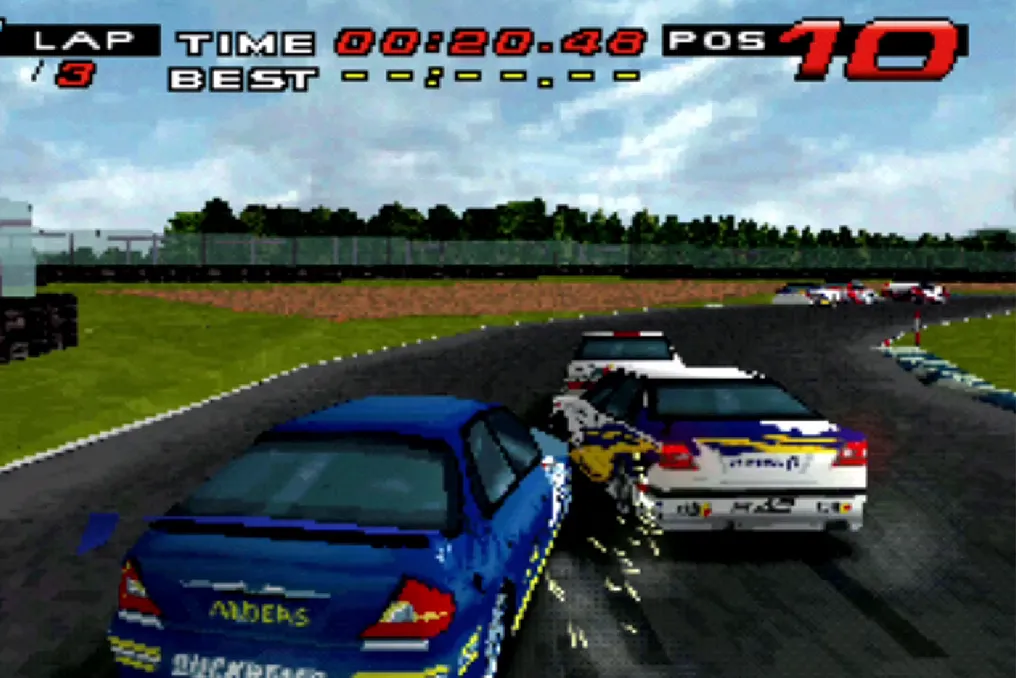
In an era where cars in video games seemed like indestructible blocks, allowing the wall to be used as support in corners, TOCA embraced the inherent violence of touring car racing without reservation. A harder impact on the opponent's rear would deform the trunk, and a mistake in the Donington Park corner could send the Honda Accord's hood flying. Windshields shattered and side windows disappeared, potentially leading to the car overturning in severe collisions.
The damage was primarily aesthetic and structural; there were no complex mechanical failures in the engine caused by impacts, which prevented the experience from becoming frustrating. Even so, crossing the finish line with the Peugeot 406 looking dented provided a feeling of survival and victory hard to match in Gran Turismo.
This level of detail is even more remarkable considering the technical limitations of the PlayStation hardware, which imposed clear restrictions on polygonal rendering, forcing most games to limit the number of vehicles on the track to 6 or 8 to maintain an acceptable frame rate, including Gran Turismo. Codemasters achieved a feat by presenting 16 cars racing simultaneously side-by-side at 25 frames per second (considered acceptable) and modeled with over 3,000 visible polygons. Starting a race in the middle of the pack, surrounded by 15 aggressive AI opponents, was chaotic and spectacular. The AI did not follow fixed tracks; cars bumped into each other, made braking errors, and occasionally, leaders got tangled trying to overtake the slower ones, creating opportunities for memorable overtakes.
The controls reflected this technical ambition. Although TOCA could be played on the standard PlayStation digital controller, the game reached its peak on the DualShock controller. The physics model demanded attention: cars sank their suspension when braking and leaned in corners, severely punishing anyone who tried to play it like Ridge Racer. It was necessary to find the ideal trajectory, brake in advance, and resume acceleration precisely, managing control with caution. The game rewarded patience and practice.
Codemasters understood the importance of weather to simulate a British championship. TOCA pioneered offering variable weather conditions, including sun, cloudy skies, dense fog, rain, and storms. Fog generated by tires on rainy days actively reduced visibility, and the glare from opponents' brake lights often served as the main navigation reference. Although these atmospheric factors did not drastically alter drivability, they significantly contributed to the overall atmosphere.
Unprecedented Features
TOCA offered the option of an internal cockpit view, placing the player directly behind the steering wheel, an uncommon feature in 1997. To further increase immersion and simulate an authentic television broadcast, the English version included commentary from Tiff Needell, former test driver and host of the original Top Gear.
Curiously, the game contained some purely arcade elements. The absence of an interior rearview mirror hindered defense for those ahead, there were no pre-race mechanical adjustment options, and peculiarly, it allowed the use of the horn in the middle of the track. Virtual opponents did not swerve upon hearing the horn, but the feature added a peculiar tone to such technical driving.
The core of the game was the Championship mode, capable of testing the limits of the most experienced players. Faithfully imitating the real BTCC, each stage required two races on the same track: the player had to qualify, complete the first battery, and immediately proceed to the second without the possibility of saving progress between heats. A slip on the last lap of the second race could nullify all effort, forcing a restart of the entire weekend if the combined score was insufficient to unlock the next circuit.