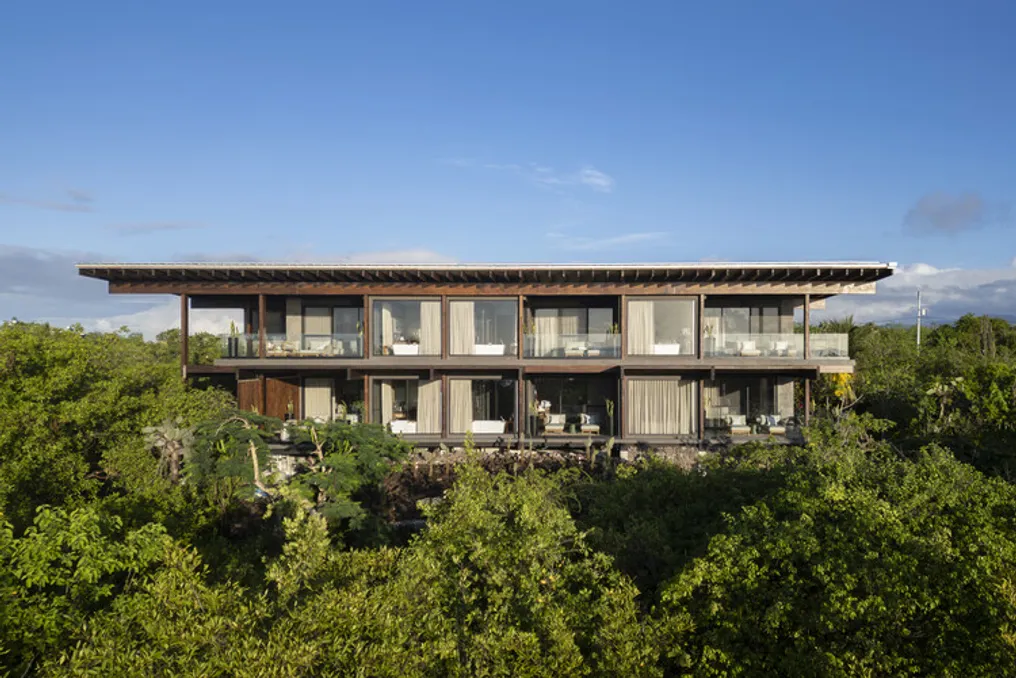
Hotel Finch Bay receives expansion focused on sustainable architecture in the Galapagos Islands
Read more
ArchDaily Brasil
archdaily.com.br

Hotel Finch Bay receives expansion focused on sustainable architecture in the Galapagos Islands

The project team presented details about Hotel Finch Bay, highlighting the intrinsic connection of the Galapagos Islands with the history of evolution, whose observations by Charles Darwin influenced evolutionary theory. These islands remain a place of constant adaptation, where life, landscape, and human presence coexist in a unique manner.

Over the years, the Hotel Finch Bay Galapagos Hotel has developed in this setting, acting as a link between visitors and one of the planet's most remarkable natural environments. The most recent intervention consisted of expanding the hotel with new suites, while maintaining the original architectural philosophy: developing constructions that integrate into the landscape without competing with it.

Located on Santa Cruz Island, near Puerto Ayora, the hotel is organized into several small-scale volumes arranged around a central landscaped area. This arrangement allows the architecture to maintain a secondary role relative to the surrounding vegetation, topography, and coastal environment.

Construction in Galapagos poses considerable challenges, including strict environmental regulations, complicated logistics, and material scarcity, demanding high-level planning. For this reason, the expansion was planned from the outset using a prefabricated construction system. The components were designed, coordinated, and manufactured in Quito before being sent to the islands for assembly, which resulted in a significant reduction in construction time, material handling, waste, and impact on the construction site.

The main structure uses laminated teak sourced from cultivated forests, offering a renewable structural system with a considerably lower carbon footprint than many traditional options. The efficient and adaptable construction system is complemented by prefabricated cement floor panels with polyurethane insulation and light internal partitions. Furthermore, prefabrication aided in quality control, resource optimization, and minimizing interference in such a delicate ecosystem.

The choice of materials reinforces the connection to the location. A sober and timeless palette, composed of wood, volcanic stone, concrete, and neutral finishes, was selected not only for its visual aspect but also for its resistance, low maintenance needs, and ability to age naturally in a challenging coastal climate.

The sustainability approach encompasses aspects beyond physical construction. Broader environmental strategies of the hotel include rainwater harvesting, wastewater treatment, recycling programs, energy efficiency measures, and the installation of photovoltaic panels.

In summary, the result is an expansion that maintains the identity of Finch Bay, proving that sustainable architecture arises from essential choices: how to build, which materials to use, and how subtly architecture can coexist with an extraordinary landscape.


Similar stories

Pope Leo XIV believes concerns about artificial intelligence should be taken seriously
Read more
noticiasaominuto.com

Pope Leo XIV believes concerns about artificial intelligence should be taken seriously

Pope Leo XIV told journalists on a plane while returning from a four-day visit to France that although he is not panicking and sleeps well, he is convinced that the concerns raised by many AI experts must be taken seriously.

During his apostolic journey to France, the Pope repeatedly warned about the need to protect humanity from the influence of AI. In his speech in Paris on Friday, he stated that it is crucial to develop ethical judgment so as not to lose our humanity amidst the 'heaven of machines' that is invading and shaping our daily lives.

Discussions about the risks associated with this technology have intensified in recent months, fueled by various incidents and apocalyptic warnings from industry specialists. On the plane, the Pope emphasized that these anxieties are not 'fake news,' contrary to claims by some who allegedly spread them for financial gain or other advantages.

He noted that this is an issue that, in his opinion, should be discussed jointly, adding that simply saying 'oh, that won't happen' and ignoring the problem is probably not the most responsible approach.

In the encyclical 'Magnifica Humanitas' (Great Humanity), published in May, the head of the Catholic Church made a firm call to 'disarm' AI to 'prevent its domination over humanity.' In recent months, the Holy See has also intensified its initiatives for international governance of AI based on human dignity, particularly in the fields of nuclear technology, culture, and artistic creation.

Some garden plants can attract snakes: tips for home safety
Read more
www.aajtak.in

Some garden plants can attract snakes: tips for home safety

People enjoy planting trees, shrubs, and flowering plants in their homes because they not only decorate the dwelling but also purify the air. However, some types of plants, dense bushes, and vines located in the garden or yard can unintentionally attract snakes to the house.

Although scientific data suggests that snakes do not react to plant aromas, as they perceive smells through their tongues, the cool, moist, and dark environment created by these plants, along with the accumulation of insects, attracts snakes looking for prey and shelter. If such plants are near your home, immediate precautions should be taken. Below are five main types of plants and shrubs that become favorite habitats for snakes.

The dense foliage of these flowers, along with their coolness and delicate scent, attracts many small insects and birds. Bears come here to hunt these insects, and snakes follow them to catch frogs. Additionally, dense vines create safe hiding places for snakes.

Sandalwood trees remain very cool. Snakes use sandalwood trees and the roots around them as shelter to avoid the heat during the summer months and find coolness.

Dense grass or clumps of sarkanda growing on the ground prevent sunlight from reaching the soil. This creates a moist and dark environment that is ideal for snakes wishing to hide from predators such as falcons or mongooses.

In lime or orange trees, mouse and bird nests are often built. Since the smell of mice is a primary food source for snakes, snakes may reach the walls or roofs of the house through these trees in pursuit of prey.

To deter snakes, it is necessary to regularly trim dry branches and drooping leaves around the house so that the ground remains clean and open for visibility. It is also recommended to plant lemongrass, marigolds, or sansevieria at the property boundary, as their prickly structure discourages snakes from lingering in that area.

It is important to control the population of mice and debris in the house, as the appearance of mice will inevitably lead to the appearance of snakes.

Popular