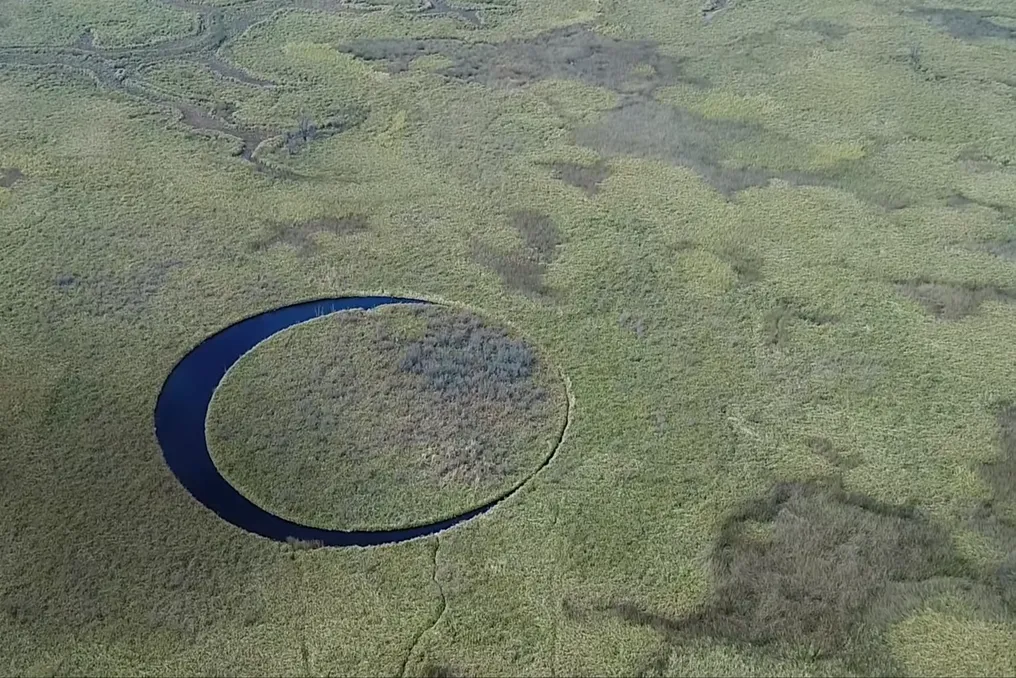
There are places on Earth that seem otherworldly and make one ponder the might of nature. One such object is El Ojo. It is located deep in the Paraná Delta of Argentina, north of Buenos Aires, where a nearly perfectly round green spot lies within a dark ring of water. It looks more like a carefully drawn element of the landscape than a marshy area.
This island received the name El Ojo, which translates to 'The Eye.' This name becomes obvious when viewed from above. A more astonishing aspect is its ability to move.
El Ojo is an uninhabited island with a diameter of about 118 meters, situated within a circular body of water in the vast Paraná Delta, which is a constantly changing landscape of waterways, swamps, and islands. Unlike a typical island fixed to the riverbed, El Ojo appears to be floating. Satellite images demonstrate that its position has changed over time, and the island itself seems to rotate in the surrounding water.
This object became known to the general public in 2016 when Argentine filmmaker Sergio Neuspiller discovered it in Google Earth while investigating unusual phenomena in the delta. Historical satellite images confirmed that the island was not remaining in the same spot. Naturally, he wanted to see it in person.
Access to the island was difficult because the delta is a labyrinth of waterways and dense vegetation; the first expedition failed to reach it. However, a subsequent attempt was successful, allowing Neuspiller and his team to conduct research from the shore. Their findings only increased interest in this place.
El Ojo has spawned many dramatic theories, including supernatural and extraterrestrial explanations. Nevertheless, scientific evidence supporting these claims is absent. A more plausible explanation relates to more earthly processes: water, erosion, and floating masses of vegetation, roots, and organic material.
If the island is capable of moving in the aquatic environment, currents could gradually erode and alter its edges. Over time, such movement may have contributed to the formation of the strikingly round shape seen today. The Paraná Delta is a landscape built on change, where water, sediments, and vegetation continuously transform islands and channels. El Ojo may simply be an unusual example of these natural processes.
The exact history of the island remains unclear. Satellite images show that the formation existed at least since 2003, but they cannot pinpoint the moment of its formation or explain all the details of its movement. This gap in knowledge is part of its appeal.
There is something wonderfully human about how El Ojo was discovered. Someone was browsing the landscape on a computer screen and noticed something that did not quite match expectations: a tiny green island located almost perfectly inside a circular basin. Instead of scrolling past, the person decided to find it. This impulse is familiar to us all: we see something strange on a map and immediately want to know what it is. In the case of El Ojo, the answer leads to an even more interesting question: how does such an island move?
From the ground, it is easy to imagine El Ojo disappearing into the surrounding swamps. Its extraordinary geometry only becomes apparent from above, where the green center of the island and the dark circular channel form the unmistakable shape of an eye. However, looking at old satellite images, the picture changes again: the Eye has moved.
There is a temptation to explain strange places until there is no mystery left around them. El Ojo resists such a simple conclusion. Although currents and erosion offer a plausible explanation for its shape and movement, its exact formation and history remain uncertain. Perhaps this is what makes it so intriguing.