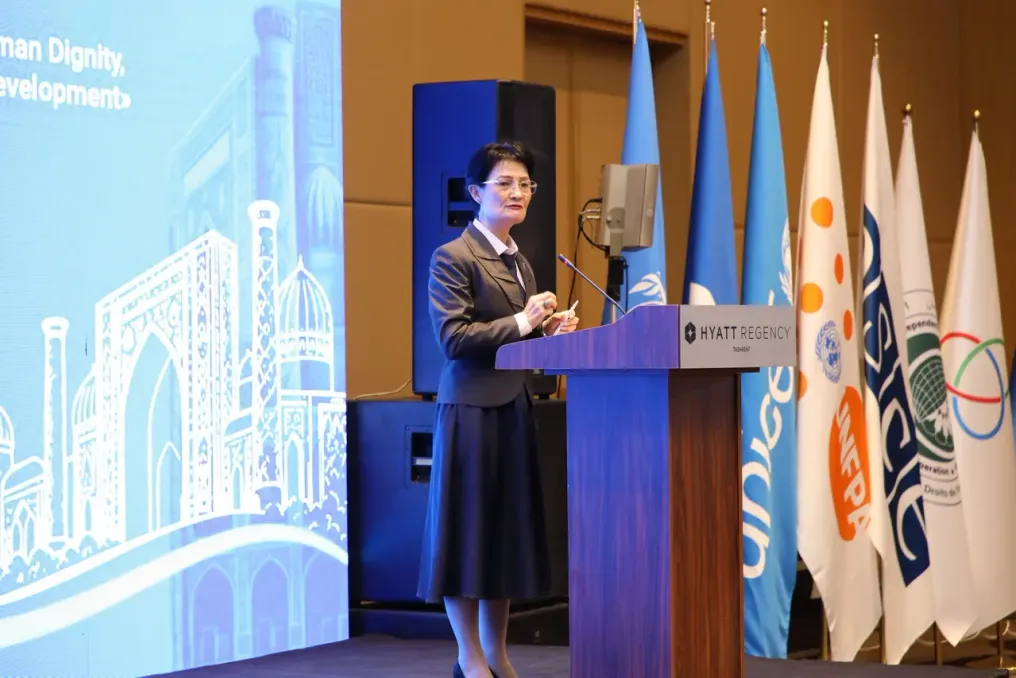
The Fifth Samarkand Human Rights Forum continued its work after the plenary session by holding seven thematic sessions. Participants discussed a wide range of issues, including economic, social, and cultural rights, protection of the rights of persons with disabilities, gender equality, climate justice, artificial intelligence, and the problem of statelessness.
The plenary sessions focused primarily on the sixty years of experience in implementing International Human Rights Covenants, the significance of the right to development as a universal human right, global solidarity, and further strengthening national and international human rights protection mechanisms.
The first session was dedicated to '60 Years of the International Covenant on Economic, Social and Cultural Rights and 40 Years of the Declaration on the Right to Development: Promoting Sustainable Development through Human Rights.' Participants discussed the right to education and the need to ensure quality, inclusive, and lifelong learning, as well as the right to health and the development of sustainable healthcare systems. Furthermore, decent work, social protection, and fair economic growth were examined as key components of sustainable development.
Special attention was paid to reducing poverty and inequality, ensuring inclusive development, realizing the right to development, and the role of national experience and international cooperation in achieving the Sustainable Development Goals. Other topics included the participation of international financial institutions in financing sustainable development and realizing socio-economic rights, as well as the protection of cultural heritage during armed conflicts.
The second session was themed '60 Years of the International Covenant on Civil and Political Rights: Rule of Law and New Challenges.' National, foreign, and international experts analyzed the relationship between international law and national legal systems, compliance with treaty obligations, and the incorporation of Covenant provisions into national legislation.
The discussion also covered mechanisms for states to submit periodic reports, the implementation of concluding observations by the UN Human Rights Committee, and the coordination of relevant state bodies. Special emphasis was placed on the role of national courts, the prosecution, and the legal profession in ensuring the application of Covenant provisions, as well as the development of the UN Human Rights Committee's practice over the last six decades.
The third session focused on '20 Years of the Convention on the Rights of Persons with Disabilities: From Recognizing Rights to Inclusive Societies.' Participants stressed the need for further fulfillment of international obligations for the full realization of the rights of persons with disabilities. Discussions addressed eliminating barriers to full integration, equality, and non-discrimination, creating an accessible environment, and ensuring equal opportunities in education, employment, and social protection.
Participants also reviewed access to justice, independent living, and participation in public life, digital inclusion, assistive technologies, and the use of artificial intelligence.
The fourth session was titled 'Demographic Sustainability: Human Rights, Human Capital, and the Well-being of Current and Future Generations.' It discussed human rights, the well-being of youth and families in the context of sustainable development and the realization of human potential. Experts analyzed demographic trends, including population aging, and their impact on state policy, the labor market, social protection systems, and regional development.
Particular attention was given to investments in education, healthcare, vocational skills, and lifelong human capital, as well as gender equality, youth participation in public life, digital transformation, and intergenerational solidarity.
The fifth session was dedicated to 'Women's Rights, Gender Equality, and Climate Justice: From International Obligations to Effective Implementation.' Participants reviewed the fulfillment of international obligations to protect women's rights and promote gender equality. The importance of expanding women's economic opportunities for achieving inclusive and sustainable development was emphasized.
A separate part of the discussion focused on the links between climate change and women's rights, the protection of vulnerable groups, and women's access to natural resources, food, water, healthcare, and decent living conditions. Participants also discussed women's participation in decision-making, the prevention of discrimination and violence, and the impact of digital transformation on expanding women's access to technology, education, and innovation.
The sixth session was dedicated to 'Artificial Intelligence, Digital Technologies, and Human Rights: Ethics, Legal Regulation, and International Cooperation.' Experts studied international approaches to the legal regulation of artificial intelligence and its implications for human rights protection. The discussion focused on transparency, accountability, and non-discrimination in the development and use of AI, as well as privacy, freedom of expression, and the right to access information.
Participants also touched upon algorithmic discrimination, digital divide, and equal access to opportunities provided by modern technologies. The global governance system for AI and international cooperation were discussed separately. Participants considered the opportunities and risks of using AI in public administration and the judicial system, as well as the humanitarian consequences of the growing application of artificial intelligence in modern armed conflicts.
The seventh session was themed '65 Years of the Convention on the Reduction of Statelessness: Its Continuing Importance, Achievements, and Future Prospects for Central Asian Countries.' Participants noted the significance of the 1961 UN Convention in protecting the human right to nationality and analyzed the successes of Central Asian countries in preventing and reducing statelessness.
The discussion included the exchange of experiences and practices used by countries in the region. Special attention was paid to regional cooperation, including the implementation of the Ashgabat Declaration provisions, as well as cooperation with international organizations and civil society institutions. The discussions resulted in practical recommendations for the further application of international standards and accelerating efforts to eradicate statelessness in Central Asia and beyond.
The closing plenary session of the Fifth Samarkand Human Rights Forum will take place in Samarkand on September 29.