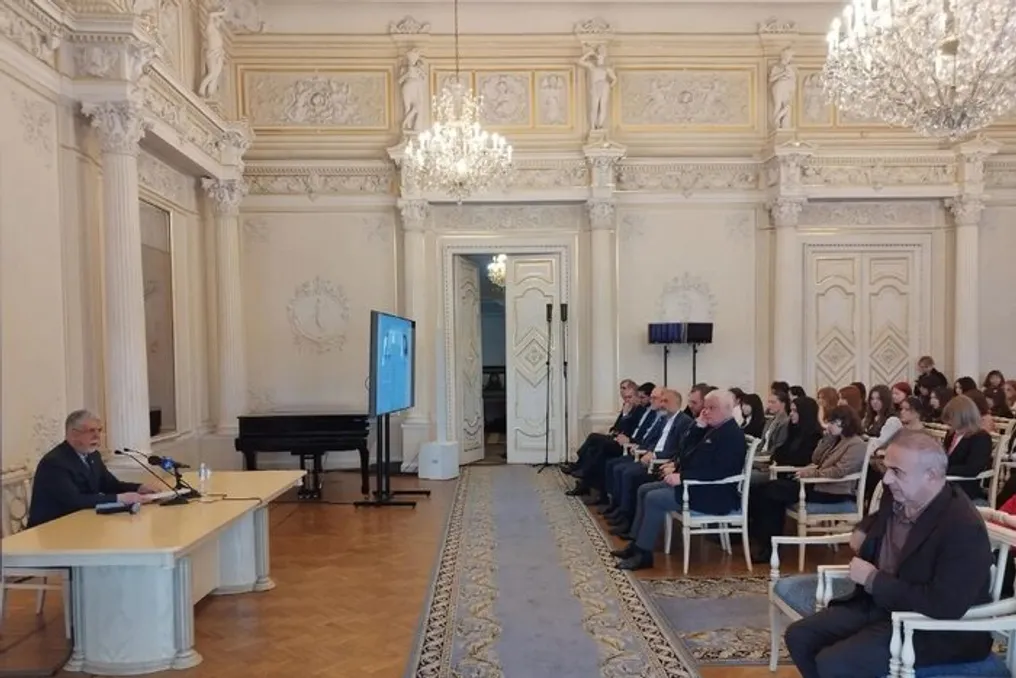
The Iranian Minister of Culture, Saeed Abbas Salehi, spoke on Sunday before the faculty and students of the Saint Petersburg State University of Culture and Arts. He emphasized the importance of a strategic approach to Iranian-Russian cultural and civilizational dialogue as a means of strengthening resilience in the face of future crises. Furthermore, he discussed the country's cultural components and its 'cultural shield' amid military threats.
Speaking at events within the framework of Iran's Cultural Week in Russia, Salehi began with a fundamental question: 'Why do some civilizations collapse in the face of crises, while others not only withstand them but draw new strength from them?'
Referring to the numerous crises that Iran and Russia have faced throughout history—including imposed wars, foreign occupation, economic sanctions, attempts at geopolitical isolation, natural disasters, and cultural pressure—Salehi noted that the longevity of both countries lies not only in military might or material resources but also in the cultural and civilizational elements accumulated over centuries, according to IRNA.
He continued to explain the cultural factors upon which Iran relies when confronting modern crises. 'Every crisis activates different cultural elements; therefore, Iran uses a diverse set of cultural resources in response to different crises,' he stated.
Addressing Iran's experience in the war with Iraq, recent attacks by the US and Israel, and ongoing military threats, Salehi stressed: 'The first activated cultural element is emotional solidarity. This solidarity is rooted in a culture of altruism and collective commitment, which is reinforced by Persian literature and religious teachings.'
He specifically highlighted the role of women in Iran, stating that they are central to forming this solidarity during external threats. 'They play a vital role in caregiving, aid distribution, and rebuilding social ties, which was fully evident during the recent attacks by the American and Israeli regimes,' he asserted.
Salehi also pointed to the effective role of Russian women during World War II, suggesting that empowering women during times of crisis could be an area of cooperation between Iran and Russia.
After discussing emotional solidarity and the role of women, the minister identified historical memory of suffering and resistance as the third cultural factor in countering external threats. He noted: 'Exchanging experiences in the positive retelling of historical memory can become another area of cultural cooperation between Iran and Russia.'
Salehi named religion, spirituality, and mysticism as the fourth cultural element shaping Iranians' response to external threats, emphasizing the central role of Iran's religious, spiritual, and mystical doctrines and traditions. He added: 'Iranian religious and spiritual traditions view commitment to others and altruism as conditions of humanity, and therefore reject passivity and egoism.'
He compared this to the emphasis on Orthodox spiritual traditions in preserving Russia's national identity, calling it a similar cultural factor. 'These traditions helped strengthen social bonds and provided the potential and foundation for broad national solidarity during times of crisis,' he concluded.
Summarizing the cultural elements acting in response to war and external threats, he stated that Iran relies on emotional solidarity, women, historical memory, and spirituality. 'These four resources are Iran's cultural shield against foreign military threats.'
In another part of his speech, the minister examined the cultural aspects that Iran utilizes in response to sanctions and attempts by adversaries to isolate it economically. He listed elements such as adaptability and informal initiatives; youth activity and communication networks; traditions of public administration and governance; as well as science, knowledge, and educational institutions.
He explained: 'In conditions of scarcity and instability, Iranians demonstrate a significant ability to change lifestyles, find alternatives, and use resources in multiple ways. This skill of managing complex circumstances is a significant advantage.'
According to the minister, a 'resilient informal economy' is reflected in Persian literature, proverbs, and stories. He strongly recommended: 'Comparative study of culture and the informal economy could become an area of current cooperation between Iran and Russia.'
Salehi concluded by stating that Iran's greatest asset in a crisis is the people's capacity for solidarity and mutual support. 'This asset is not stored in the Central Bank or in military pacts,' he said.
He stressed: 'It lies in a shared sense of identity, attachment to the homeland, and historical memory. The modern experience of Iranians, from the eight-year imposed war to unjust sanctions and recent attacks, has shown that despite all difficulties, Iranians are ready to sacrifice anything for their culture, civilization, and homeland. The secret to the survival of this civilization throughout the ages lies in this common Iranian identity.'
In conclusion, Salehi called on Russian educators, researchers, and students to view the Iranian-Russian cultural and civilizational dialogue not as a diplomatic project, but as a strategic investment in common resilience in the face of future crises.
Salehi arrived in Russia on Thursday to participate in the XII International Forum of United Cultures and the Promotion of Joint Cultural Programs between Iran and Russia through the organization of Iran's Cultural Week in four Russian cities. On Friday, the second day of his trip to Russia, the Minister of Culture and Islamic Guidance spoke at the XII International Forum of United Cultures in St. Petersburg before ministers and influential figures from more than 70 countries and answered questions from journalists. On Saturday, he met with his Russian counterpart Olga Lyubimova, and both sides signed a memorandum of understanding on joint film production. Iran's Cultural Week includes performances by Iranian artists, an art exhibition, as well as specialized sessions and film screenings.