India and France are preparing to launch the 'Trishna' satellite from the Sriharikota spaceport in 2027. This project is designed to observe Earth's energy and water resources. The 'Trishna' satellite (Thermal Infra-Red Imaging Satellite for High-resolution Natural Resource Assessment) is a joint venture between ISRO and the French space agency CNES.
It is designed to provide monitoring of Earth's surface temperature, emissive, biophysical, and radiation variables with high spatial and temporal resolution, which will allow for surface energy budgeting on regional and global scales.
During a meeting with a large French delegation focused on scientific and space cooperation, Minister of Science and Space Jitendra Singh stated that the implementation of the joint 'TRISHNA' satellite is progressing successfully. He also highly praised CNES's support for India's Gaganyaan program, including the supply of consumables and training for flight surgeons.
Indian and French teams have begun discussions on research in microgravity and parabolic flights in the context of manned space missions. The 'Trishna' mission will also assist in the comprehensive assessment of urban heat islands, the detection of thermal anomalies related to volcanic activity and geothermal sources, as well as the precise monitoring of snowmelt runoff and glacier dynamics.
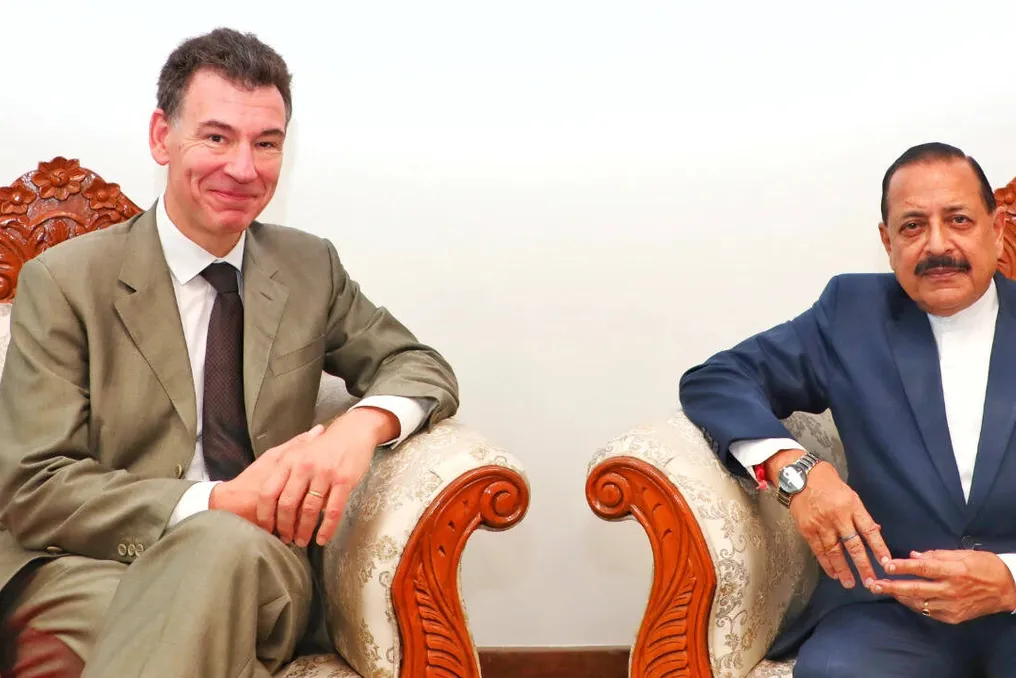
Furthermore, the mission will provide valuable data on aerosol optical depth, atmospheric water vapor, and cloud cover. A high-level French delegation led by Philippe Baptiste, Minister of Higher Education, Research, and Space, met with Singh in Delhi on Monday. They discussed the Space Summit, the Year of Innovation for India and France in 2026, and priorities in scientific and technological cooperation, including space, CEFIPRA, and the blue economy.
Singh noted that the cooperation between India and France in the space sector has transformed from early experiments with sounding rockets in the 1960s into an extensive partnership. This partnership covers joint satellite missions, launch vehicle technologies, manned flights, and new space applications. Discussions on microgravity research and parabolic flights have also commenced.
Referring to reforms in India's space sector and the growth of the private ecosystem, he reported that over 400 Indian space startups operate in areas such as rocket manufacturing, satellite assembly, and space applications. He emphasized that the next phase of cooperation between India and France could unite state institutions, industry, and startups from both sides to create a broader ecosystem and a larger pool of resources.
Philippe Baptiste called 'Trishna' a prime example of what India and France can achieve together and welcomed the strengthening of cooperation in manned space flights, astronaut health, microgravity and parabolic flight research.