Relationships between the Baron of Mauá and the Baianinho de Mauá
Read more
Super Abril
super.abril.com.br

Relationships between the Baron of Mauá and the Baianinho de Mauá

Irineu Evangelista de Sousa, known as the Baron of Mauá (1813 – 1889), was fundamental to the start of industrialization in Brazil. He conceived the Mauá Railway, which became the country's first railway line, earning him the title of baron.

On April 30, 1854, Dom Pedro II (1825 – 1891) inaugurated the first 14.5 km segment of this railway, connecting the Port of Mauá to Fragoso, both located in the municipality of Magé, Rio de Janeiro.

Henry Chamberlain

Henry Chamberlain (1796-1844), the son of a prominent English diplomat residing in Brazil, was one of the individuals who addressed letters to Pedro I on September 7, 1822, encouraging him to proclaim the independence of Portugal.

Sir Neville Fitzgerald Chamberlain

Sir Neville Fitzgerald Chamberlain (1856-1944), a British officer, served in India under the rule of the United Kingdom. It was he who established the rules for a variation of billiards that became popular among soldiers: pool.

Baianinho de Mauá

Josué Ramalho da Silva, known as Baianinho de Mauá (1973 -), was born in Paulo Afonso, Bahia. He won several pool championships throughout Brazil, most of which occurred in bar tables. His nickname derives from the period he lived in the city of Mauá, in São Paulo, which is named in honor of the Baron of Mauá.

Similar stories

Analysis of Characters and Plots in the Brazilian Naturalist Novel O Cortiço
Read more
super.abril.com.br

Analysis of Characters and Plots in the Brazilian Naturalist Novel O Cortiço

Published in 1890, O Cortiço is considered one of the most relevant naturalist novels in Brazilian literature. The work was written by Aluísio Azevedo (1857-1913) and explores life in 19th-century Rio de Janeiro society, detailing the daily life of a housing complex where the lives of the residents intertwine in a complex scenario of passions, ambitions, and tragedies.

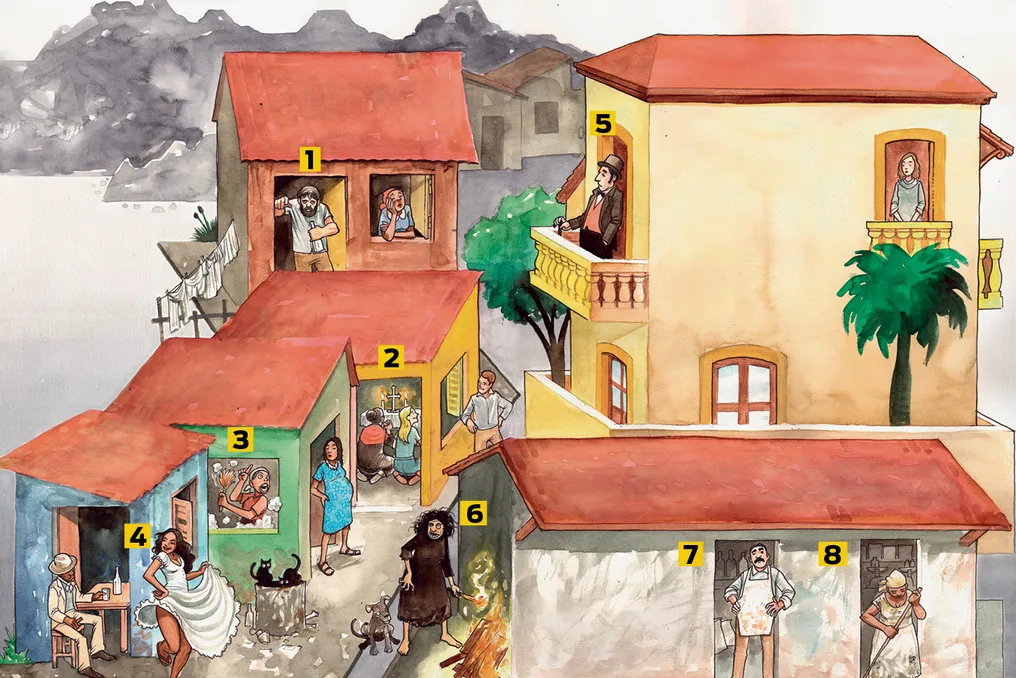
The narrative presents various stories and relationships between its characters, as illustrated in specific scenes:

Love Goes Mad

Jerônimo and his companion, Piedade, lived in room 35. His character and strength guaranteed him respect at the quarry adjacent to the tenement. However, his life took a turn after witnessing Rita Baiana dancing. Passionate, he began consuming cachaça, spending excessively, and finally abandoned his wife and daughter to dedicate himself to Rita.

Vocation for Mother-in-Law

Dona Isabel, a resident of house 15, dedicated herself entirely to educating Pombinha, aiming to marry her to João da Costa, a merchant, with the goal of restoring her former social status. The mother only permitted the marriage after the young woman's first menstruation. However, the union was brief because Pombinha betrayed her husband, was expelled, and ended up becoming a prostitute.

Painted Dirt

In number 12, where Marciana lived, another dramatic situation occurred. She was extremely meticulous about cleaning the house, but went mad when her daughter, Florinda, only 15 years old, became pregnant by an employee of the shop, João Romão. Since he did not assume paternity, the girl ran away after being assaulted by her mother. Consequently, Marciana was evicted from the tenement.

What Does the Baiana Have?

Rita Baiana lived in number 9. Beautiful and skilled at samba, she was the lover of the capoeirista Firmo, but also attracted the interest of the neighbor, Jerônimo, who was Portuguese. During the dispute over Rita's affection, Firmo wounded the Lusitanian with a razor. Later, Jerônimo recovered and eliminated his rival in an ambush.

Neighbors and Rivals

Miranda acted as an antagonist to João Romão. He lived in the townhouse next to the store and watched his property gradually surrounded by the growth of the tenement. The merchant valued status above all else; he married Dona Estela because of the dowry and harbored doubts about whether he was truly the father of his daughter, Zulmirinha. This generated envy in him regarding how Romão prospered and his relationship with Bertoleza.

The Witch's Bonfire

Paula, known as the Witch, possessed striking physical characteristics, such as being ugly, corpulent, having bulging eyes, and threatening teeth. Furthermore, she was capable of treating skin problems and fevers through prayers and blessings. She wished to burn down the tenement and succeeded in doing so on the second attempt. After the fire, João Romão had to rebuild the place, transforming it into a grand and aristocratic space.

The Owner of the Place

João Romão started his venture by inheriting the tavern where he had worked for twelve years. Later, he bought land behind the tavern at an auction and built three small houses, marking the beginning of the tenement. He used Bertoleza's money to expand the business (in addition to owning a quarry in the back). Although he liked to delay payments, he was effective at collecting debts, which made him even richer. In his pursuit of social ascent, he distanced himself from Bertoleza to try to marry Zulmirinha.

Eternally Slave

To achieve her freedom, the slave Bertoleza gathered twenty thousand reis. However, she was tricked by her lover, João Romão: the Portuguese provided her with a false freedom document and used the money to increase sales. This happened because Bertoleza did everything for him, working from early morning until late at night, taking care of the shop and the residence they shared.

The History of the Automatic Transmission: The Contribution of Brazilian Engineers José Brazo Araripe and Fernando Lemos
Read more
olhardigital.com.br

The History of the Automatic Transmission: The Contribution of Brazilian Engineers José Brazo Araripe and Fernando Lemos

As part of the series 'Brazilian Technologies That Changed the World,' this article discusses the history of the automatic transmission, an invention made possible by two Brazilian engineers: José Brazo Araripe and Fernando Lemos.

Similar to the typewriter, early devices existed, but it was the Brazilians who developed the first truly working model. In 1902, brothers Thomas J. and Thomas L. Stertewant created a rudimentary automatic gearbox; the prototype, patented in 1904, was mechanical and only functioned at high speeds.

Later, in 1921, Canadian Munro Alfred Horner, a steam specialist, developed a pneumatic mechanism using compressed air. Although this device lacked sufficient power for commercial use, Horner patented it in 1923.

Two years later, German Hermann Rißeler patented his version, making a significant contribution by combining a hydraulic torque converter with a planetary gear set. However, his design was also not released into commercial production.

The main difference between these three projects lay in the force used for gear shifting. In the 1930s, prototypes existed, but none of them functioned properly for market release. Among them, Rißeler's project was considered the most promising, serving as the basis for the device created by the Brazilian engineers Araripe and Lemos.

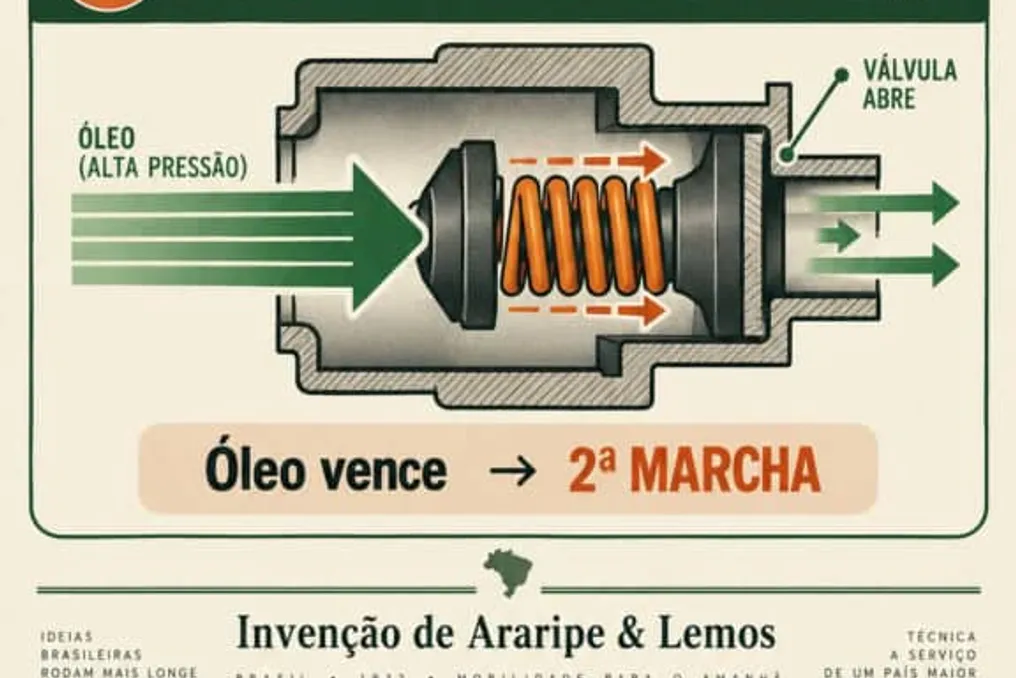
In 1932, this pair of engineers achieved a decisive breakthrough by learning to precisely control oil pressure. While Rißeler used hydraulic fluid to transmit engine power, the Brazilians developed a system where the pressurized oil itself controlled and executed gear shifting without jerking.

Although the system might have seemed similar to artificial intelligence, this was impossible given that the development took place in the 1930s. This system was based purely on physics and fluid mechanics.

Imagine a labyrinth of channels with small baffles (valves) pressed by springs. The 'brain' of this system was the speed of the vehicle. Thus, the pair of engineers created the first functional prototype of an automatic transmission ready for the market. It is important to note that, being Brazilians, they developed this system in the United States, as they moved there in the 1920s to work in ship repair workshops, dedicating over ten years to this secret project.

In 1932, they patented their invention and presented it to General Motors in Detroit. GM showed interest and made two offers: $10,000 lump sum or $1 per car sold using the technology. The pair chose the first offer. According to the official U.S. Bureau of Labor Statistics inflation index, this amount is equivalent to approximately $244,500 today (about 1.25 million Brazilian reais at the current exchange rate), which is a substantial sum. However, if they had chosen the second option, they would have earned much more.

After perfecting the Brazilians' project, GM released the Hydra-Matic transmission in late 1939. This technology debuted in Oldsmobile models in 1940.

Today, the technology invented by this pair of engineers is called the Standard Automatic Transmission (also known as 'Torque Converter'). Since the 1930s, this technology has undergone significant changes, but its hydraulic foundation remains the same. Over time, the system has gained computer control and increased from four to six, eight, nine, or even ten gears.

In conclusion, it is worth mentioning that mechanical engineer José Brazo Araripe was the cousin of the writer Paulo Coelho. Part of the story of the automatic transmission invention is contained in the book 'Mag,' the author's biography written by journalist Fernando Moraes.

Popular