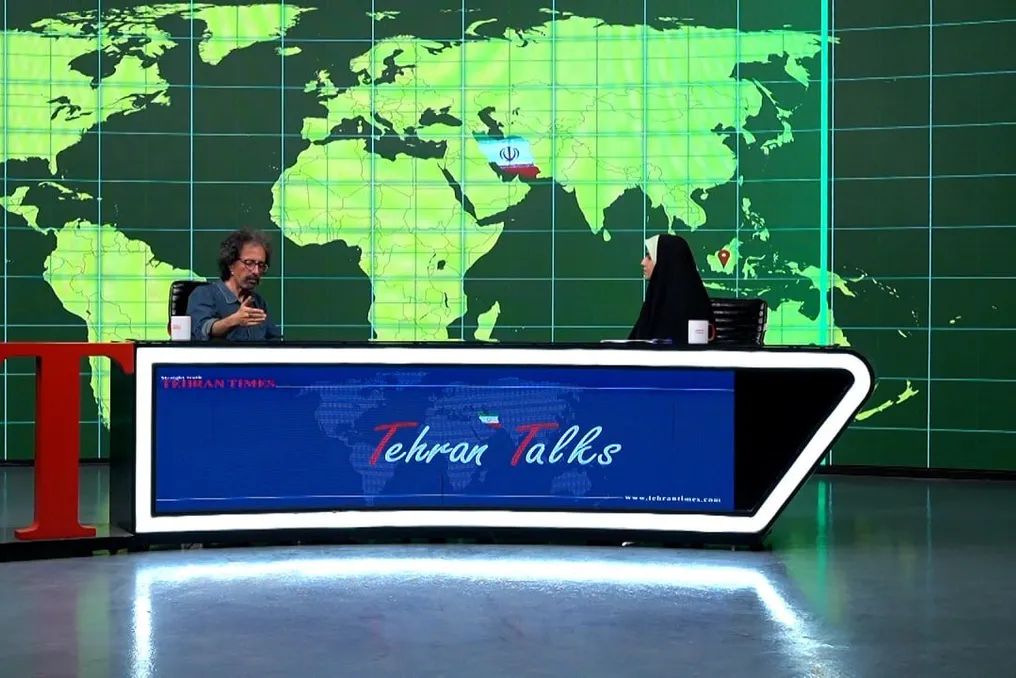
Iranian film director Babaak Hajepasha believes that cinema should do more than just depict suffering. In his opinion, a film addressing themes of war, child death, or social tragedy should leave viewers with questions rather than simply eliciting tears.
Hajepasha, whose film 'In the Embrace of the Tree' was presented by Iran at the Academy Awards for 2025, often focuses on themes of family and children in his works. His recent film 'Land of Angels' is dedicated to children in Gaza and participated in international events, including the 'Golden Minbar' International Film Festival in Kazan, where it won the Grand Prix for Best Feature Film. Furthermore, Hajepasha is part of the jury for the BRICS+ International Film Festival in St. Petersburg in 2026.
In an interview with Tehran Times, he discussed the possibility of making a film about the recent tragedy in Minab, the difficulty of depicting child death without reducing cinema to melodrama, his decision to shoot films during the 40-day war, and his impressions from a recent visit to Hiroshima. He also touched upon the international status of Iranian cinema, his previous criticism of the 'Oscar' award and some major festivals, and explained why family remains one of the themes he intends to explore in the future.
Moving Beyond Tragedy
Speaking about the possibility of making a film about the Minab tragedy, Hajepasha stated that he would be more interested in studying the causes of such events rather than just showing their devastating consequences. He emphasized that society must question the reasons for such suffering.
The director pointed to the loss of children in various regions of Iran, including Minab, Lamerd, Tabriz, and Kermanshah, during the recent war. He noted that while highlighting the suffering of children is important, cinema must also investigate why children constantly become victims of violence and conflict. This concern was central to his research on 'Land of Angels.' During his work and conversations with Palestinians, he encountered stories demonstrating the deep psychological impact of losing a child.
Hajepasha recalled a conversation with a Palestinian father who held his child when it died. According to the director, the man later repeatedly returned to the same place, hoping to be killed too so he could join his child. The father said he couldn't understand why he was left alive. For Hajepasha, such stories show that a child's death affects much more than the immediate victim; it leaves a psychological wound in the family and, ultimately, in the wider community. Nevertheless, he believes that cinema must avoid turning such suffering into a tool for emotional manipulation.
From Tears to Questions
This is why Hajepasha is cautious about creating films about war and children that rely entirely on emotion. He noted that if merely depicting the suffering of children were enough to change the world's reaction to violence, numerous films and documentaries about Gaza and other conflicts would have already brought about such changes.
He stated: 'Simply talking about the pain we feel does not necessarily move us forward. We must look at this intellectually. We must seek its causes and ask where this pain should lead us.' For 'Land of Angels,' he wanted the audience to leave with a question. The viewer can accept the fact of fighters, military conflict, and casualties in the war, but the death of thousands of children should raise another question: why are these children being killed?
In his view, this question can open the door to broader discussions about the place of children in modern society, the pressure placed on them, and even the declining significance of having children in some parts of the world. Hajepasha prefers this type of cinema over that which simply asks the audience to cry. He stressed: 'I do not want to make a film just so that the audience cries. We must value the film itself. There must be other reasons for its creation.' He referenced techniques from dramatic literature and epic theatre, including distancing, which prompt the audience to think about the work rather than simply succumbing to its emotional impact. The film, in his words, should remain with the viewer as a question after viewing.
When Filmmaking Becomes a Duty
The same idea of responsibility underpinned Hajepasha's decision to work during the 40-day war. At that time, Tehran and other parts of the country were in an exceptional situation due to airstrikes by US and Zionist regimes. Hajepasha observed people of various professions fulfilling duties beyond the ordinary: bakers working overtime, doctors and nurses continuing work in hospitals, and other citizens finding ways to contribute. For him and some colleagues, filmmaking became another form of service.
He said: 'Sometimes we make films because we are filmmakers. Sometimes, like Iranians, we have another national duty. At that moment, it stops being just filmmaking. It is a form of service.'
Under normal circumstances, he would admit that starting production quickly without usual preparation would be illogical, but he felt that the circumstances demanded a response. 'As an artist, I felt responsible. My tool is cinema and television.' He started working just a few days after the war began and now recalls this experience with satisfaction. The reason, he explained, was not necessarily that the films were more successful than his other works, but the feeling that he was doing something directly for his people. 'I am glad that during that period, instead of standing aside, I managed to take a step.'
Hiroshima: Between Memory and Spectacle
A recent trip to Hiroshima gave Hajepasha another opportunity to reflect on how great human tragedies are remembered. He attended the annual ceremony in memory of the victims of the atomic bombing of Hiroshima and found the gathering visually striking and, from a filmmaker's perspective, fascinating. However, the event left him with mixed feelings. He argued that the scale of the tragedy seemed much larger than what was broadcast at the ceremony. 'I felt that instead of a full expression of the truth, I was watching more of a show,' he remarked.
Hajepasha extended this observation to how peaceful processes are sometimes presented on the international stage. He questioned the gap that can exist between institutions and governments publicly promoting peace and countries whose policies have contributed to conflicts elsewhere. But his experience in Japan did not leave him as a pessimist. He recounted meeting ordinary people who appeared genuinely concerned about events outside their borders. When some Japanese people learned he was Iranian, they immediately mentioned the victims of the recent tragedy in Minab and other Iranian casualties. He said he had encountered similar reactions in other countries and believes that ordinary people can ultimately understand such tragedies more deeply than political rhetoric suggests.
Iranian Cinema and the International Festival Circuit
Hajepasha also returned to comments made during the presentation of 'In the Embrace of the Tree' as Iran's bid for the 'Oscar.' At the time, he questioned whether artistic quality alone determines a film's international success. He explained that his criticism was not only about whether his own film would advance in the 'Oscar' race but also about the broader state of art and cinema. In his view, political considerations, lobbying, and connections can influence some major international cultural institutions. He also believes that the influence of politics has become particularly noticeable in some film festivals. This does not mean he considers the entire international festival circuit politicized. He mentioned festivals held in South Korea, Morocco, Egypt, Armenia, Russia, and Turkey as those that continue to offer valuable platforms for filmmakers. Hajepasha emphasized that Iranian cinema has also gained genuine international recognition thanks to the work of directors such as Asghar Farhadi and Majid Majidi. He argued that the quality of an individual film should not be reduced to the festival where it is shown or the award it receives. 'One festival award cannot define the value of a film,' he stated.
He also believes that filmmakers themselves should not allow the desire for international recognition to dictate their artistic choices.
Family at the Center
Children play a notable role in both 'In the Embrace of the Tree' and 'Land of Angels,' but Hajepasha does not consider himself primarily a filmmaker of children's stories. His deeper interest, he says, is family. He usually includes children in his films because their presence adds an extra dimension to the story, but in future work, he wants to explore the family itself in more detail. 'I would like to make more films about the family itself,' he said, describing it as one of the most important and vulnerable foundations of human societies. He believes this issue is particularly significant in Iran, as family relationships are closely tied to the country's cultural identity. Iran cannot simply replicate changes that have occurred in other societies. The relationship between parents, children, and the extended family holds a special cultural meaning in Iranian society. For this reason, he believes that Iranian cinema should address the problems facing families rather than viewing changes in family structure as inevitable.
'Make a Good Film First'
Soon, Hajepasha will have the opportunity to look at films from a different side of the filmmaking process as a member of the jury for the BRICS+ International Film Festival in St. Petersburg. At the time of the interview, the festival films had not yet been submitted to the jury, so he had not started watching them. But he already knew what his first criterion would be. For Hajepasha, a film must have a compelling story and plot, as well as convincing cinematic elements, such as mise-en-scène and visual language. A political or social message cannot compensate for flaws in filmmaking. He is particularly critical of films that, in his opinion, were created primarily to convey a message. 'If we want to criticize society, we must first make a good film. If we just shout our message at the audience, the audience will immediately realize that the director has a hidden agenda.' The same principle applies to message-driven films that he agrees with. 'A good film that disagrees with our beliefs can sometimes be less harmful than a bad film trying to push our beliefs.' As a jury member, Hajepasha stated that his primary task would be cinematic quality. 'Before a film can make the audience believe in its message, it must make the audience believe in the film itself,' he concluded.