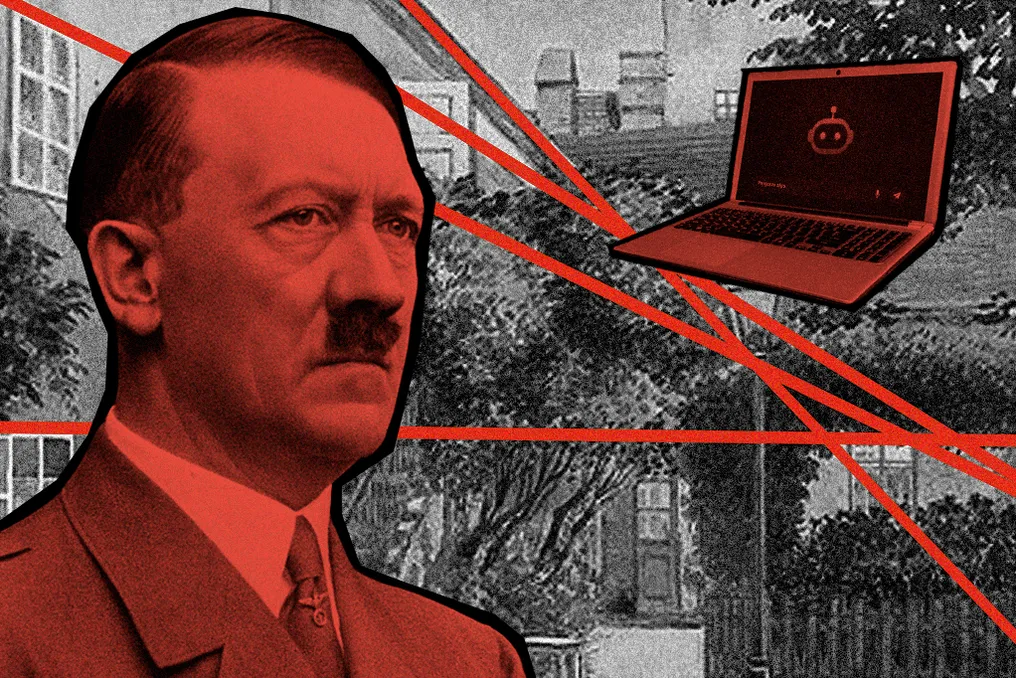
There is a specific error that experts look for when trying to determine if an image was created by artificial intelligence: a certain imprecision in the geometry of the scenes, which can be observed by analyzing Hitler's works.
Before gaining power, Adolf Hitler was a frustrated artist. Between 1908 and 1913, while residing in Austria, he spent years in financial difficulty, trying to establish a career as a painter in the streets of Vienna. Most of his work, which consisted of watercolors of notable buildings in the city, barely covered the cost of meals and attracted a varied audience, from tourists looking for souvenirs to frame sellers looking for images to fill empty spaces.
During this period, Hitler's desire to be an artist was becoming increasingly remote. His interest in art arose in childhood, when he learned to draw and paint on his own, and this permeated his entire trajectory (something that also characterized, in part, the aesthetic project of the Nazi regime). However, his ambitions were frustrated early on, being rejected by the Vienna Academy of Fine Arts in 1907 and again in 1908.
It is not difficult to understand why. His paintings, which frequently depicted facades of public buildings, churches, and other structures in a hyper-realistic style typical of postcards, rarely captured attention. And when they did, they tended to look stranger over time.
The feeling is that something is misaligned in the image, and indeed, it is. You have probably encountered this composition on the internet: it is a painting by Adolf Hitler, made during his time in Vienna, marked with red lines exposing a geometric strangeness. The problem lies in the completely distorted perspective.
To explain, if straight lines were drawn over a real photograph, they would all converge at a single point on the horizon, called the 'vanishing point.' Since the painting is a two-dimensional surface, this convergence of lines helps give the works an illusion of depth. Although artists do not need to follow this rule—since no one criticizes the geometry of Abaporu—in the hyper-realistic style Hitler sought to replicate, any imperfect convergence can generate a strong sense of strangeness. This could be intentional, but Hitler was not an avant-garde artist (in fact, he despised Modern Art); it seems that in his case, it was simply incompetence.
Similar errors occurred in the alignment of shadows and in other real-world features that he had difficulty reproducing on canvas, possibly due to a lack of planning in his process. Or perhaps it was simply carelessness. Historian Frederic Spotts, in his book Hitler and the Power of Aesthetics, observes: 'He had to paint the kind of thing that an unknown and untalented amateur could sell, and those were cheap reproductions of familiar places.' He admitted this once to an acquaintance, saying: 'I paint what people want.'
However, this happened more than a hundred years ago. Currently, this demand for fast and accessible art is fully met by artificial intelligences, which, as a bonus, are already capable of producing hyper-realistic images almost indistinguishable from reality. Curiously, AIs often exhibit this same type of oversight.
The photograph shown, with soldiers marching down a corridor, is not authentic; it was generated by an AI, and the proof of this is precisely the warped perspective. Other indications include disorganized text on uniforms, deformed faces, and inconsistencies in clothing. However, many of these elements could be interpreted as mere digital artifacts in a low-quality image, given that many modern AIs can simulate these small details with greater accuracy.
For this reason, forensic investigators specializing in verifying digital images often look for inconsistencies in the physics of images, including, naturally, perspective. Hany Farid, one of the world's leading experts in detecting digitally altered images, stated in an April issue of Science magazine: 'Generative AI does not understand physics, it does not understand geometry, and it makes all sorts of nonsense.'
In the same year, Farid published an article with his colleague Sarah Barrington from the University of California, detailing the difficulty AI has in simulating realistic explosions (in short, they tend to be excessively dramatic, with much more fire than expected and much larger smoke clouds).
Other similar factors help experts distinguish the real from the fake. Shadows, for example: rays of light are emitted parallelly; therefore, by following the lines of shadows in an image, one should arrive at a vanishing point, which is the light source. If these straight lines do not converge, it is a sign that the image was fabricated. Reflections are also difficult to simulate. In a normal image of someone in front of a mirror, it is possible to draw a line between the tip of the real head and the tip of the head in the mirror, between the real nose and the nose in the mirror, the eyes and the mouth, and in the end, all these lines will be perfectly parallel. In AI images, they may point in various directions.
It is possible that, over time, AIs will learn to correct these errors, producing videos increasingly identical to real life. But it is also unlikely that all these defects will disappear: the world is extremely complex, and there is no incentive for simulations to be perfect. Farid stated: 'The visual system forgives all kinds of absurdity in photos because it doesn't care.' He added: 'In terms of what people want to share and what people want to see, a lot of AI content is better than the real thing. It is what you expect to see in movies.' In this market of cheap images intended for quick and ephemeral consumption, a certain level of sloppiness is even acceptable—the AI just needs to portray what the public desires.