Epiklogue Company Unveils New E-commerce Model in India: The 'Try and Buy' System
Read more
YourStory [india, en]
yourstory.com

Epiklogue Company Unveils New E-commerce Model in India: The 'Try and Buy' System

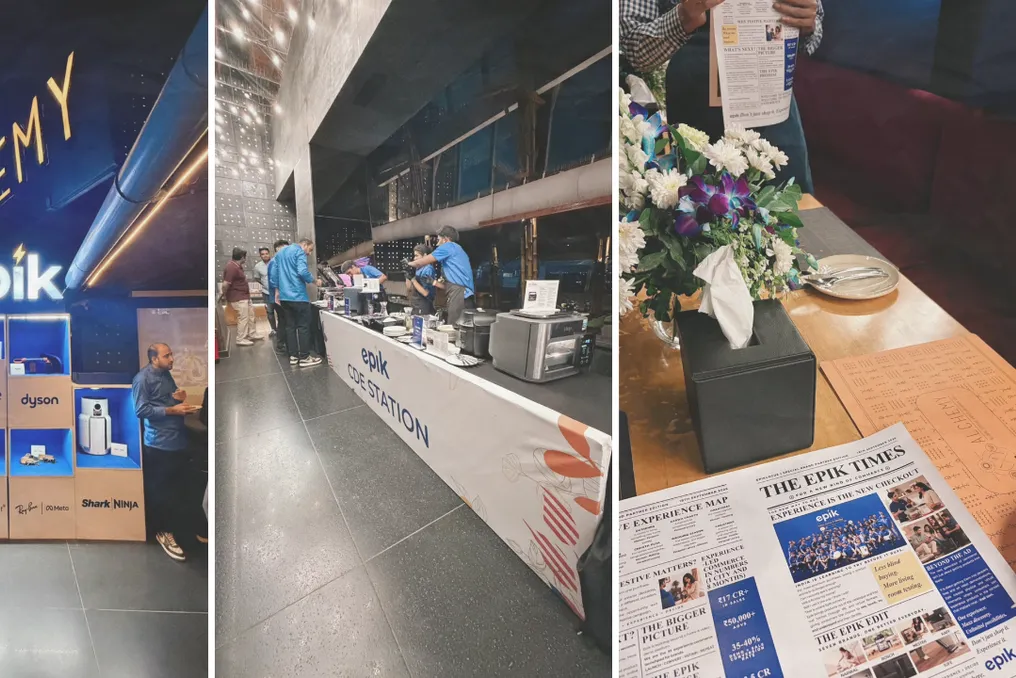
While major retail concepts have traditionally originated from the US or China, the company Epik, which created the 'Try and Buy Everything' store, held an Epiklogue event for its brand partners on September 18th.

Epik is an e-commerce experience marketplace based in Bangalore that is developing the world's first 'Try and Buy Everything' store. The event gathered leaders from smart home, smartphone, personal electronics, kitchen, and cleaning appliance industries, as well as representatives from non-electronic categories such as cosmetics, perfumes, premium tableware, travel accessories, and luxury apparel. The main topic of discussion was the future of the modern Indian consumer in the mass premium segment.

For the first time in the world, Epik offers customers a choice between the 'Try at Home' option, where an expert visits the buyer, and 'Try via Video,' where an expert demonstrates the product in real-time through a video call. In both cases, the expert shows the product, explains its features, compares options, and helps the customer make the best choice. Only after this does the purchase take place. Because of this, purchases made this way have a high degree of confidence, resulting in a return rate for Epik hovering around zero or low single digits.

In the age of artificial intelligence, where everything looks flawless but what you see cannot be fully trusted, people need a reliable human. Epik's answer lies in the 'human in the loop' principle: an expert who guides each customer to a product suitable for their specific needs, supported by the company's patented AI.

Behind every Epik experience is the world's first e-commerce experience engine, which manages the entire level of service and order fulfillment. It determines the necessary number of demonstration samples, places them with relevant partners, and matches each customer with the nearest available representative at a convenient time for them.

Several multi-billion dollar multinational corporations have already entered into partnership agreements with Epik through exclusive product launches. During the current festive season, they are also offering special promotions to customers through the 'Try and Buy' model.

Epik occupies a middle ground between two of the country's largest purchasing models. E-commerce is like an ocean with endless and overwhelming choices and unpleasant after-sales service. Modern retail is a lake with a limited assortment that is good for trying on but not for buying.

Epik represents a river that combines AI-personalized product cataloging with a warm, home-like experience.

The highlight of the event was a 45-minute stand-up set by Anmol Garg. He mocked the everyday difficulties of purchasing premium goods in Bangalore, including traffic and weather issues, and jokingly teased some of the brand partners present at the event. The atmosphere remained lively throughout the night as partners exchanged ideas and comments long after the show ended.

In a world where we are accustomed to most retail innovations happening in the US or China, Epik is a refreshing addition. The company has created a truly unique trading model, becoming a pioneer in e-commerce experience, thereby putting India on the global commercial map. As a country, we have already begun taking steps toward truly innovative models in fintech, deep tech, and space technology.

Manu Sharma, Managing Director of Dreame Technology, India, stated: 'Premium technologies are best understood when you experience them at home. With Epik, consumers can see Dreame products in action, feel their performance in real conditions, and then make a purchase with greater confidence. This brings the showroom experience right to the consumer's doorstep.'

Pushpa V, Head of Marketing at Philips India (Personal Care), noted that modern consumers want to understand a product deeper than just its functions. 'They want to experience how it works for them. Epik's 'Try and Buy' approach makes this experience part of the purchasing process, helping customers make more confident decisions in premium categories.'

Gotam Gouda, Founder and CEO of Epik, believes that Indian buyers have long been forced to choose between excess and deficiency. 'We created Epik at this perfect intersection as an AI plus human solution. Every customer deserves a real expert next to them, at home or via video, and any delay in the checkout process is a lost sale for the brand. We solve both these problems. The future of mass premium purchasing is Epik.'


Similar stories

Trust in the Indian real estate market is growing: AI and data centers are becoming investment drivers
Read more
www.aajtak.in

Trust in the Indian real estate market is growing: AI and data centers are becoming investment drivers

According to a JLL report, the Indian real estate market is becoming more transparent and reliable, with significant growth in investments in artificial intelligence (AI) and data centers. These positive changes could attract major global investors to the Indian real estate market. However, for India to fully realize this potential, it needs to implement several important reforms, including simplifying property-related regulations, broader adoption of new technologies in sales transactions, and ensuring easy access to complete and accurate property information.

The JLL report, based on the Global Real Estate Transparency Index 2026 (GRETI), shows that transparency has significantly improved in two-thirds of the 88 tracked markets and regions. However, the same document notes that the gap in transparency levels between leading and less transparent markets continues to widen.

In the GRETI 2026 survey, the Asia-Pacific region led global improvements in real estate transparency, with half of the ten markets showing the greatest progress belonging to this region. Among them, India took the lead, followed by Vietnam, South Korea, Australia, and Thailand.

The report highlights that India demonstrates steady growth, ranking fourth in improvement over 10 years and third over 20 years in the Asia-Pacific region. This growth in transparency is accompanied by a sharp increase in cross-border investments in the Asia-Pacific region, with India and Vietnam achieving record transaction volumes. Furthermore, India attracted $8.1 billion in cross-border investments, the highest figure in the last two decades.

JLL notes that despite India being at a critical juncture, having made the most progress in the Asia-Pacific region in the last two years and entering the top five countries globally, much still needs to be addressed. According to the report, the growing interest in AI and data centers represents not just an opportunity but the very engine that can attract major international investors. However, this is only possible if India strengthens its rules and systems at the same pace as the new opportunities.

According to JLL, 'land pooling' mechanisms in India, created to consolidate scattered private land parcels, are still in the initial stages. While master plans at the city level are undergoing administrative procedures, they are not being implemented on a large scale.

For plans to be uniformly implemented across the country and translated into measurable results, the application of GIS and aerial photography (drone) based digitalization needs to be expanded beyond pilot cities. Discrepancies also remain in plans concerning regulations and reporting on building operational performance standards, energy consumption disclosure at the property level, and climate risk reporting for sustainability.

From a technological standpoint, the adoption of technology in real estate acquisition and sales processes lags behind more developed markets, and government interaction with PropTech remains uneven. There is a significant disparity in the availability and depth of data in smaller Indian cities, creating gaps that better-resourced markets have already managed to address to a greater extent. The use of new technologies, such as digital registries and software, in real estate transactions is currently limited to major cities and has not reached smaller towns. Although tenants' rights to audit landlord accounts have improved, they still lag significantly behind those in developed countries.

Arbitflow introduces managed crypto platform featuring professionals and AI analytics support
Read more
ventureburn.com

Arbitflow introduces managed crypto platform featuring professionals and AI analytics support

Arbitflow has launched a managed cryptocurrency trading platform that is based on market analysis using artificial intelligence, yet it is managed by professionals. Within this system, professional traders are responsible for the actual execution of trades, while AI handles the processing of data on the market, news, performance indicators, and risks.

After users select traders and allocate capital through the platform, professionals make decisions regarding entering, holding, adjusting, or closing positions according to their strategy. Users do not need to build trades themselves or constantly monitor the market.

Before receiving approval, traders undergo identity verification, professional experience checks, and simulated skill testing. After joining the Arbitflow platform, Arbitflow monitors the current activity and results of each trader. This selection process combines identity, experience, and simulated performance checks before real capital management begins.

Users have the option to review traders' history before deciding where to place their funds. They can also divide funds among several traders and strategies instead of relying on a single approach. This gives users access to various trading styles within one managed account structure. The selection of traders and capital allocation remain under user control after account setup. Approved specialists then handle the daily execution and management of positions according to the chosen allocations.

Arbitflow began market research and strategy development in 2023 before creating its current patented AI infrastructure. This technology was developed around trading workflows rather than functioning as an independent automated trading engine. Its design is oriented towards the information used by professional traders when assessing markets and analyzing active positions.

Artificial intelligence processes factors such as market conditions, news events, trader behavior, performance records, and potential risks. Professional traders can use this data alongside their own experience when considering possible market moves. Arbitflow built the system on the principle that AI supports professional traders, rather than replacing them. Consequently, the final responsibility remains with the specialists managing the positions through the platform.

The technology also provides continuous performance monitoring among available traders. This adds another layer of data to track activity after the initial professional screening is complete. Research and trading workflows are closely integrated into Arbitflow's technological infrastructure. The company continues to use its AI exclusively as an analytical tool, not as an autonomous execution system.

Arbitflow offers a live trading feature that displays traders' performance, their trading history, and the most completed trades. Users can view this information before changing allocations or selecting other specialists. All trading operations are conducted on spot markets without the use of leverage, margin, or borrowed trading capital. Traders work with dedicated funds, not increasing risk exposure through debt.

This configuration eliminates the risk of liquidation caused by leverage from the platform. Standard cryptocurrency market risk remains, as digital assets can lose value. Users can start with $25 and decide how much capital they wish to allocate. They can also distribute funds among several approved traders instead of concentrating all capital in one strategy.

User setup includes trader selection, allocation control, performance visibility, and execution only on the spot market. Professional traders make market decisions, while users retain access to information about the performance of their selected allocations.

Arbitflow presents a managed crypto platform with AI support that connects users with professional traders through a spot-only trading model. The platform combines human-executed trade management with patented AI analysis, trader vetting, performance monitoring, and a live trading feature. Users can allocate capital across multiple traders and strategies while maintaining control over how their funds are distributed.

Popular