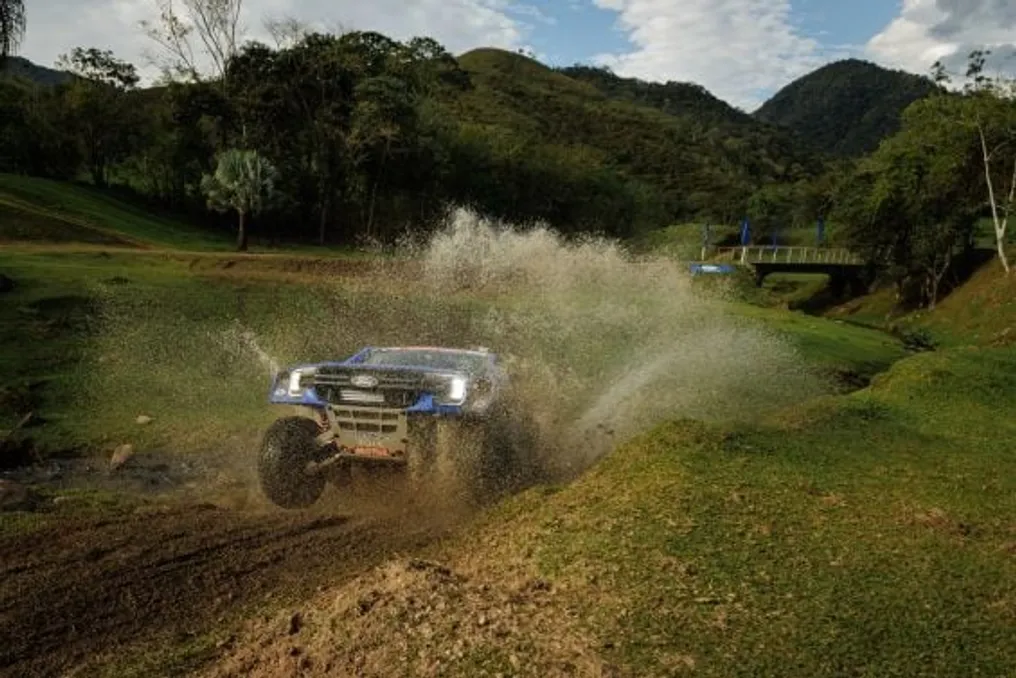
Before starting acceleration, it is essential to learn how to enter the vehicle; before racing, one must accept the discomfort. In the context of rallying, every second gained results from a combination of preparation, sacrifice, and confidence, not just speed.
Getting into a competition pickup differs significantly from getting into a regular car, as there are no running boards, luxurious finishes, or excess space. The seat is bordered by steel bars, the body is held by the harness, the helmet restricts movement, and the engine fills the environment with an intense noise that prevents any conversation.
In this extreme scenario, drivers and navigators spend long hours inside machines designed to cover thousands of kilometers off-road, facing challenging speeds even on asphalt, where grip and visibility are total.
Contact with the Ford Ranger T1 and Ranger T1+ models from the Sizmic team took place in São Paulo. These vehicles were developed by Neil Woolridge Motorsports (NWM), a partner of Ford in South Africa, retaining only the visual identity of the production Ranger, while the rest was completely adapted for competition.
The T1 version is equipped with the Ford V8 5.0 engine, similar to the one used in the Mustang, generating 385 hp and 57.6 kgfm of torque, distributed to all four wheels through a six-speed Sadev sequential gearbox and permanent 4x4 system. The suspension uses BOS double dampers, and the brakes are Brembo, with an air system in the front and water in the rear. The body is a composition of fiberglass, carbon, and Kevlar, resulting in a pickup capable of reaching 185 km/h and accelerating from 0 to 100 km/h in 7.1 seconds.
The T1+ shares the base but replaces the V8 with a 3.5 EcoBoost twin-turbo V6, which delivers 390 hp and 57.1 kgfm. The Sadev transmission, permanent 4x4 traction, BOS dampers, and Brembo brakes are maintained. In this version, the body is entirely made of carbon fiber, complemented by larger tires and wheel sizes, in addition to new aerodynamic components. This reduces the 0 to 100 km/h time to 6.5 seconds, with a top speed of 170 km/h.
Although the numbers are remarkable, they do not capture the reality of being inside these machines. To optimize weight, all non-essential items for competition were removed, eliminating any possibility of comfort or silence.
Access to the vehicle requires stepping onto the spare tire located under the cockpit, followed by a contortionist maneuver to pass through the roll cage, made difficult by the use of a helmet and neck protector. If the passenger exceeds the ideal weight, the task becomes even more arduous, especially for the team assistants who need to accommodate a bulky body in a seat sized for the navigator.
Once seated, the body is fixed by a five-point harness, drastically limiting the freedom of movement for both driver and navigator. Communication occurs exclusively through the helmet audio system, but the noise from the Ranger T1's V8 transforms the cockpit into an acoustic box. In the T1+, the twin-turbo V6 generates a shrill sound, comparable to that of a Mad Max Interceptor.
Instead of comfort panels or multimedia centers, there are specific competition instruments, such as speedometer, tachometer, stopwatch, and digital spreadsheet. Managing this equipment under bumps, high speed, and centrifugal force is described as a torturous experience.
The navigator's role goes beyond driving; they are responsible for translating route information into commands for the driver, indicating curve intensity, alerting about obstacles, and predicting terrain changes. There is no room for hesitation.
In rally raid races, the driver and navigator do not have prior knowledge of every meter of the route like in conventional tracks. They rely on trust in the received information and the ability to react to constantly changing terrain. An unexpected obstacle, a deeper ditch, a change in sand consistency, or a sudden loss of grip requires the car to keep moving forward.
In the Sizmic team, Bia Figueiredo drives the Ranger T1 with Marcos Baumgart, having Beco Andreotti as navigator. The T1 Plus features Marcos Baumgart as driver and Kleber Cincea as navigator. In recent competitions, the T1 won the Jalapão Rally 2026 with 11h11min07s69 on a course exceeding 1,300 km. The T1 Plus participated in the Sertões Rally 2026, a race of about 4,000 km, completing it in 54h40min15s16.
The author reports that getting into the T1+ was almost impossible due to the size of the body and the minimal access space, although he managed it in the T1 after considerable physical effort. After securing himself firmly, the focus was simply on getting out of the vehicle.
When accelerating the Ranger T1, the sound of the V8 dominates the cockpit, pressing the body against the seat as the landscape rushes by. The instruction given is simply: 'forget navigation, let's just have fun,' although this fun is only a brief moment inside the car.
Behind this lies an extensive routine preceding the start, including training, physical preparation, technical knowledge, study, experience, equipment development and maintenance, planning, and crucially, mutual trust between the two individuals who make decisions at high speed.
The author concludes that no rally experience is repeated, unlike a track, because each passage alters the terrain—tires dig, rocks are exposed, ditches appear, and grip changes. Thus, speed is not just accelerating; it is knowing how to brake, interpreting the terrain, trusting the navigator, knowing the car, enduring prolonged impacts, and maintaining concentration despite physical fatigue.