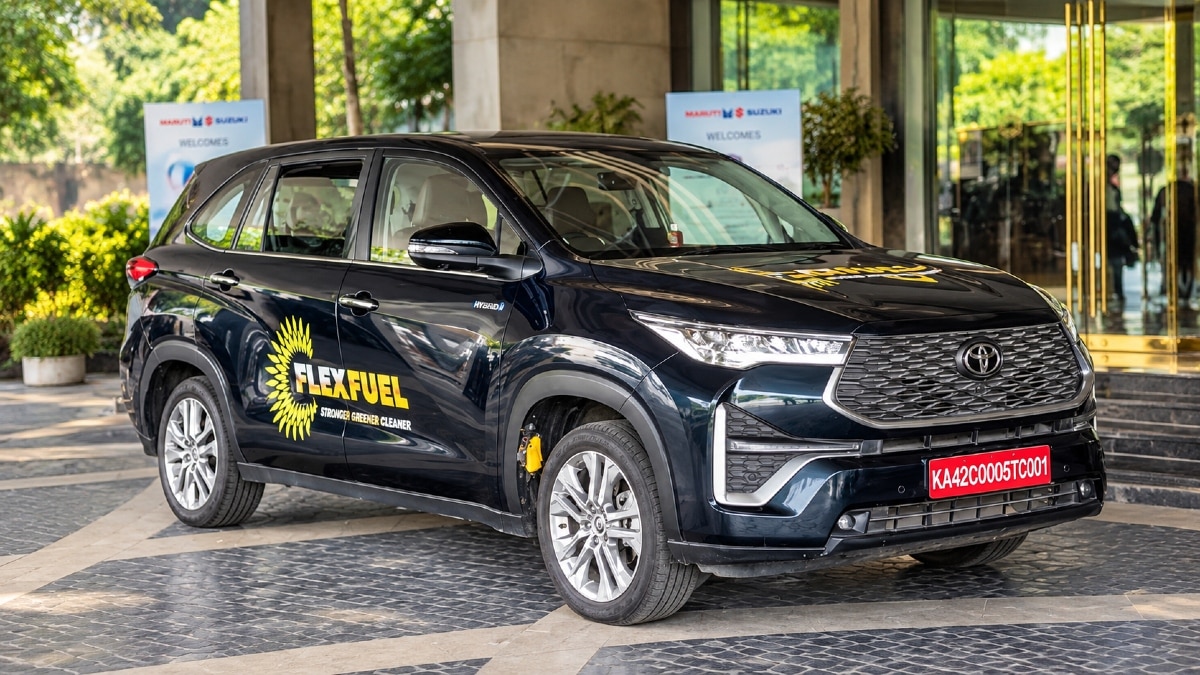
According to the transport minister's statement, Toyota is preparing to launch the Innova HyCross model, capable of running on 100% ethanol and utilizing hybrid technology with an electric motor. Nitin Gadkari, the Union Minister of Road Transport and Highways, announced that this vehicle is planned for release in October.
Gadkari asserted that the operating costs of this vehicle could be comparable to gasoline consumption at a price of around 25 rupees per liter. However, it is important to understand that this figure is only an approximate estimate of operating costs, not the actual price of ethanol.
During an event in Delhi, Nitin Gadkari mentioned that he was invited to the presentation of Toyota's new Innova Flex-Fuel model, which will operate on pure ethanol, eliminating the need for gasoline. However, the official launch date from Toyota has not yet been announced.
The minister also made a statement regarding operating costs, suggesting they might be equivalent to those of a gasoline car at a price of 25 rupees per liter. He emphasized that this comparison pertains only to fuel consumption over a certain distance, not the market price of ethanol.
Gadkari has not provided detailed calculations substantiating the claim of 25 rupees per liter in fuel costs, so this figure should be viewed as a preliminary statement. In simpler terms, he believes this ethanol-hybrid Toyota vehicle can cover the same distance as a regular gasoline car but with significantly lower fuel expenses.
The main advantage lies in the combination of an ethanol engine with a complex hybrid system. Since the energy density of ethanol is lower than that of gasoline, more ethanol may be required to cover the same distance. Toyota addressed this by integrating an electric motor, allowing the vehicle to operate in electric mode in several situations.
Previously, in August 2023, Toyota demonstrated a prototype of the Innova HyCross equipped with electrified fuel and a hybrid powertrain. The company stated then that this vehicle is capable of running on a fuel mixture with an ethanol content higher than E20. Toyota clarified that before bringing this technology to the market, calibration, homologation, and certification procedures must be completed. It is assumed that most of these processes are finished, and the company is preparing to present the production version.
The key feature of the vehicle is not only its ability to run on 100% ethanol but also its power hybrid system. Here, the Flex-Fuel engine interacts with the electric motor and a small battery. The prototype used a battery capacity of about 1.3–1.5 kWh, which is significantly smaller than the large batteries used in fully electric vehicles. This allows for electric power provision without the need for a large and heavy battery.
The hybrid system distributes the load between the engine and the electric motor depending on the needs. At low speeds or under certain driving conditions, the vehicle moves using the electric motor, and the ethanol engine engages when necessary. This helps not only increase the use of ethanol instead of gasoline but also improve fuel efficiency.
Nitin Gadkari also stated that the Innova HyCross Flex-Fuel would generate 60% of the electricity during movement. However, this statement should not be interpreted as the vehicle generating 60% of its total consumed energy itself. It means the vehicle can function in electric mode to a significant extent. The existing Innova HighCross can also operate in EV mode for about 60% of the time and cover approximately 40% of the distance in electric mode under certain test conditions.
At such times, the vehicle's engine shuts down, and movement is achieved via the electric motor. Thus, the 60% figure mainly reflects the duration of the vehicle's operation in electric mode during a driving cycle, rather than it generating 60% of the required energy independently.
If Toyota launches this technology in October, it will be a significant step towards implementing hybrid and flexible fuel technologies in India. It is important to note that the vehicle will be able to run on 100% ethanol while still using an electric motor. Nevertheless, information regarding the vehicle's price, actual fuel consumption, fuel economy on 100% ethanol, and the actual calculation of operating costs at 25 rupees per liter has not yet been provided, and the full picture will become clear after the launch.