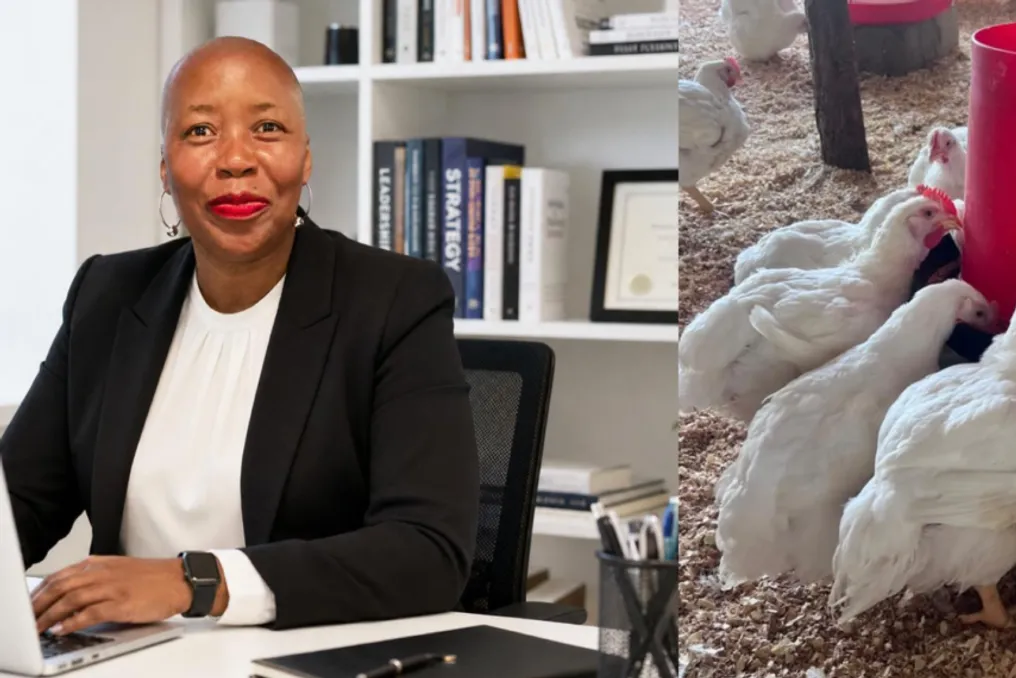
Jennifer Gazide, a former teacher and real estate specialist, established a thriving poultry enterprise in Mpumalanga using her savings and a small plot of land, a result of her rural roots.
Gazide was born and raised in Roll Village, Bushbuckridge, Mpumalanga, where she was surrounded by agricultural activities from childhood. Her initial education took place at Florafof Lower Primary School and Visani High Primary School, after which she graduated from Godide High School, receiving her certificate in 1987.
Although her early adult life was primarily tied to formal employment, the connection to the land remained strong. Her mother, Betty Gazide, practiced crop farming on the family land, instilling in her an early understanding of agriculture as a way of life.
Gazide's career initially led her into the field of education. After receiving her certificate, she completed a diploma in junior primary teaching at Hoxani College and began teaching in 1992 at Nanjji and Maswameni schools.
Demonstrating a continuous commitment to self-improvement, she continued her studies while working, earning a Bachelor of Arts degree from Unisa, followed by a Bachelor of Education in Special Needs. Her academic pursuits later expanded into real estate development, culminating in a Master's degree in Real Estate from Pretoria University.
In 2001, Gazide joined Stannic as a business consultant, and later moved to the Mpumalanga Economic Growth Agency (MEGA) as a leasing specialist. She recalls: 'Although I spent many years in formal employment, farming was always what I loved and felt connected to because of my rural upbringing and my family's involvement in agriculture.'
The turning point came in 2023, prompted by an opportunity within her own family. Her nephew, Thabo Magvena, managed a small poultry farm in the backyard, but circumstances prevented him from continuing the work. Realizing that the established customer base still needed fresh poultry meat, Gazide decided to take over the project to preserve and expand it.
She explains: 'I saw an opportunity to continue what he started and turn it into something bigger.' Starting her own poultry business allowed her to reconnect with what she loved and begin a new chapter in her life.
To formally establish her enterprise, she registered Jen Ronior Associates in 2023, launching operations on a one-hectare family plot using personal savings instead of waiting for external loans. Another nephew, Vizeman Gazide, helped her build housing for the first batch, and Gazide seeded the farm with 100 broilers and 500 layers. Transitioning from corporate routines to practical farm management, she quickly mastered critical on-site operational aspects—from feeding schedules, heat stress, and disease risks to mortality rates and daily farm accounting.
Gazide notes: 'Starting with personal resources was not easy, but it also taught me an important lesson: sometimes you have to start with what you have, not wait until everything is perfect.'
Through continuous reinvestment, Jen Ronior Associates has expanded beyond the initial area. Today, the farm supports a continuous cycle of 200 broilers and approximately 360 layers in a modernized housing system. To complement the livestock, Gazide diversified into small-scale gardening, growing onions, cabbage, parsley, lettuce, tomatoes, and habaneros.
A small, dedicated team assists with daily operations. Assistant Nkululeko Mkhlongo handles routine tasks. Her high school-aged nephew, Khulani Sibuyi, helps after school and on weekends with maintenance. For Gazide, the nephew's involvement serves a dual purpose: practical support and structured succession planning. 'I want him to gain practical knowledge and experience so he understands the business and the opportunities that agriculture can create.'
Working in the Mpumalanga countryside comes with specific challenges, notably rising resource costs and weather instability. Sharp increases in poultry feed prices directly reduce profits, while intense heatwaves cause stress to laying hens. Managing these weather fluctuations, alongside disease risks and capital limitations for infrastructure modernization, requires constant operational adaptation.
She reflects: 'The transition from a formal professional career to agriculture required me to learn a completely different way of doing business.' 'Poultry farming taught me resilience, patience, discipline, and the importance of understanding my financial metrics.'
Despite operational hurdles, Jen Ronior Associates has established a solid commercial base in the Bushbuckridge area. The enterprise supplies fresh eggs and meat directly to local households, spaza shops, catering companies, and kindergartens. While expansion into commercial retail chains remains a long-term goal, Gazide values its local customer base for providing a stable and immediate market that strengthens community relations.
Looking ahead, Gazide has developed an ambitious five-year growth strategy. Her main objective is to increase poultry production to approximately 40,000 layers, expand broiler capacity, upgrade infrastructure, and implement climate-resilient farming methods. She states: 'I want to build a business that is commercially sustainable, provides livelihoods, and demonstrates that rural agriculture can be a viable business if approached professionally.'