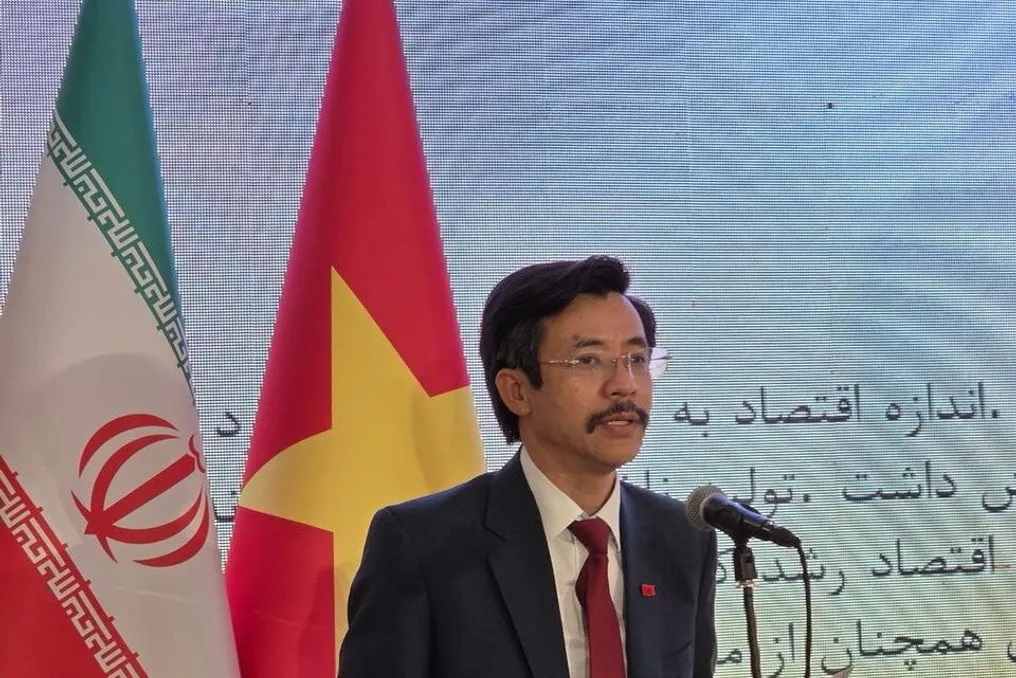
On the evening of September 27, the Embassy of Vietnam in Iran organized an event to foster business ties between Vietnam and Iran at its embassy in Tehran. The meeting gathered over fifty entrepreneurs working in various sectors.
In his opening remarks, Mr. Sunny, the First Secretary of the Embassy, noted that Vietnam should be viewed not only as a market but also as a strategic platform. He emphasized that Vietnam can serve as a bridge between Iranian companies and ASEAN, while Iran can provide Vietnamese firms with access to its market and a wider region. Vietnam is integrated into global production chains and possesses geographical advantages, connections with ASEAN, and extensive maritime access. Its trade combines manufacturing capacity with competitive agriculture and food processing.
This creates complementarity: goods from Vietnam for Iran, and raw materials, petrochemical products, agricultural products, and other goods from Iran for Vietnam. Since existing bilateral trade is limited relative to potential, the goal of the event is not just to increase volume, but to create new channels, establish direct company contacts, and find practical solutions for logistics, standards, payments, and market access. Agriculture offers immediate opportunities, including coffee, cashew nuts, pistachios, dried fruits, petrochemicals, fertilizers, minerals, and handicrafts.
He proposed conducting a targeted, results-oriented business mission to Vietnam with pre-arranged B2B meetings, sessions with VCCI and the Iranian Embassy, cooperation with the Vietnamese Persian Market, and visits to Cai Lang/Ha Long and Ho Chi Minh ports. He particularly highlighted the importance of regional connectivity, which is as vital as individual markets, calling for the building of practical business bridges.
Next, His Excellency Nguyen Luong Ngoc, the Ambassador of Vietnam to Iran, spoke. He thanked all attendees for participating in the event. The Ambassador expressed satisfaction that many guests already have business ties with Vietnam, have imported or distributed Vietnamese products, or are actively exploring new cooperation opportunities with Vietnamese companies.
Therefore, today he did not just want to present Vietnam's potential. He called on participants to jointly review Vietnam's achievements, current trade between the two countries, and openly discuss existing difficulties and what both sides can do to maintain and further develop business relations.
Speaking about Vietnam's economic development, the Ambassador noted that despite significant volatility in the global economy in recent years, Vietnam has maintained macroeconomic stability and achieved relatively high economic growth. In 2025, Vietnam's GDP grew by 8.02%, reaching approximately $514 billion, which is $38 billion more than in 2024. GDP per capita exceeded $5,000. Growth was observed across all three main economic sectors: industry and construction increased by nearly 9%, and the service sector expanded by more than 8.6%.
International trade remains one of the main strengths of the Vietnamese economy. Total import and export turnover in 2025 amounted to about $930 billion, an 18% increase from the previous year. Vietnam continued to show a trade surplus, marking ten consecutive years of surplus. This is partly due to Vietnam's network of 17 free trade agreements, which grant preferential tariff access to 60 economies, including most major world economies.
Furthermore, in the last year, total registered foreign investment capital in Vietnam reached approximately $38.4 billion, and the number of international visitors was 21.2 million. It is particularly noteworthy that realized foreign direct investment reached approximately $27.6 billion, an increase of 9% compared to the previous year and the highest figure in the last five years. These figures indicate that Vietnam is not only a market for over 100 million people but is also strengthening its position as a manufacturing and export hub, and an important link in regional supply chains. Vietnam aims to become a high-income developed country by 2045, targeting annual economic growth of 10% or higher.
Alongside manufacturing and processing, agriculture and the food industry remain key strengths of Vietnam. Vietnam is one of the world's largest producers and exporters of a wide range of products, including coffee, pepper, cashews, rice, tea, seafood, fruits, and vegetables, as well as processed food products. According to the Ambassador, these are areas where Vietnam and Iran still have significant potential to expand cooperation.
Vietnam and Iran maintain a long-standing traditional friendship, establishing diplomatic relations in 1973 and maintaining good relations in many areas for over half a century. Despite difficulties arising from the regional and international situation, trade between the two countries continues. According to customs statistics, in 2025, the total direct trade turnover between Vietnam and Iran reached approximately $170 million, of which Vietnam's exports to Iran accounted for about $150 million, and imports from Iran were about $20 million.
However, when evaluating these figures, it is necessary to consider an important feature of bilateral trade: customs statistics on direct trade turnover between Vietnam and Iran do not fully reflect the actual scale of transactions and goods flows between the two economies. This is why they believe that the real potential of bilateral trade significantly exceeds what is reflected in official statistics.
Vietnamese goods such as coffee, pepper, cashews, tea, seafood, some food products, and consumer goods are sold in the Iranian market. In return, Vietnam also needs products where Iran is strong, including chemicals, petroleum products, plastics and raw materials, metals, pharmaceuticals, and certain unique Iranian agricultural products.
The Ambassador specifically highlighted coffee among Vietnamese products. Vietnam is the second-largest producer and exporter of coffee in the world and holds a particularly strong position in Robusta production. In addition to green coffee beans, Vietnamese companies are increasingly developing higher value-added products such as roasted and ground coffee, instant coffee, packaged coffee, and private label products for their clients. Given the developed beverage consumption culture in Iran and the growing demand for coffee, he considers this area very promising for building long-term partnerships.
Besides coffee, Vietnamese pepper, cashews, and tea are already present in the Iranian market—products in which Vietnam is among the world leaders in exports—and they have great potential for further growth. It is important not to limit oneself to simple buying and selling of raw materials; both sides can deepen cooperation in processing, roasting, packaging, branding, and developing products tailored to Iranian consumer preferences.
Another important area for bilateral relations is air transport and tourism. Geographical distance has always been a barrier to exchanges between Vietnam and Iran. Therefore, efforts to develop direct flights between the two countries are important not only for tourism but also for trade, investment, and people-to-people exchange. Vietnam is becoming an increasingly well-known tourist destination in Asia, while Iran boasts an ancient civilization, rich cultural heritage, and many unique places that Vietnamese people have yet to explore.
The Ambassador noted that if better and more convenient air connectivity can be strengthened and maintained, the number of tourists, businessmen, and trade delegations traveling in both directions will significantly increase. When people can meet more often, opportunities for developing trade and investment will inevitably grow.
Recognizing these opportunities, it is necessary to honestly admit that trade between Vietnam and Iran faces a number of challenges. The first is payments. The lack of direct banking payment channels remains one of the biggest obstacles, making many transactions more complex, costly, and risky.
The second problem is transportation and logistics. Significant geographical distance combined with recent changes in the region has seriously affected delivery routes, shipping schedules, timelines, and logistical costs, which directly impacts product competitiveness.
The third is procedures and technical requirements for goods, especially agricultural and food products. Businesses on both sides need clearer information on standards, quarantine and sanitary requirements, product registration, labeling, and import procedures to avoid additional costs and delays after goods arrive at the port.
The fourth is commercial risks and vetting business partners. When deals encounter difficulties related to payment and transportation, choosing the right partners, clearly defining responsibilities in contracts, and maintaining direct communication between buyers and sellers become even more important.
In the Ambassador's opinion, these issues cannot be solved by a single meeting or trade promotion event. However, they can be addressed in stages if enterprises and relevant authorities of both countries work together practically and effectively. The Embassy of Vietnam in Iran intends to focus on several specific areas. Firstly, it will continue to connect businesses from the two countries that have genuine commercial needs, especially in coffee, tea, pepper, cashews, food products, and other agricultural goods. Secondly, the embassy is ready to assist Iranian companies in identifying and vetting suitable suppliers in Vietnam, and to support Vietnamese companies in finding capable partners in Iran. Thirdly, both sides should facilitate the exchange of information on import regulations, quarantine requirements, quality standards, logistics, and payment methods so that businesses can fully assess potential risks before signing contracts. For goods with established trade flows, such as coffee, pepper, cashews, and tea, the plan is to gradually transition from individual deals to stable and long-term relationships, while encouraging cooperation in processing, packaging, and branding in the Iranian market. Furthermore, Vietnam presents a promising destination for direct investment by Iranian enterprises aiming to produce goods for export to the markets of 60 economies. The Vietnamese government welcomes foreign investors and strives to create favorable conditions for their investment and business.