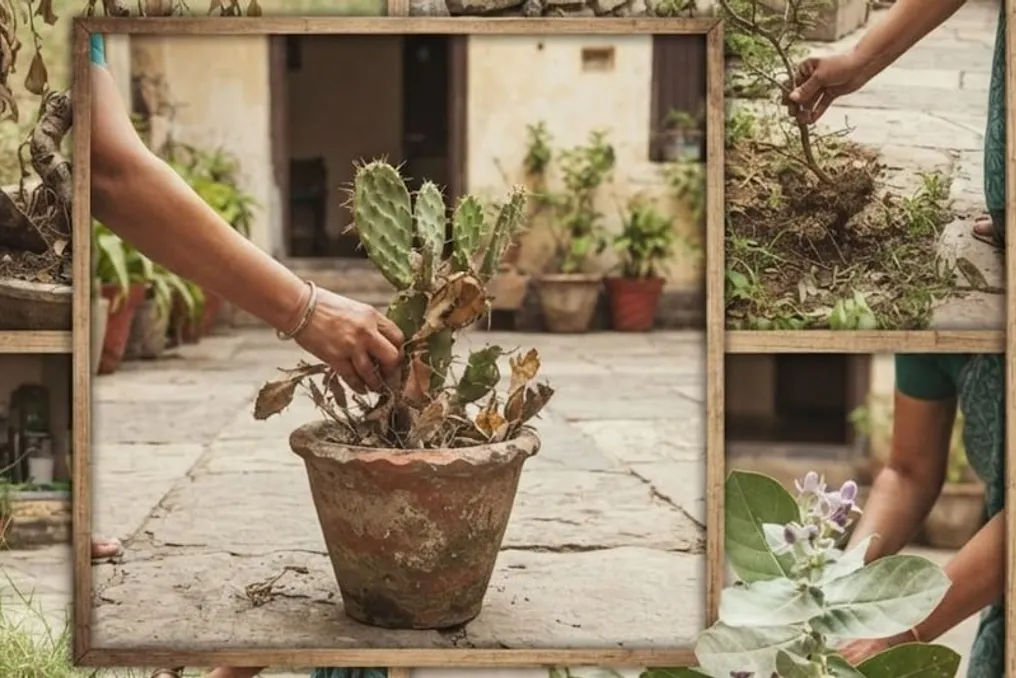
People often use various plants to decorate their homes and give them a green appearance. However, in Vastu Shastra, not all plants are considered favorable for living spaces. There are beliefs suggesting that placing certain types of plants inside the house or in inappropriate locations can cause negative effects. Vastu pays particular attention to caution when dealing with thorny, dry, and some specific plants.
There are concepts linking certain plants to well-being, financial status, and progress within the home. The following discusses types of plants that should be avoided in a residence, as well as advice on what to consider if such plants are already present in the home.
According to Vastu principles, keeping cacti, नागफानी cacti, or any other thorny plants inside the house is not considered auspicious. According to folklore, they may contribute to increased tension and disagreements among family members. If such plants are used for decoration, it is advised to place them outside, rather than in the bedroom or living room. It is important to remember proper care and protection of the plants, especially if there are small children or pets in the house.
The ash tree holds great religious significance, but some Vastu beliefs warn against placing it indoors. It is believed that having an ash tree in the house can lead to increased financial difficulties. If an ash plant sprouts on a wall or in a corner of the house, it should not be ignored. From a practical standpoint, the roots of trees growing in walls can damage the structure, so it is better to use a safe and appropriate method for its removal.
Regular care is necessary after planting. Within Vastu, dry and dead plants are not considered auspicious. Such plants are associated with stagnation and negativity. Therefore, if a plant located on a balcony, by a window, or in any corner of the house has completely dried up and has no chance of recovery, it should be removed. Only healthy and lush plants should serve as decorative elements of the home.
The Mehendi plant is known for its aroma and beautiful leaves. Nevertheless, some Vastu beliefs advise against placing it indoors. In the original text, Mehendi is associated with negative energy. Although these beliefs lack scientific confirmation, if a person adheres to Vastu rules, they might choose to place the plant in an open area instead of inside the house.
Bonsai is currently very popular in interior design. Due to its small size, it is easy to place on a table, balcony, or in the living room. However, according to Vastu beliefs, keeping bonsai is associated with obstacles to progress. In Vastu, its small and limited size is seen as a symbol of stalled development. On the other hand, there are also positive views on bonsai, and many people keep it purely as a decorative plant.
It is important to pay attention not only to the choice of plant but also to its placement and care. According to Vastu, it is preferable to have green and healthy plants in the house. Plants should be placed in areas where they receive sufficient light and air, appropriate to their type. Before planting plants indoors, one must check whether their roots might damage the walls, floor, or pipes. Dry leaves and fallen parts must be cleaned regularly. In Vastu, some plants, such as Tulsi, Snake Plant, Bamboo, and White Aparajita, are considered auspicious because in various beliefs, they are associated with positivity, prosperity, or good luck. Separate Vastu rules also exist for these plants regarding direction.