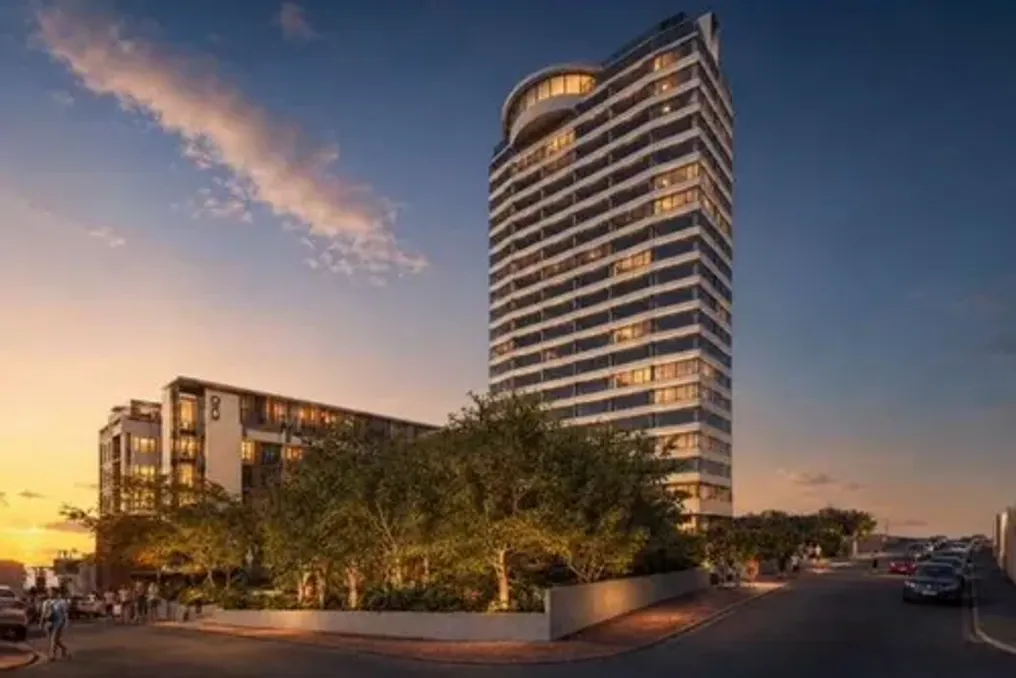
The abandoned Ritz hotel in Cape Town, which for a long time stood as a symbol of the city's former glamour, is now on the threshold of significant changes thanks to an ambitious reconstruction plan. Previously, the hotel's restaurant was frozen in time, and the rooms were deemed unfit for use.
According to an exclusive report by The National, informed sources claim that internal work may have begun despite no visible changes from the street. Specifically, plans were submitted to the City of Cape Town Administration that envision the revival of the hotel, the construction of 44 residential apartments, as well as the creation of restaurants and wellness areas.
The City Administration officially announced the acceptance of applications on September 18, opening a period for public comments until November 2. The application was submitted on behalf of OKU Cape Town and requires permission to change the zoning of part of the site, legalize the existing 75-meter tower, create an easement for a substation, and approve development and landscape design plans.
It is important to note that this is not yet final approval for the Ritz redevelopment; the City must still assess the application and consider public feedback. Nevertheless, these plans provide the clearest picture of the new owner's intentions after many years of uncertainty.
The existing 25-story hotel tower will be preserved. Major changes will concern the interior space: the hotel rooms will remain on the ninth to twenty-second floors, while floors four to eight will be converted into residential apartments. The upper part of the tower will retain restaurant facilities on the 23rd and 24th floors, maintaining the Ritz's renown with panoramic views of the Atlantic coast.
The project also includes a new facade, which must comply with fire safety and structural integrity requirements, as well as new railings and building screening. At ground level, it is proposed to expand the pool, gym, and spa center, and to add a covered yoga area and a larger arrival area and parade ground. The existing parking structure along Grimsby Road will remain unchanged.
The larger complex will include 44 residential units. Additionally, a multi-functional building facing Main Road is planned, which will house retail space, the hotel lobby and lounge, coworking and conference rooms, as well as apartments, hotel rooms, a pool terrace, bar, and restaurant.
The planning documents contain an interesting question: why does the City now need to approve a new land use application for a hotel that has stood on this site for decades? The answer partly lies in the complex planning history of the property. The site is divided into two zones: GB5 covers the area of the multi-functional building along Main Road, and GR4 covers most of the territory where the hotel tower is located.
The issue is that the hotel's use is not the primary permitted use in the GR4 zone according to the current scheme, and the existing 75-meter tower exceeds the permissible height for that zoning. The City could not find previous records of the hotel's use and height in its archives. However, the applicant argues that the hotel's use may never have required a separate planning permit.
Under the old Cape Town zoning scheme, effective before the Municipal Planning By-law of 2015, 'residential buildings' were automatically permitted in the corresponding general residential zone, and the definition of a residential building included a hotel. Thus, the application assumes that the hotel's use was legal at the time of the Ritz's construction.
The height issue is more complex. The document classifies the Ritz as a group of high-rise buildings constructed under old schemes that now exceed the limits of current zoning. The applicant considers it reasonable to assume that the height was authorized at the time of construction, even if the City could not find such a permit in its records. The application does not claim that the tower was built without permission.
The applicant also puts forward an unusual argument: they suggest that when the new planning system came into effect in 2015, the property could have been registered as General Business 7 (GB7). This zone would allow the hotel to be accounted for as a primary use and would approximate the existing tower height, although a technical deviation in height would still be required. The applicant interprets that the failure to register the property as GB7 might have been intentional to allow the City to use the Site Development Plan to restrict other parameters during future hotel reconstruction.
Thus, the current application aims to resolve the planning situation within the Ritz revival, including a request to increase the height by 75 meters above the 60-meter limit within the proposed GB7 zoning. It also requests permission for four existing road intersections along Grimsby Road (with permission for two) and a site division to create an easement for a substation.
Ritz was completed in 1972, meaning it is just under 60 years old. Although the reconstruction application falls under the scope of the National Heritage Resources Act, the City of Cape Town Administration classified the building as 'Not of heritage value'. Consequently, despite being one of the most famous landmarks of Sea Point, the reconstruction application does not require additional heritage protection permits applicable to protected or valuable sites.
Ritz was once one of Sea Point's iconic locations. Its revolving restaurant, Top of the Ritz, attracted Cape Town visitors with stunning views of the Atlantic coast. The hotel also played a role in Cape Town's political and cultural history: Nelson Mandela stayed at the Ritz after his release from prison in 1990, Victor Verster.
During a visit to the building by photographer Armand Howe and writer in 2025, the contrast between past and present was evident. The building lacked electricity and working elevators, staircases and windows were broken, there was water damage and discarded furniture. Almost every floor had access prohibition warnings. Nevertheless, through the decay, elements that made the building special were visible: marble, gold detailing, dramatic bathrooms, a poolside terrace, and at the top, still an impressive revolving restaurant with panoramic views.
New owner, new concept. The property was acquired by OKU Cape Town in 2025 for 368 million rand. OKU Hotels, an international group of luxury hotels, described Ritz as its first urban hotel in Africa. CEO Piers Bradley stated that the company intends to 'restore this iconic property with care and creativity', bringing the OKU design-based hospitality concept to Cape Town.
Now Sea Point has a voice. The planning application marks an important turning point in the history of Ritz, as the next phase is no longer entirely dependent on the developer. The City has officially opened the proposal for public discussion, and residents, businesses, and other interested parties can submit their comments until November 2. The planning process may lead to changes in the proposal, objections, or the imposition of conditions before any reconstruction begins.