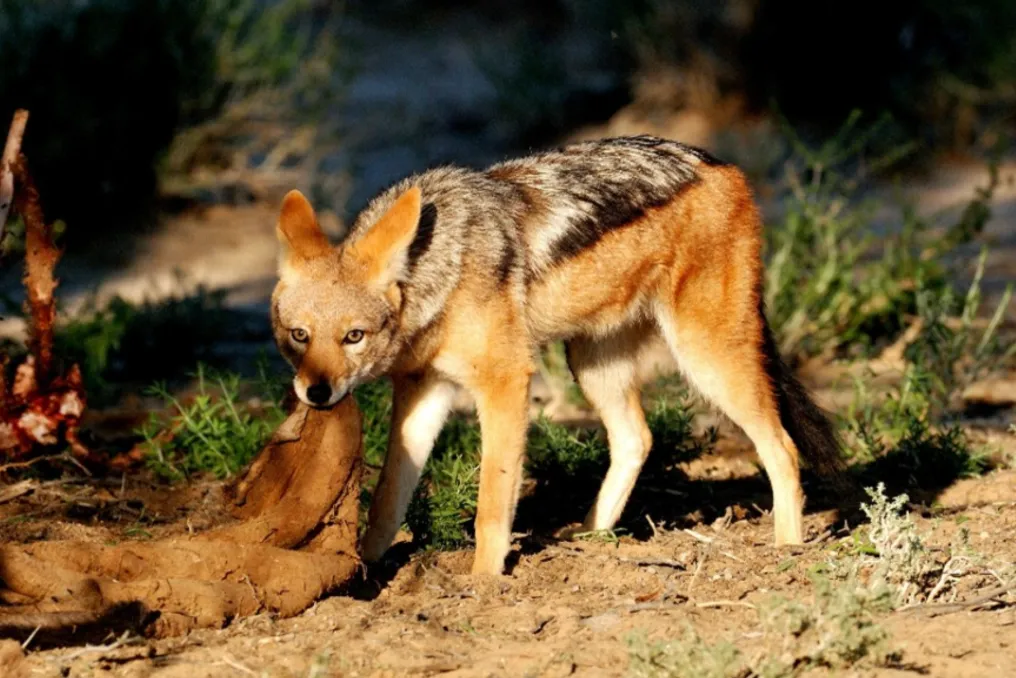
Black-backed jackals are becoming a serious problem for small farmers and emerging farms in South Africa, as these opportunistic predators damage sheep flocks, reports Cape Town Etc. The losses are not only financial but also cause significant emotional and psychological burdens on people whose livelihoods depend on livestock.
Traditional methods of combating this growing threat have proven ineffective. Megan le Roux, a postgraduate student at Stellenbosch University (SU) in the Digital Signal Processing Laboratory, notes that 'black-backed jackal predation presents a complex problem for farmers, and there are few obvious solutions.'
Even standard tactics, such as 'calling and shooting at night,' which use recorded sounds of jackals and prey distress to attract animals, have yielded disappointing results. The situation is exacerbated by ecologists' concerns regarding lethal control, as they believe it disrupts the complex social structure of jackals and could unintentionally lead to an increase in predatory attacks.
Due to a decrease in natural enemies and significant habitat loss, populations of black-backed jackals have increased in areas where livestock farming is widespread. In response to this escalating problem, Le Roux developed an innovative biotelemetry system as part of her master's thesis in electronic engineering at SU.
This innovative system aims to provide farmers, ecologists, and research biologists with critical information about jackal behavior through remote monitoring of their activity. The system combines video recording capabilities with environmental sensors to collect extensive data on the elusive creatures and their hunting patterns. A network of wireless sensor nodes, strategically placed on both rural and equestrian farms, records video footage while tracking environmental conditions.
Le Roux explains that 'each node is equipped with cameras capable of operating in low light conditions, which is crucial since jackals are predominantly nocturnal. This allows for comprehensive recording upon detecting movement.'