When building a home, people pay close attention to choosing wall colors, furniture, suspended ceilings, and lighting, but they often overlook a small area—the unfilled joint between the wall and the ceiling. Although this may seem like an insignificant element, installing crown molding in this area can significantly enhance the aesthetic appeal of the entire room. It is important to note that crown molding serves not only a decorative purpose but also masks the connection between the wall and the ceiling.
You may have noticed that in some rooms everything looks very neat and stylish. The furniture might be simple, and there might not be any special patterns on the walls, yet the room still seems attractive. The reason for this might be the crown molding installed at the junction of the wall and ceiling. With proper design and lighting, it can give the room a completely new look.
Crown molding is a decorative strip or molding that is attached where the wall and ceiling meet. Its main function is to cover the seam between the two surfaces and give the room a more high-quality appearance. Usually, where the wall and ceiling meet, a straight and rigid angle is formed. Crown molding hides this angle, making it more elegant and tidy. This is why in modern homes, crown molding is used not only for decoration but also to give the room a finished and orderly look.
The choice of crown molding design depends on the architecture of the room and the height of the ceiling. In small spaces, light and simple designs look better, whereas in large rooms, more protruding or richly decorated moldings can be used.
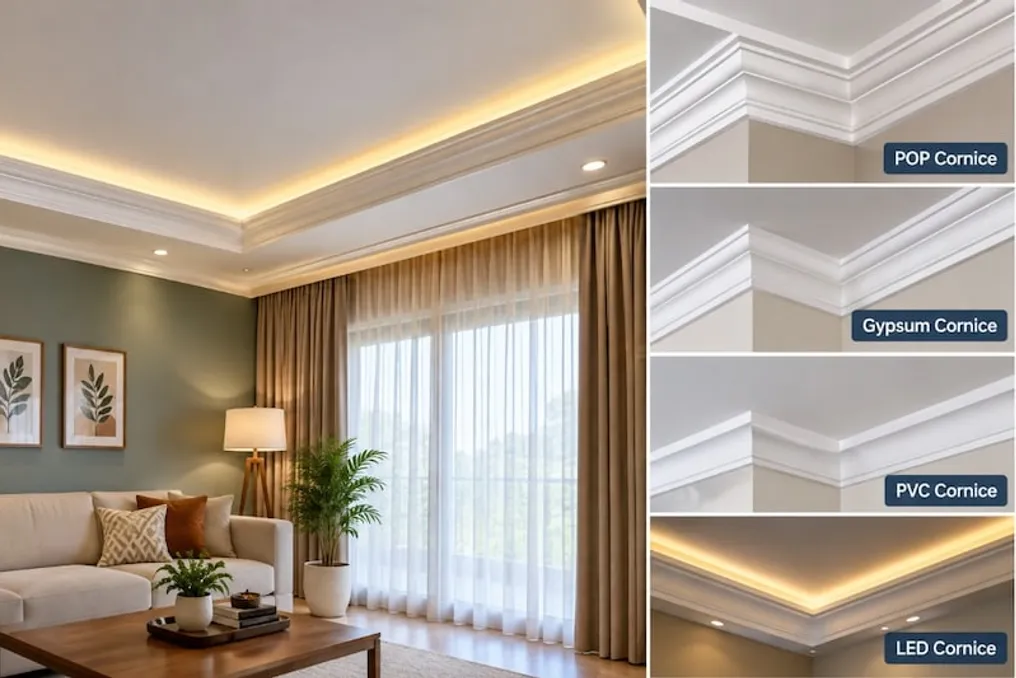
Many materials are used to make crown moldings, the main ones being POP, gypsum, and PVC. Each material has its own features, and the choice depends on the design, budget, and specific needs. POP (plaster of Paris) moldings allow for the creation of desired shapes and designs. If you want to install crown molding with fine carving or a custom design in your home, this can be a suitable option.
Gypsum moldings are used to create clean and modern designs. They can be used in homes where an attractive look is required while maintaining simplicity. And if the budget is limited, and the goal is to beautifully finish the wall-ceiling joint, PVC moldings should be considered. They offer a decorative option at low cost.
Crown molding and molding are often confused, but there are differences between them. Molding is a broad category of decorative strips and profiles. It includes various types of strips used in different parts of the house. While crown molding is a type of molding specifically installed at the junction of the wall and ceiling. Although baseboards, which are attached near doorways and the floor, are also examples of molding, they are used in different places.
Today, the use of crown molding in homes is not limited to just masking the joint between the wall and ceiling. Adding LED lighting to the crown molding allows the room to become more attractive. When an LED is embedded in the crown molding, the light is diffused on the ceiling or wall rather than shining directly into the eyes. This creates a soft and comfortable lighting atmosphere in the room. This is especially noticeable at night, when such lighting gives the room a special look. In Indian homes, crown molding with LED lighting can be a useful solution, as it serves both as decoration and lighting. However, for this, you need to decide on the crown molding design and the location of the light in advance.