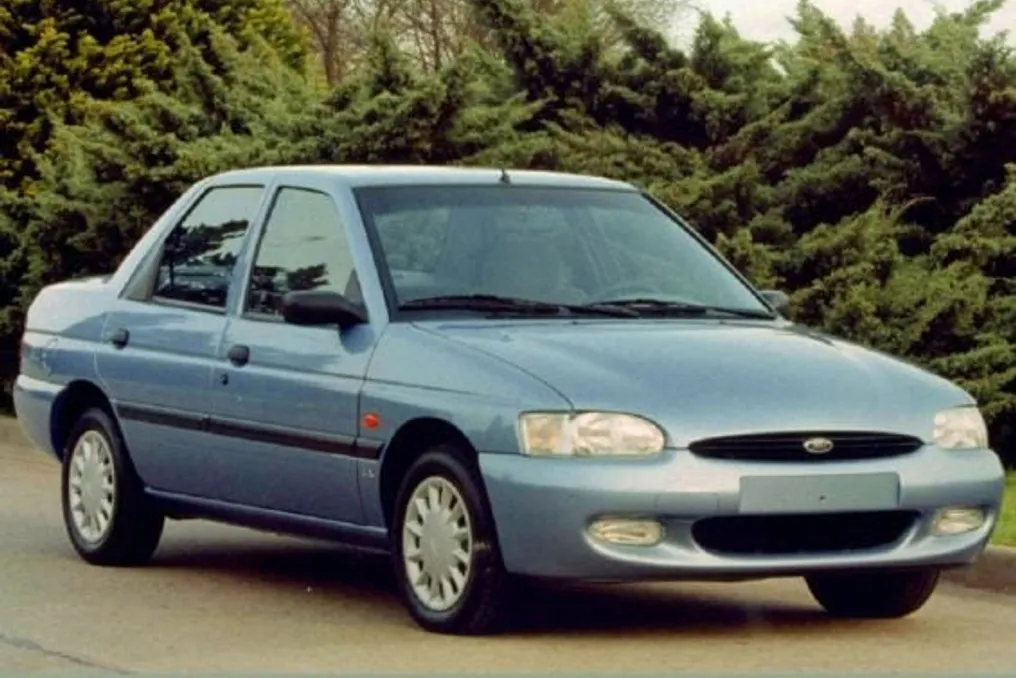
The Ford Verona, the first sedan derived from the Escort family introduced in Brazil in 1989 during the Autolatina period—the union between Ford and Volkswagen—had merits but did not reach the level of mid-size sedans of the 1990s. Although it shared almost all its mechanical base with the Escort, it gained its own name and identity in the market. Verona production continued until 1996, when it was discontinued along with the end of the partnership between the two manufacturers.
Curiously, the end of Verona production coincided with the resurgence of its original identity. After the closure of Autolatina, Ford resumed its autonomous path and, at the end of 1996 and beginning of 1997, launched the new national generation of the Escort. At this time, the old Verona came to be simply called the Escort Sedan, standardizing the nomenclature used in other markets.
This new Escort line included hatchback, SW wagon, and sedan versions. The model featured a renewed design, inspired by contemporary European Escorts, and utilized mechanics entirely developed by Ford. Under the hood was the 115 hp Zetec 1.8 16V engine, imported from England, paired with a five-speed manual transmission also created by the brand. This setup was considered modern and sophisticated, placing the Escort in a competitive position in the Brazilian automotive scene.
Although the new look was well received, especially the hatchback version, which maintained buyer preference, the wagon also had a loyal following, particularly among families who valued that body style. However, the Escort Sedan failed to replicate the success expected by Ford, despite possessing good technical qualities and a satisfactory level of finish.
The main obstacle was the transformation of the market. The Ford sedan faced extremely strong competitors in the segment it aimed to occupy. Among these rivals were the Volkswagen Polo Classic, which came from Argentina with a good reputation, and the entry-level versions of the Chevrolet Vectra, a larger vehicle highly appreciated by the Brazilian consumer. Often, customers willing to invest a little more opted for the GM sedan.
Recognizing the model's positioning difficulty, Ford introduced, at the end of 1999, already in the 2000 line, a variant equipped with the 95 hp Rocam 1.6 8V engine. The goal of this change was to lower the initial price and increase the competitiveness of the Escort Sedan. The model continued to offer an important differential: a vast trunk capacity of 459 liters, in addition to adequate interior space for the family. Nevertheless, sales never reached the projected growth.
In practice, the introduction of the 1.6 version helped pave the way for the launch of the Focus in Brazil. In Europe, the new model had already replaced the Escort, and the same strategy would be adopted in the country. Besides competing with established adversaries, the Escort Sedan began to compete for space within the dealership itself with a more contemporary and current project, which quickly gained consumer preference.
Ford also tried to target the 1.6 versions towards fleet operators and taxi drivers, emphasizing benefits such as low maintenance cost, fuel economy, and good interior space. Nonetheless, the model continued to register modest results and never achieved the sales volume predicted by the manufacturer. In 2003, it was permanently discontinued, ending a trajectory full of unfulfilled expectations.
Over the years, the Escort Sedan also accumulated frequent complaints. Owners reported premature wear of the front suspension components, which frequently emitted noises on Brazilian roads. Electrical problems were also relatively common in the most used cars, especially those with wear on the wiring harness and electrical connectors. In versions equipped with the Zetec engine, many owners mentioned failures in the cooling system, which, if ignored, could lead to overheating and head gasket damage.
Considering the strong competition, the arrival of the Focus, and the issues that tarnished its image in the used car market, the Escort Sedan concluded its useful life without leaving a significant legacy. Although it was a technically capable and modern car for its time, it never managed to persuade the Brazilian buyer that it represented the best alternative among the mid-size sedans available in the market.