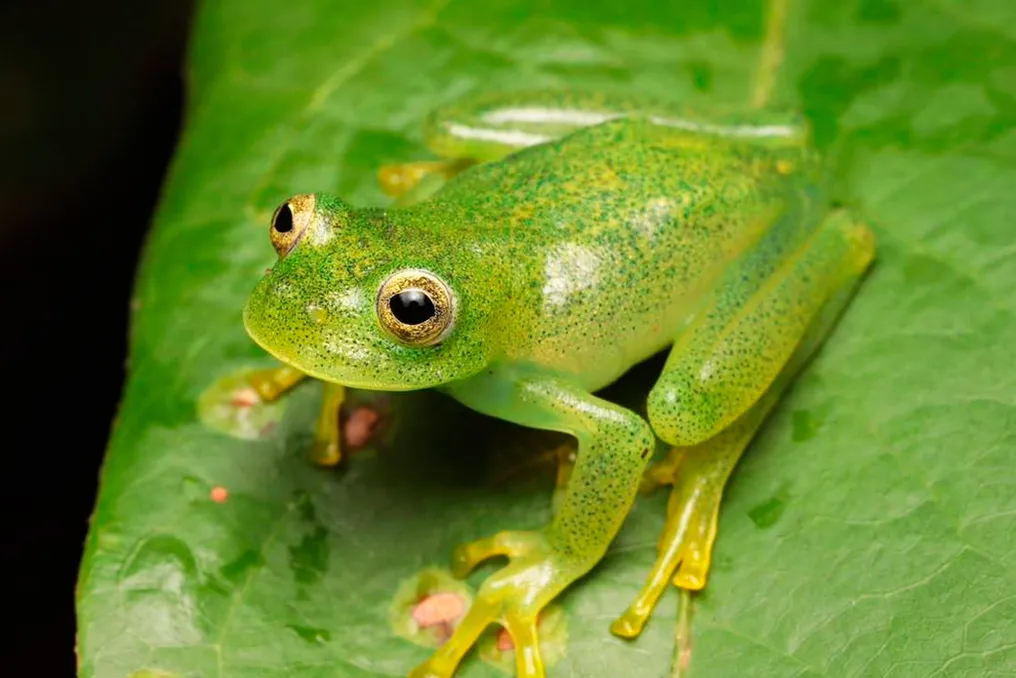
A new species of glass frog, named Vitreorana micaelae, was described after being discovered in Goiás, Brazil. This scientific finding resulted from the joint efforts of researchers from the Catholic University of Goiás (PUC-GO), the Federal University of Goiás (UFG), and the University of Brasília (UnB).
The small, greenish, and nearly transparent frog attracted the attention of a group of scientists led by biologist William Vaz-Silva in forest strips bordering small streams fed by the Corumbá River, within the Cerrado biome. Despite its external resemblance to already known species, the group decided to conduct further research.
Analysis and characteristics of the new species
One of the study's authors, Reuber Brandão, a member of the Grupo Boticário Foundation's Nature Conservation Expert Network, noted that after discovering the animals and recording their calls, they began assessing and comparing them with other glass frog species, as these species are generally more common in the Atlantic Forest and the Amazon.
Through the integrated work of various fields of knowledge—morphology, bioacoustics, molecular genetics, and field studies—scientists concluded that this is the 11th species of the glass frog genus; only four species of this genus are found in Brazil, and this one is the second exclusively found in the Cerrado.
According to Brandão, besides having different molecular material compared to already known species, unique traits were identified in the analyzed individuals. He explained that from a bioacoustic perspective, this animal emits significantly fewer notes in its song and also has subtle but consistent differences in iris shape, dorsal pigmentation, and morphology, especially in the area near the cloaca (the final opening for excretion and reproduction).
Researchers note that the lack of deep knowledge about this species, even among the local population, is due to the lifestyle of Vitreorana micaelae. As Brandão reported, 'this animal sings high up in the trees on steep slopes near the river, and only during heavy rain. Therefore, even we, who are in the field actively searching for these animals, require time to find populations in this region.'
The difficulty of access, combined with its size of just over two centimeters and scattered distribution of individuals, prevented the assignment of a popular name used by local communities. Brandão added that people more often give popular names to amphibians that sing more clearly, such as the club toad or dog toad, whereas this species is more likely to be referred to as a 'stream frog' or 'small frog.'
Reproduction and classification
During the study, scientists were able to better understand the reproductive process of the species, which is very similar to the processes in other species belonging to the Vitreorana group. The pair lays eggs on the leaves of tall trees, where they remain attached. The male takes care of them. After hatching, these tadpoles fall into the stream below, where they burrow into the stream sediment.
This similarity may have led other researchers who reported specimens in this Cerrado region in 2013 to identify it as the already described species [Vitreorana] eurygnatha, without noticing that it was a new species. The study describing this species was published in the September issue of the scientific journal ZooKeys, and it recommends classifying Vitreorana micaelae under the International Union for Conservation of Nature (IUCN) as Data Deficient (DD), due to the need to study the population size and threats to the species.
Brandão also reported that following this study, another location in the Cerrado with the presence of this species was identified. Currently, there are three, but this is new information that is still under study and not yet published.
The chosen species name reflects the collaboration of the scientists who worked on the study and is a tribute to the biologist Micaela de Holopian L. Vaz, the spouse of William Vaz-Silva. These joint efforts represent a race against time, as climate change affecting the water regime and human interference in the Cerrado, including deforestation and the construction of dams for small hydroelectric power plants, directly impact the habitat of amphibians like the small Vitreorana micaelae. Reuber Brandão concludes that these threats could lead to the extinction of species that were not even known to science: 'Less rain, fewer streams, fewer frogs and toads, and fewer discoveries.'