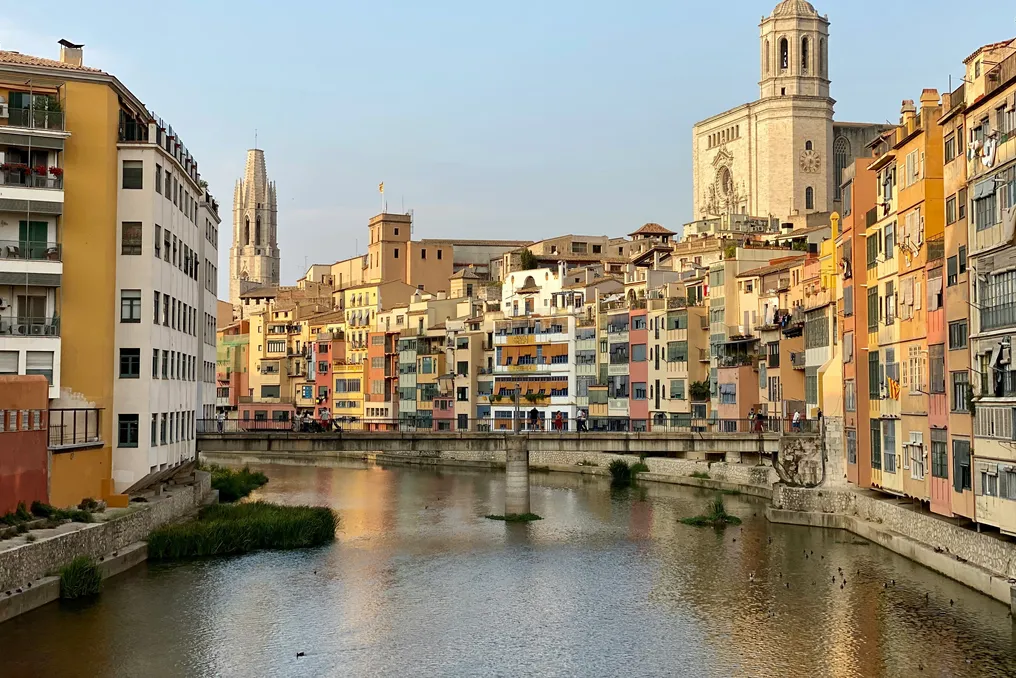
Anyone visiting Catalonia in Spain cannot ignore Girona—a medieval city rich in history, located just 100 kilometers from the well-known Barcelona (reachable by train in about 40 minutes). Girona serves as an excellent starting point for exploring the surroundings of the Spanish Pyrenees.
The Pyrenees, situated between the regions of Navarre, Aragon, and Catalonia itself, form the border between Spain and the rest of Europe, bordering France and the small principality of Andorra. These mountains, whose height can exceed 3,000 meters, conceal beautiful landscapes, as well as rich flora and fauna, and numerous villages with stunning views of the mountain range are located around the ridge.
The Pyrenees can be explored year-round, but the route to the foot of the mountains takes on a special charm in summer: from June to September, it gets warmer, and the vegetation blooms. This is the most popular season among tourists, so it is recommended to plan the trip in advance and be prepared for higher prices compared to the low season.
If you want to get to know the Spanish Pyrenees, you can create a route covering three regions where they meet: Navarre, Aragon, and Catalonia. In Catalonia, besides Girona, the city of Lleida is also a good base for studying the Pyrenees and their villages. From Lleida, you can visit the villages of Boí, Taüll, and Bellver de Cerdanya, which are abundant with churches and romantic paintings.
The city, located between the Ter and Fluvià rivers, developed around the Benedictine monastery of Santa Maria de Ripoll, which is its main attraction. The monastery was founded in the 9th century and is considered one of the most important monastic centers in Catalonia. A legend exists around the foundation of the monastery concerning Wilfred the Bearded.
Wilfred was the Count of Barcelona and received this nickname due to his lush hair, which set him apart from other noble figures. He also played a role in the unification of Catalonia and the founding of the region's historical dynasty. He was the last Count of Barcelona to be granted the title by the French kings.
The myth associated with this nobleman also explains the legendary origin of the Catalan flag: after a battle on the side of the Franks against the Normans, the Bearded man supposedly wounded himself. King Charles the Bald then ran his blood-covered fingers over Wilfred's golden shield, creating the four red stripes depicted on the Catalan flag today.
This tale has no historical confirmation but is part of local mythology, as it is believed that the monastery was built by Wilfred for his own burial, and remains attributed to him.
Near the Monastery of Santa Maria de Ripoll is the Church of Sant Pere. The temple was originally founded in the 9th century. Its architecture includes pre-Romanesque elements from the 12th century, as it underwent reconstructions throughout the centuries.
This monastery is also located in the province of Girona and is connected to Wilfred. Sant Joan de les Abadesses is the only women's monastery in Catalonia, once managed by Wilfred's daughter, Emma.
The villages around Girona are rich in history and medieval legends. This monastery also has its fable: Count Arnau, a tyrannical character in Catalan folklore, supposedly fell in love with the local abbess. The legend says he also made a deal with the devil to build Pont Vell (which is also a Girona attraction) overnight.
Due to his sins and cruelty towards vassals, Arnau was condemned to wander the Pyrenees at night, riding a fire-breathing horse accompanied by hellhounds.
Montgrí Sanctuary
The Montgrí Sanctuary offers a view of the Pyrenees from an altitude of 1,408 meters above sea level. Fog may obscure the panoramic view, although the weather in the region often changes. The sanctuary has a staircase of 144 steps, which, naturally, is also surrounded by myth.
Among the acts of tyranny of Count Arnau, he allegedly ordered the construction of a stone staircase and never paid the workers responsible for the construction—which also led to his condemnation to wander the mountains without rest.
Campadorny
Known as the 'Little Swiss Switzerland of Catalonia,' Campadorny came alive in summer as a favorite destination for the region's bourgeoisie. The village's popularity is partly linked to Bartomeu Robert and Jarzabal, Dr. Robert, a respected physician from late 19th-century Barcelona.
The doctor advised patients to visit this place, believing that the mountain air was beneficial for health. There, one can see a bust of Dr. Robert on the Maristany promenade, where works by architects Enric Sany and Josep Coderch are also displayed.
Located in the Pre-Pyrenees area at an altitude of almost 600 meters, this mountain village features stone buildings, bridges, and houses with wooden balconies typical of the medieval period. Among the main attractions, visitors will find the Church of Sant Cristòfol, built in the Romanesque style, with a bell tower and a two-meter-tall sculpture of Christ in Majesty.
Gastronomy is also a feature of the village; local dishes include *butifarra* sausage, bread with tomatoes or sheep cheese, as well as dishes made from potatoes, veal, and lamb, characteristic of mountain cuisine.
In addition to visiting the villages of the Girona province, it is worth exploring the city itself. Girona also has typical medieval buildings, such as Pont Vell (Old Bridge) and the Girona Cathedral, which served as a backdrop for the series 'Game of Thrones.'
The Artigas Gardens are one of the peaks of Girona's architecture. This open-air park was designed by Gaudí, combining natural resources with special structures conceived by the architect.
The city's Jewish Quarter is one of the best preserved in Europe and is also worth visiting. The Bonastruc sa Porta center is the last medieval synagogue in Spain, used until 1492 when Jews were expelled from the country.
For those interested in art and history, it is also worth visiting the city's museums, such as the Girona Art Museum, the Girona Film Museum, and the Dalí Museum in Figueres. One of the world's most famous and award-winning restaurants is also in Girona—El Celler de Can Roca.