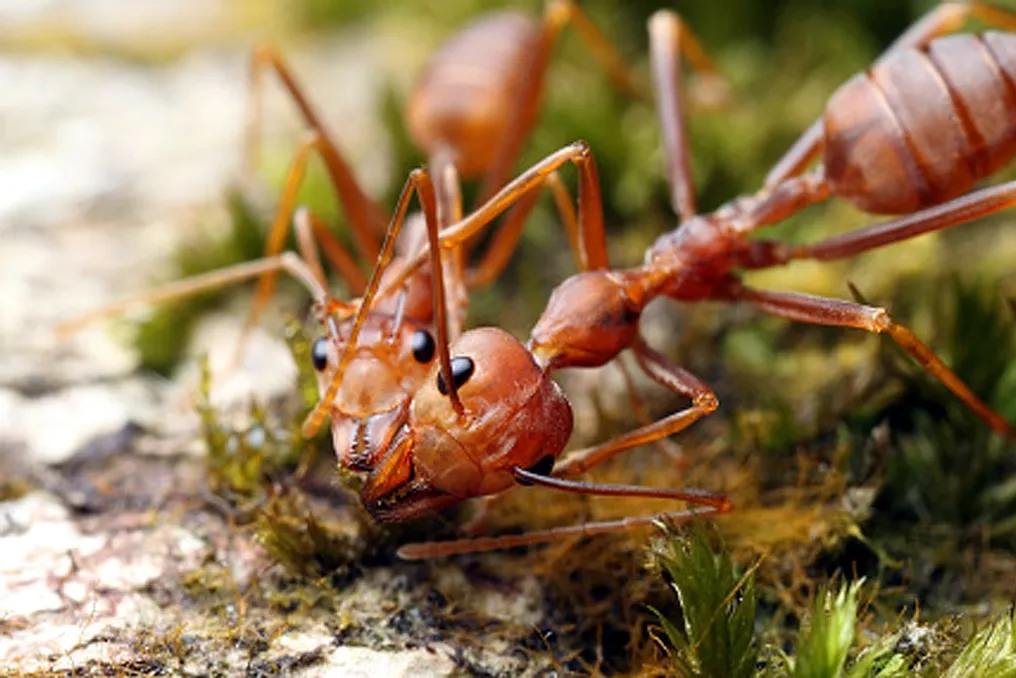
A highly unusual phenomenon has been discovered in the world of ants. The queen of the ant species Mesor ebericus produces not only males of its own species but also males of another species—Mesor structor. According to scientists, the queen clones a male of another species and gives birth to it in her colony. This is the first case where one species was observed to clone another.
This study was published in the journal Nature. To confirm this discovery, a team of scientists examined numerous ant colonies. Researchers collected 132 males from 26 Mesor ebericus colonies. Approximately 44 percent of these males had hair, while the rest were almost hairless. DNA analysis showed that they belonged to different species: the hairy males were Mesor ebericus, and the hairless ones were Mesor structor.
The need for males of another species is related to the reproduction process. Males of Mesor structor are necessary for the Mesor ebericus queen to produce worker ants. The crossbreeding of the two species results in worker ants that contain genetic material from both species.
Scientists studied the genome of 164 worker ants, and all of them contained genetic components of both species, meaning these worker ants were hybrids. However, a question arose: some Mesor ebericus colonies were found in areas where there were no Mesor structor colonies. How did these ants get the sperm of another species then?
During the investigation, it was found that the queen herself creates males of another species. After mating with a Mesor structor male, she stores his sperm in her body. Then, when the queen lays eggs, she does not incorporate her genetic material into some of them. From these eggs hatch males whose nuclear DNA belongs to Mesor structor, meaning they are clones of another species.
Meanwhile, the mitochondria of these males remain Mesor ebericus, which provided scientists with convincing evidence of cloning. The research team checked 286 eggs and larvae, and in 11.5 percent of them, only Mesor structor nuclear DNA was detected. Scientists monitored one colony for 18 months, during which males of both species were observed in the colony of one queen.
DNA analysis showed that the two species diverged about 5 million years ago. Despite this, their reproduction remains linked. Because of this, Mesor ebericus can establish its colony even where Mesor structor is absent, as the queen does not need to find a male of another species—she can clone it herself.
According to the scientists, cloning in ants has been observed before, but the creation of offspring of one species through the cloning of another has never been recorded. This is why this discovery is considered very important for understanding ant reproduction and evolution.