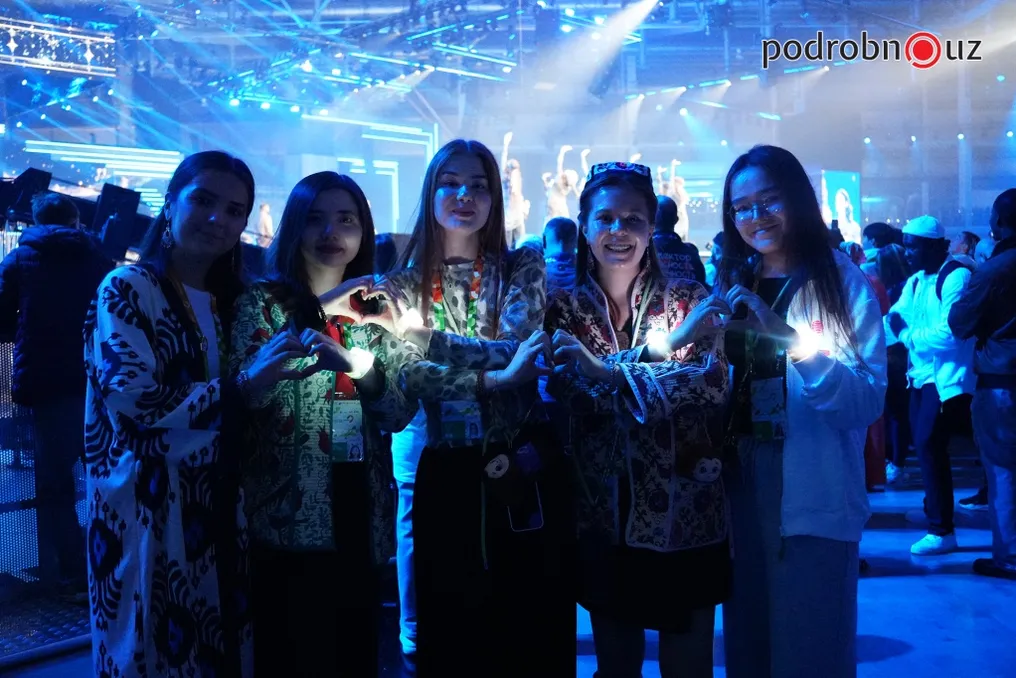
The International Youth Festival (IYF-2026), held in Yekaterinburg from September 11 to 17, gathered about ten thousand participants from 191 countries, serving as a platform for cultural exchange. Among the festival guests were representatives from Uzbekistan. Participants shared their impressions of what they managed to see during the week and what stories they took with them.
The First Sleepless Night
The festival did not begin with an official opening but with musical gatherings. On the first night, Dildora Azimjonova practiced playing drums with a participant from Morocco. The participants did not go to sleep, spending time in the 'Africa' building, where they sang and chatted until the early morning. Her roommates turned out to be girls from Indonesia and Malaysia, and on the very first day, Dildora noticed that she had forgotten the English word 'fan'.
Vlad Morozova, a student at the MSU branch in Tashkent, came under the 'Media' program. She recalls that after the official concerts, participants organized their own events, performing with guitar and African drums right on the street.
Freedom Instead of a Schedule
Vlad was initially prepared for strict camp discipline with group classes and a rigid schedule, but the organizers provided participants with a complete map and schedule, leaving them the freedom of choice. She was impressed by the scale of the work, noting that housing and accreditation for ten thousand people were completed in just two days. Acquaintances formed very quickly: Vlad noted that a stranger could approach her on a bench asking, 'Where are you from?', and within five minutes, they could be conversing like old friends. Before the trip, she was sure she wouldn't be able to speak English.
Dildora did not count the number of acquaintances but is confident that she spoke with people from more than twenty countries, including Tunisia, Morocco, Kyrgyzstan, South Korea, and Saudi Arabia. Common topics emerged quickly: in the lunch queue, it was discovered that there were medics nearby, and in the queue for free books, that her roommates shared a love for Dostoevsky.
Their Projects, Their Stories
Discussions often concerned not only common interests but also existing projects. According to Dildora, a web developer from Pakistan created a website with financial literacy lessons for women. Another participant from Russia developed an application for pediatricians based on child anthropometry, which Dildora would like to implement in Uzbekistan.
Vlad remembers Denis from Tomsk, whose acquaintance turned into a friendship. He was taught Uzbek words and told about the cuisine and traditions, and he plans to visit Uzbekistan next year. Although they are currently communicating via video call, Vlad admits that she is unaccustomed to not seeing each other. Another memorable incident was the exchange of gifts with a girl from India: in response to a gift from Uzbekistan, she presented a shark tooth pendant made by her father.
For Mardona Shavkatjonov, a master's student at the University of Sapienza in Rome, the festival was the third in a row, following events in Sochi in 2024 and Nizhny Novgorod in 2025. In Yekaterinburg, he reconnected with Oscar from Brazil, whom he had previously met in Sochi but had not exchanged contact details with. Donier Mahmudov also has experience with similar trips and noted that volunteers met the participants at the airport with national elements, and he particularly highlighted the 'silver' senior volunteers working at all venues.
Questions about the country elicited diverse opinions. Mardon sees positive changes: if previously the word 'Uzbekistan' was often followed by the question 'Pakistan?', now foreigners know about the country's footballers like Abdukodir Husanov, chess player Javohir Sindarov, and boxers, having learned about them from social media. Vlad holds a more skeptical position: she brought handmade postcards of historical cities, but most people only asked about tourism. Donier believes that for many interlocutors, he was the first person to tell them about the country, although he was also called by the name of a footballer.
Dildora preferred a more material approach, handing out traditional kurt and inviting people over; some interlocutors had already visited Uzbekistan and warmly recalled its sights. The Russian language attracted special attention. Vlad did not expect questions about her 'pure Russian pronunciation', as she thought everyone understood the peculiarities of the post-Soviet space. Admittingly, she said she speaks poor Uzbek, and Russian is her native language. Dildora's situation is the opposite: Uzbek is her native language, and Russian is her second language.
What They Took Home
For Mardon, the festival was a continuation of his work. After participating in the gathering in Nizhny Novgorod, he launched the SCHOLARS mentoring project, which ran for two seasons, and this time eight of his students participated in the festival selection. He is proud of this achievement. Living in Italy, he continues to help young people from Uzbekistan apply to global universities and win grants, and at the festival, he found partners for new educational initiatives.
Discussions with European colleagues about mentoring led Mardon to rethink the Uzbek tradition of 'ustoz-shogird'; he believes that a mentor is not just a teacher but a life guide, and this tradition can become a competitive advantage when integrating into modern educational formats.
Other participants had their own plans. Donier intends to transfer the experience of 'silver' volunteers to Uzbekistan together with the local Volunteer Association, believing this will activate the older generation. Vlad plans to conduct scientific research on the wedding culture of Central Asian and CIS countries, and new acquaintances from Russia and the region agreed to help with sampling and rare literature. Dildora and other participants from Uzbekistan created a group chat to search for international programs, obtain grants, and organize joint trips.
Three out of five respondents stated a desire to hold a similar festival in their country. Vlad called it a 'new, perhaps unattainable' dream, Donier is confident in the necessity of a youth forum for the country, and Mardon is convinced that 'we have absolutely everything for this'.
Some participants continued their journey after the main program: Marianna Arslanova traveled to Karachay-Cherkessia and Adygea. In this small group, away from the noise of the large forum, a kind of 'microfamily' formed.
The Simulated World They Had to Leave
At the end of the week, Dildora summarized things with her roommate from Malaysia, Li. She admitted that she learned not to judge people, either externally or internally. Li supported this observation, noting that all ten thousand participants seemed to have lived this week in an isolated, 'simulated' world from which they now have to return to normal life.
For the participants from Uzbekistan, IYF-2026 was not just a series of bright meetings but a point of development: some gained new educational partnerships and projects, others gained scientific and volunteer plans, and some gained important personal understanding of themselves and the world. The common feeling was regret over parting with the 'small good world' of the festival and hope for such events to be held in Uzbekistan itself.