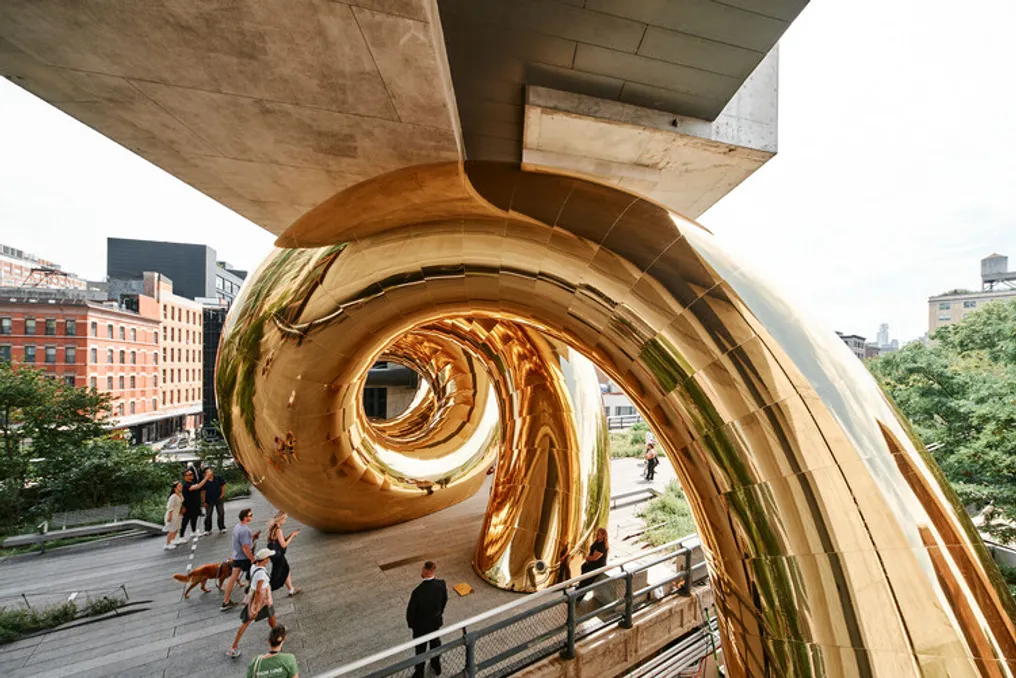
The auruBOROS installation, conceived by the Berlin-based artist duo Plastique Fantastique, transforms the traditional representation of the Ouroboros into an ephemeral urban organism traversing New York. This project connects elements of architecture, public space, and collective experience.
The work was commissioned by Bvlgari as part of the Serpenti Infinito collection. The artists developed the installation for the High Line, located beneath The Standard hotel. The concept addresses the themes of renewal, continuity, and transformation inherent to the Serpenti line, utilizing the studio's established practice of pneumatic architecture.
Instead of presenting the serpent as a static emblem, the artists chose to unfold the classic circle of the Ouroboros, allowing its body to extend toward the urban landscape. The chosen environment, the High Line, is crucial to the work because it encompasses various layers of the city: the elevated park, the underpass, The Standard, neighboring buildings, vegetation, and constant pedestrian traffic.
The Plastique Fantastique team designed auruBOROS as part of a larger organic system that invisibly circulates through these layers, with only fragments of its golden body being visible. Constructed with light, reflective membranes and maintained solely by air pressure, the installation balances imposing scale with physical lightness.
The piece's geometry was shaped by factors such as wind, circulation, anchor points, lines of sight, public safety, and the local architecture itself. The golden, reflective surface is fundamental, as it captures daylight, buildings, flora, the sky, and moving individuals, continuously altering the appearance of the city. At certain moments, the structure can appear extremely prominent or almost merge with its surroundings.
The name auruBOROS combines 'aurum,' the Latin term for gold, with Ouroboros. Gold is interpreted here not primarily as a symbol of opulence, but rather through the alchemical notion of transmutation, representing the passage of matter from one state to another. This mutable change makes the transformation perceptible in real time.
As a transient intervention, auruBOROS investigates how memory is constructed in the present moment. Unfamiliar individuals briefly share the same space, image, and instant, which the artists define as a modality of 'Public Love.' Although the structure is removed after ten days, the experience may persist through memory, discussion, and a new way of seeing the location. Thus, the work adds a temporal dimension to the urban memory of New York, encouraging a collective imagination about the city's future.