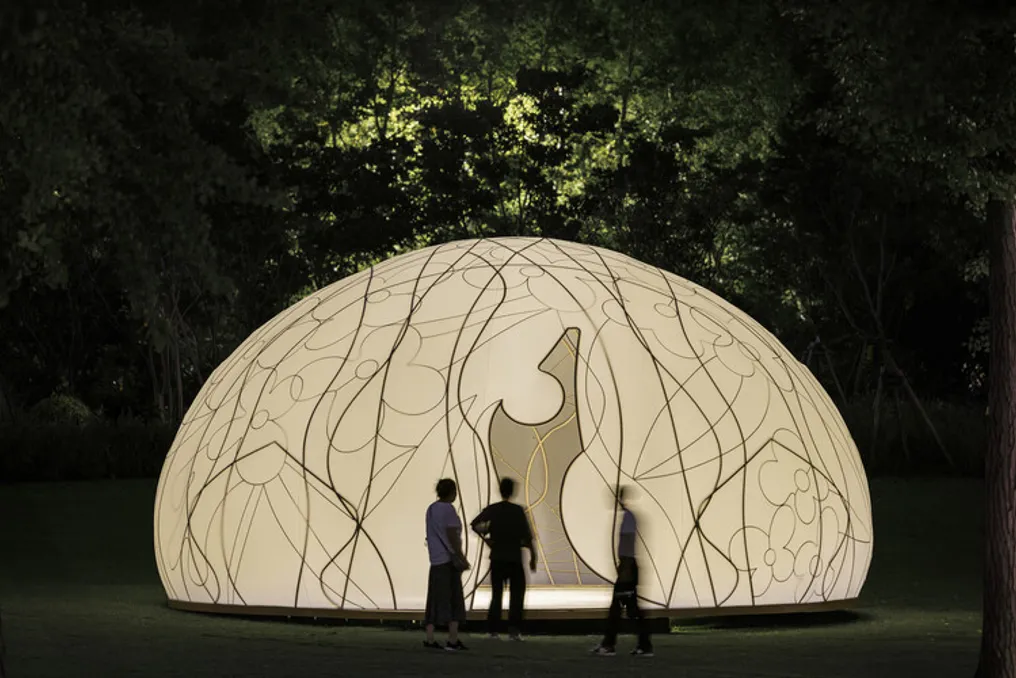
The temporary art installation Osmanthus Moon, created by HCCH Studio, was conceived to celebrate the traditional Chinese Mid-Autumn Festival. This work consists of a projection, both spatial and metaphorical, of the traditional osmanthus pattern—a plant and aroma that symbolize autumn—establishing a dialogue with the action paintings of a popular artist of 'Zao Hua' (stove flower), a practice recognized as intangible cultural heritage.
The pavilion is situated on the semicircular lawn of Century Park, resembling a translucent full moon silently descending. Its spatial structure incorporates traditional osmanthus graphics in bronze designs reminiscent of vines, while a light elastic fabric covers the surface, forming the luminous appearance of the moon. This project pays homage to the 'golden cabbage' of the Vienna Secession and simultaneously seeks to awaken the sensibility of romantic science fiction associated with Buckminster Fuller's domes.
The osmanthus patterns painted on the ground by the Zao Hua artist echo the golden trellis of the upper dome, creating a relationship of mutual projection. Together, they configure a complementary dialogue between the work done on site and pre-fabrication, between movement and serenity. The pavilion represents something delicate, radiant, and fragile, personifying the joy and desire that are timeless yet fleeting, evoked by the 'moon' and the 'osmanthus' throughout the centuries.
Visitors have the opportunity to enter the interior of the moon through two irregularly shaped openings. During the day, the space features an Impressionist style of light and soft textile surfaces; however, at night, the interaction between shadows and diffuse lighting transforms the interior into a dreamlike and immersive environment, as if it were a temporal mirror.
This project was commissioned by the Power Station of Art, located in Shanghai, and remained on display for a period of twelve days.