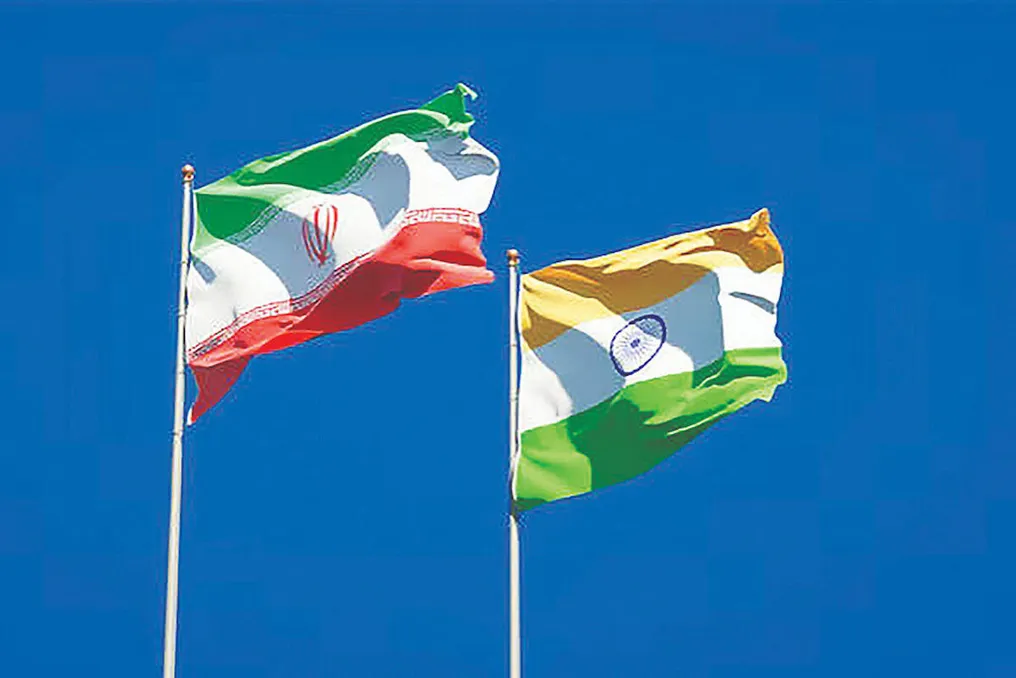
According to a report by Mehr News Agency, the potential of the private sector, Chabahar Port, the North-South Corridor, and the joint membership of Iran and India in BRICS open up new prospects for developing trade, investments, and expanding economic cooperation between the two countries.
Despite significant opportunities, economic ties between Iran and India have seen a sharp decline in bilateral trade volume in recent years. The main reasons for this decline include sanctions, banking restrictions, transportation issues, and changes in the energy relations of the two countries. Nevertheless, existing capacities in commodity trade, medicine, agriculture, joint investments, and transit corridors can contribute to returning the economic relations of Tehran and New Delhi to a growth trajectory.
In this context, the new Indian ambassador to Iran, Shri Vishvesh Negi, visited the Tehran Chamber at the beginning of his mission and met with its chairman. The parties emphasized the need to strengthen private sector ties, expand trade, and utilize BRICS opportunities.
According to official Indian statistics, the trade volume between the two countries reached approximately 1.63 billion US dollars in the 2025–2026 fiscal year. Of this amount, about 1.25 billion dollars was India's export to Iran, and about 370 million dollars was India's import from Iran.
This figure is significantly lower than the peak period of bilateral relations. In the 2018–2019 fiscal year, Iran-India trade reached approximately 17 billion dollars, a significant portion of which was Iranian oil exports to India. After the tightening of US sanctions and the cessation of most purchases of Iranian oil by Indian refineries, the structure of trade changed, and the volume of exchanges noticeably decreased. Thus, trade fell from approximately 17 billion dollars in the 2018–2019 fiscal year to about 1.6 billion dollars in the last fiscal year.
This decrease demonstrates that the current problem in economic interaction between Iran and India is not simply about increasing the export or import of a specific product, but about reviving the entire network of trade and investment cooperation that has been weakened by international restrictions in recent years.
As the share of oil in bilateral trade decreases, the importance of agricultural, food, and pharmaceutical products increases. Basmati rice is one of the most important export goods of India to Iran and has constituted a significant part of Indian exports to the Iranian market in recent years. Official Indian statistics show that the export of basmati rice from India to Iran in the first 10 months of the 2025–2026 fiscal year exceeded 790,000 tons, indicating growth compared to the same period last year.
Besides rice, other important Indian exports to Iran include tea, sugar, fresh fruits, as well as medicines and pharmaceuticals. In response, Iran exports products such as pistachios, dates, apples, and kiwis to India. This structure shows that even with banking and trade restrictions, the two countries retain complementary markets in certain areas of basic and consumer goods.
The pharmaceutical and medical equipment sector is also an area contributing to the development of economic relations. India is one of the world's centers for pharmaceutical production, and Iran, due to its own pharmaceutical industry and need for raw materials and specialized products, is considered a significant market for Indian companies. Consequently, in recent years, cooperation between the two countries in healthcare and medical product regulation has attracted attention, and opportunities have been created for industrial and pharmaceutical partnership development.
The presence of Indian companies at specialized Iranian exhibitions can form the basis for direct communication between companies, identifying market needs, and transitioning from simple commodity trade to industrial cooperation and joint production.
Chabahar Port holds a special place among the economic projects of the two countries. For India, the port's importance is not limited to trade with Iran; New Delhi views it as part of its strategy to ensure connectivity with Afghanistan, Central Asia, and Eurasian markets. In 2024, India signed a ten-year contract with Iran for the equipping and operation of the Shahid Beheshti terminal in Chabahar and committed to investing in the development of this terminal. Although India's relationship with Chabahar Port has experienced ups and downs, the port remains critically important in the context of the International North-South Transport Corridor, which can make India's route to Iran, the Caucasus, Russia, and Central Asia shorter and more diverse. The continuation of sanctions and changing conditions related to the lifting of sanctions on Chabahar pose challenges to India's economic presence in this port. New Delhi has reported in recent months that it is in contact with various parties regarding the status of Chabahar.
The joint membership of Iran and India in BRICS has also created a new opportunity for developing economic ties between the countries. India will chair BRICS in 2026, and the group's economic programs focus on increasing trade among members, strengthening supply chains, developing SME cooperation, and developing a framework for economic cooperation until 2030.
For Iran, participation in BRICS has become a platform for expanding ties with large markets of group members, beyond political and multilateral potential. India also seeks to strengthen trade and investment between member countries and create new mechanisms for economic interaction.
Meanwhile, one of the main problems in Iran-India economic interaction is the gap between state agreements and actual cooperation between companies. Under current conditions, increasing direct communication between chambers of commerce, holding B2B meetings, sending trade delegations, company participation in specialized exhibitions, and conducting training courses can help identify real market opportunities.
In this regard, proposals are being put forward to develop a schedule of trade negotiations between the private sectors of the two countries, conduct specialized courses, exchange trade delegations, and create a direct communication channel to monitor the fulfillment of agreements. Provided these measures continue, cooperation can move from the level of negotiations and memoranda of understanding to concluding trade contracts and concrete projects.
One of the most serious problems in Iran-India trade is also the restriction of money transfers and access to the international banking system. US sanctions have forced many Indian companies to face increased risks in payments, insurance, and transportation when trading with Iran. As a result, some trade is conducted through intermediary channels, which increases the cost and time of exchanges. Transportation disruptions in the region exacerbate the problem. In recent months, some Indian cargo, including rice, tea, and medicines, has faced delays in Indian ports, and regional events have affected maritime transport.
Therefore, it is becoming increasingly important for Iran and India to develop alternative logistics routes and utilize regional port and corridor capacities more effectively. Notably, while the reduction in Iranian oil exports to India has reduced the overall trade volume, it has simultaneously highlighted the need to develop non-resource exports. Agricultural products, food products, petrochemicals, minerals, industrial goods, medicine, and pharmaceutical raw materials are areas where Iran can focus to increase its presence in the Indian market. India also needs products such as food, agricultural products, medicines, and industrial raw materials, and this need creates an opportunity to form a more diversified trade model between the two countries.
However, the growth of Iranian exports to India will face limitations unless issues related to money transfers, standards, transportation, and trade tariffs are resolved. One factor capable of changing the volume and quality of economic relations between the two countries is the transition from traditional trade to joint investments. Cooperation between Iranian and Indian companies in the production of medicines, food industry, agricultural processing, industrial raw materials, and some export-oriented projects can create greater added value than simple commodity trade. In such a model, Iran can leverage India's large market and industrial capacity, while India can use Iran's geographical location to access markets in Central Asia, Afghanistan, and regional countries.
Thus, Iran-India economic relations under current conditions face not so much a lack of potential as a problem of transforming this potential into sustainable trade. India's large market, Iran's transit status, Chabahar Port, the North-South Corridor, BRICS opportunities, and the complementarity of parts of the economies represent a set of opportunities that can raise bilateral exchange above the current level. On the other hand, banking restrictions, sanctions, transportation costs, insurance risks, and difficulties with money transfers remain the main obstacles to trade development.
From this perspective, the main goal in Tehran-New Delhi economic relations is not just to return to past figures, but to create a sustainable mechanism for trade, investment, and industrial cooperation. This mechanism must take the trade of the two countries out of historical dependence on oil and build it on the private sector, non-resource goods, joint projects, Chabahar, and the multilateral opportunities of BRICS. If this path is accompanied by the creation of direct channels between companies and the gradual elimination of financial and logistical barriers, Iran-India economic relations can transition from current limited trade to more diverse and sustainable cooperation.