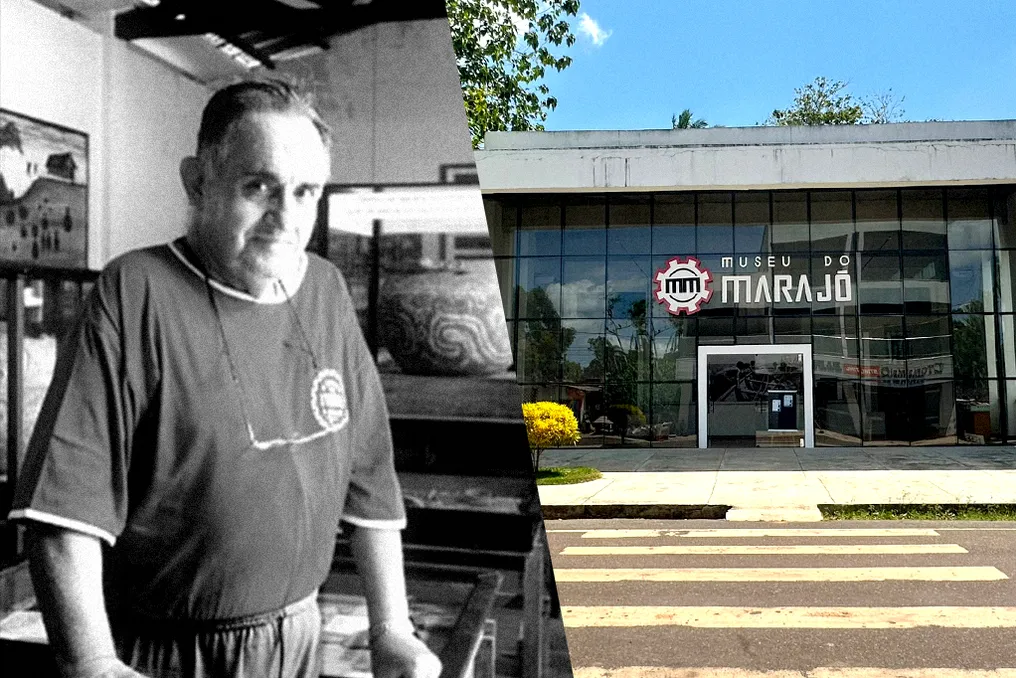
The island of Marajó is home to about 590 thousand Brazilians. This archipelago in the state of Pará is mainly known for the large number of water buffaloes, whose population is almost comparable to the population. 460 thousand buffaloes can be easily found in towns, rural areas, and on waterways.
The Marajó buffaloes attract tourists from all over the world who pay for the opportunity to ride or pet the animals. However, in the 1970s, a man from Italy arrived in Marajó, who was initially interested not in the buffaloes, but in the inhabitants of the archipelago.
Today, it can be said that a significant part of the nearly 600 thousand residents of Marajó knows a name unknown to the rest of Brazil: Giovanni Gallo, or simply 'Father Gallo.' Locals say that Marajó changed before and after Father Giovanni Gallo's arrival.
He was born in Turin, Italy, in 1927. After becoming a priest in the Society of Jesus, he worked on social projects in Sardinia and Switzerland. But the most important part of his story began when he was sent to Brazil in 1970. Before choosing Marajó—a place where, according to him, no priest wanted to go—he worked in Bahia and Maranhão.
Gallo settled in Santa Cruz do Arari, a riverside town where most houses are stilt structures. There, he not only celebrated masses as assigned but also became interested in the lifestyle of the local Caboclos. He learned to fish, communicate with the community, and studied local beliefs and superstitions. He mastered life, as he himself said, in the 'dictatorship of waters,' since half the year is dominated by rain and river floods, and the other half by drought.
Furthermore, Gallo showed interest in the archaeological history of Marajó. Before the Portuguese arrived in 1500, complex indigenous societies lived on the archipelago. There is evidence of agriculture, construction of artificial lakes, burial and fertility rituals, and division of labor—all dating back to approximately the 8th to 13th centuries. However, these peoples left no written records; archaeologists and researchers extract information from ancient pottery found beneath Marajó.
One day, the priest received a visit from a friend who gave him a package. 'It's a bunch of junk, as you like it.' Gallo received artifacts such as fragments of painted pottery. This became the seed of what later turned into the Marajó Museum.
In some places in Marajó, archaeological pottery literally grows out of the ground. Due to soil erosion, artifacts buried underground end up on the surface. Therefore, people often find pottery shards in their own yards and plots. The community began giving Father Gallo all unusual finds—from ceramics and fossils to a two-headed calf born in the region.
Thus, the collection of the first Marajó Museum, which was then called 'Our Museum of Santa Cruz do Arari,' was formed. It was officially opened in 1977 on the feast day of Sirio de Nazaré. The goal was to create a museum by the people and for the people, as a way to enhance the value of local culture.
At that time, Father Gallo was more loved and popular than any politician in the region. The mayor suggested that he could run for public office (since, obviously, Gallo would win easily). Father Gallo began receiving threats, and he recalls in his book being aimed at with weapons. Gradually, he started to be pushed out of Santa Cruz do Arari.
The strongest blow came from the Catholic Church itself. Gallo had ideological disagreements with the bishop of the time, who decided to withdraw him from Marajó. The priest was forced to break ties with the church and renounce his clerical garb to remain in Pará.
To avoid political persecution and continue his social work, Giovanni Gallo decided to change cities. He moved the museum and his collection to Cachoeira do Arari, a neighboring, equally complex municipality—where the Marajó Museum is currently located.
'He understood that the community had no idea how rich its culture was,' says Dona Zezé, a resident of Marajó who worked with Father Gallo. 'He started helping people understand this [...] I dare say he did more for Marajó than anyone from Pará.'
Zezé is an award-winning chef and owner of the restaurant Quintal da Zezé, located opposite the Marajó Museum. She recounts that the entire community united in clean-up days to renovate the city's old factory, which was supposed to become the site for Father Gallo's new museum. The space was cleaned and restored by the residents of Cachoeira do Arari themselves. In 1987, the Marajó Museum was opened in the city.
At the opening ceremony, Gallo gave a speech explaining why he decided to build the museum there rather than in more accessible cities near Belém, such as Suruí or Salvaterra: 'We created a museum that will become a center of development. That is, the Marajó Museum will help Cachoeira do Arari obtain all the structures that other municipalities have and we do not.'
The museum housed not only archaeological artifacts and fossils found in Marajó. Moreover, it was an exhibition space about the lifestyle of the Marajoara people: their beliefs, cuisine, clothing, habits... Essentially, everything Gallo learned during his years on the archipelago.
'Although he started with archaeological fragments, he said the main part of the museum was the Marajoara person. He wanted visitors to learn about the reality of the Marajoara person: how they live, what their beliefs are, their way of speaking and dressing,' says Zezé. 'He went out with cattle herders, fishermen, to feel this, and then tell this story.'
Among the most fascinating items were the so-called 'peasant computers': wooden constructions that visitors could touch, open, and learn information by interacting with them. 'A Brazilian has eyes on their fingertips. You need to touch things,' Gallo said in an interview with Globo Repórter in 1996. The report described the Marajó Museum as 'the first peasant museum in the world.'
Among the archaeological artifacts, visitors can see graphic images created by the peoples who lived on Marajó hundreds of years ago. These patterns and iconography are engraved on the pottery displayed in the museum. Giovanni Gallo wrote a book demonstrating and explaining these graphic images, titled 'Ornamental Motifs of Marajoara Pottery.' In the publication, he also includes diagrams of the cross showing how to reproduce the graphic images in embroidery. But why?
'Here, in Marajó, he saw women very submissive to their husbands. So he created this book thinking about women. They could do this embroidery work without leaving home, so as not to depend only on the money brought in by men,' says Zezé. Gallo created a group of embroiderers registered at the Marajó Museum and provided them with materials for home embroidery, without interfering with their home lives. Then he paid the embroiderers for this service and sold clothes with embroidery.
'It was a way to empower the women of Marajó,' says Zezé, whose restaurant entrance features a huge embroidered flag. She says her daughter loves to embroider.
One of Gallo's main concerns was the continuity of the museum after his death—and he was right to worry. Without outstanding leadership, the museum could end up abandoned, lacking funds to maintain operations.
Giovanni Gallo died on March 7, 2003, at the age of 76 from infections caused by a perforated ulcer. He passed away at Porto Dias Hospital in Belém, and his body was flown to Cachoeira do Arari for burial. He is buried in the courtyard of the Marajó Museum.
After his death, the Marajó Museum Association took care of the heritage. The association consists of residents of Cachoeira do Arari, including Zezé. The community supported the museum by helping the city hall pay for electricity.
However, over time, repairs were needed, for which the association could not find money. Zezé recounts that she often asked the state government for resources and help to repair the museum, but always received a negative answer.
In 2018, Brazil experienced one of the largest museum disasters in the country's history: a fire at the National Museum in Rio de Janeiro, which destroyed 18.5 million exhibits. This tragedy raised concerns about the safety status of other Brazilian museums. Thus, the Public Prosecutor's Office initiated an inspection by the fire department to check the Marajó Museum.
On December 12, on the museum's anniversary, a report arrived stating that the building was unfit for operation. There were problems with the roof, cracks in the walls, termite infestation, and an almost non-existent fire suppression system. The museum was closed pending requested adaptations.
'We asked the prosecutor for a deadline to gather the community and inform them that the museum would be closed indefinitely because the association lacked the resources to make changes,' says Zezé. 'Then he said it was a heritage, and therefore the responsibility of the state government.'
The prosecutor traveled to Belém and requested a public hearing with Governor Helder Barbalho. The governor visited the Marajó Museum and signed a repair agreement. The museum came under the guardianship of the State Secretariat of Culture of Pará (Secult).
In 2022, after four years of closure, the museum reopened in its current form. It displays archaeological artifacts and some 'peasant computers.' Due to fire department adaptations, there is no space to display the entire collection. Part is kept in a technical reserve located in a nearby house owned by the Association. The lack of exhibition space is one of Zezé's main complaints about the repairs.
Another difficulty is access to the Marajó Museum. Those who visit Marajó usually stay in Suruí or Salvaterra, towns closer to Belém. Leaving Salvaterra, one must drive for an hour before the route is interrupted by the Camará River, which is 100 meters wide from bank to bank. There is no bridge connecting the banks. Visitors have to wait an hour to board a ferry to cross.
The state government approved tenders for the construction of a bridge in 2022, but it has not yet been built. Despite the access difficulties, the Marajó Museum is worth visiting. Not only because of its rich collection and history, but also because of the people who help keep it running.