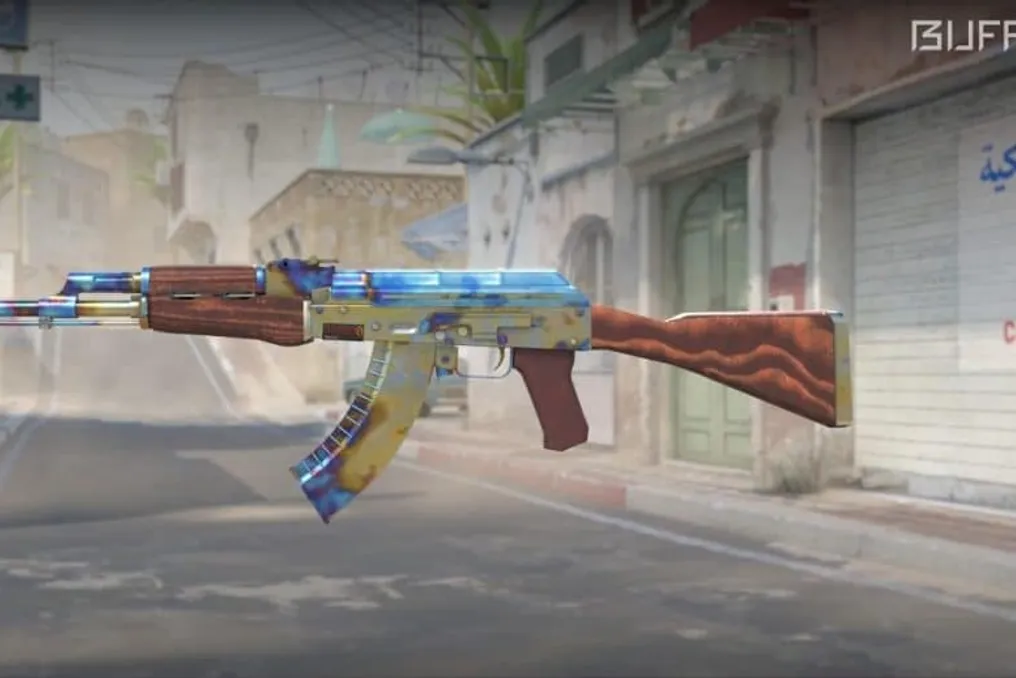
In June 2024, the gaming community was impacted by a notable piece of news: a weapon skin in CS, specifically the StatTrak Factory New AK-47 Blue Gem Standard 661, was traded for over US$1 million. However, this high value is not exclusive to this item or video games; it reflects a pattern with deep causes that transcend developer interests.
Several elements explain this appreciation. The first is scarcity. The probability of obtaining such items is extremely low. For example, the chance of getting a knife or glove is approximately 0.26%, while a specific pattern like 661 has an even lower chance. This rarity makes the item almost unique and visible to all community members, as Valve discloses official rarity probabilities for cases. Furthermore, the discontinuation of certain item cases increases their rarity and, consequently, player desire.
These circumstances lead to the second factor: status. In highly competitive games like CS2, this feeling is amplified and transmitted to thousands of players, both in tournaments and through influencers. In this context, owning an exceptionally rare skin is equivalent to having a luxury vehicle or designer clothing, conferring immediate prestige within the community.
Even a rare item in CS2 can acquire unique characteristics through patterns. Its appearance is generated based on a numerical identifier (pattern ID) and a wear level (float). Thus, every item of the same pattern presents a distinct design, and variants considered perfect attract collectors, driving up high prices.
All these factors are intensified by third-party markets, where users make purchases, sales, and transfer profits directly to their bank accounts. This ecosystem attracts not only players but also investors and speculators who acquire skins not to play with, but rather to profit from future appreciation, mirroring the functioning of the stock or art market.
It is crucial to differentiate between estimated value and actual value, as illustrated by the case of a Karambit Case Hardened Pattern 387. Although the item is valued up to US$2.5 million, there were offers reaching US$1.5 million. However, the owner rejected all offers, maintaining its valuation at US$2 million.
Nevertheless, until an item reaches the stipulated value and is paid for, any estimate remains theoretical. Even with offers close to that amount, the value can only be confirmed as real after the sale is finalized, remaining in the realm of speculation until then.
Despite the speculations and transactions not involving the developer, it maintains significant power over the market. A single action by Valve can generate major repercussions in this sector, which has already happened in the game's history.
In July 2025, Valve introduced a new set of gloves (character skins) from the Death Hand collection, causing a drastic change in prices. Previous gloves suffered a considerable loss in value, with some registering up to 30% depreciation due to the novelty factor. Additionally, Valve implemented a security feature that allows reversing item trades for up to seven days if the user proves they were a victim of fraud or hacking. Despite seeming beneficial, this measure resulted in a $600 million retraction in the market.
Later, in October 2025, an update allowed players to trade five 'covert' (red) weapons from the same collection for a knife or glove from the collection of one of the items used in the trade. Consequently, all knives lost substantial value, while red weapons saw a sharp increase in price. This modification deeply impacted the skin market, which was valued at $6 billion, but plummeted by $2 billion, causing significant financial losses for those using the market as an investment.
All this demonstrates how company decisions, even seemingly simple ones, enormously affect this market. Moreover, it is a billion-dollar market without volatility control mechanisms, such as circuit breakers or pre-announcement windows, which would serve to contain instability, while Valve can unilaterally modify the rules without prior notice.
Although it is a billion-dollar, dynamic, and fun market because it is embedded in a game, it is extremely volatile and lacks any control, including to protect its investors. The rules can be changed by the company regardless of the economic impact, and investors have no means to reverse or obtain compensation.
Another major problem lies in the fact that the player owns the skin, but it is intrinsically linked to a game sold as a service. This means that in a new version of the game, skins may lose value or even be completely removed (although this latter hypothesis has not yet occurred). Furthermore, if the service is discontinued, the game will cease to exist, extinguishing this entire market.
In summary, it is a very high-risk and volatile market, devoid of any system of control, compensation, or redress. Values are sustained by a combination of scarcity, status, and speculation, added to a market that is not under the control of the players. These are the factors that make this ecosystem extremely risky, requiring caution and moderation from anyone wishing to enter it.