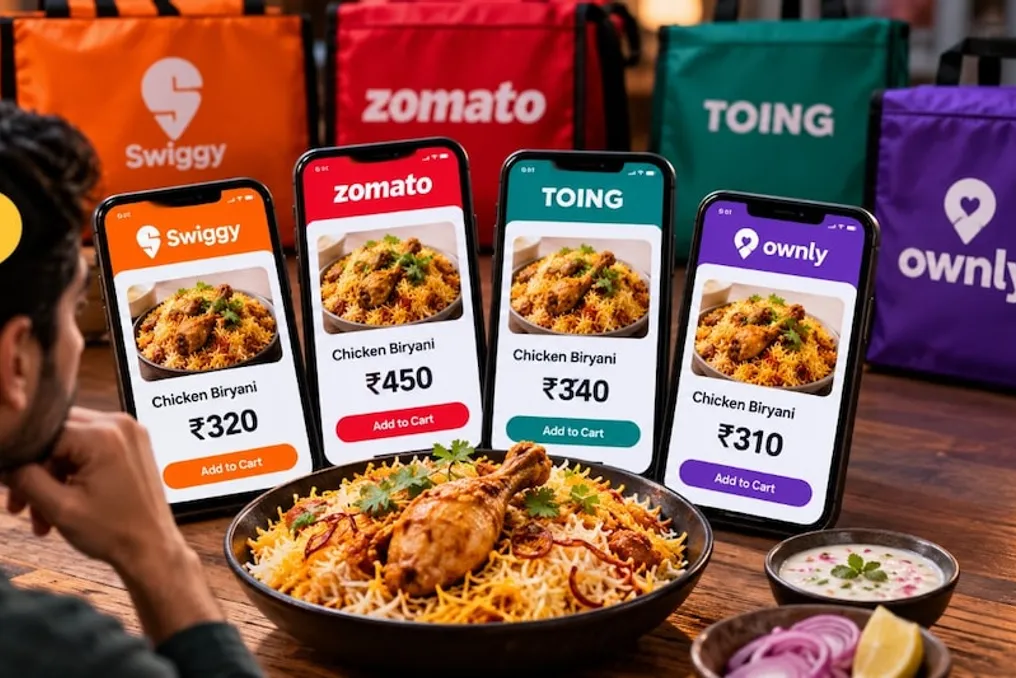
When ordering food online, users often notice that the cost of the same dish from the same restaurant appears differently across various applications. This issue became a topic of discussion after one user's experience on Reddit, who once paid 130 rupees more for the exact same biryani.
Following this incident, the user began comparing prices on different food delivery services. He mentioned comparing prices across various platforms, including Swiggy, Zomato, Toing, and Only. The question arose: why does the price of one plate of chicken biryani vary across different apps?
The simplest answer is that the final price displayed in food delivery apps includes more than just the cost of the dish itself. In addition to the base price listed by the restaurant, it may include delivery fees, platform commissions, packaging or handling charges, taxes, as well as the impact of various discounts.
According to Zomato's terms, the price shown on the platform is provided by the partner restaurant and may include packaging or handling fees set by the restaurant itself. The company notes that the final order cost can change.
Swiggy's terms also state that menu and price information is provided by the merchant, i.e., the restaurant. Consequently, the price visible in the app is not a single price set by the application company itself.
The situation is further complicated by discounts. Suppose the biryani costs 400 rupees at the restaurant in both apps. If one app offers a coupon for 100 rupees, and the other offers no discounts, the customer's final bill will be different, even though the dish is the same.
Furthermore, delivery distance, delivery fees, and other applicable charges can also alter the final amount. The order of the Competition Commission of India (CCI) contains information about restaurants offering partners various discounts and schemes on different platforms, which allows the final price of the dish to differ depending on the platform.
For this reason, it is not enough to just look at the price of biryani, pizza, or burger in any app. It is necessary to compare the total amount in the cart. For example, a dish might cost 250 rupees in one app, but after adding delivery fees and other charges, the total amount could be 320 rupees. In another app, the same dish might cost 270 rupees, but thanks to a coupon or reduced delivery fees, the final bill could be 290 rupees. Thus, an app with a higher menu price might end up being cheaper overall.
Discounts and special offers available on food delivery platforms are not the same for every customer or every order. Due to different coupons, subscription benefits, and bank promotions, the cost of one dish can vary.
Because of this, tools and applications have emerged that claim to compare prices for the same food on different delivery platforms. According to one such tool available on Google Play, it compares menus, delivery fees, and discounts on Zomato, Swiggy, and other platforms.
Next time you order food, do not rely solely on which app shows the lowest price for biryani. If possible, add the same item to the cart in both apps and check the final amount due. Often, a dish may look cheaper, but after adding delivery fees or other charges, the entire order becomes more expensive. At the same time, even if the dish is slightly more expensive in another app, the total amount might be less due to discounts and reduced charges.
The issue, which started with the experience of a Reddit user paying an extra 130 rupees, is not limited to just one biryani. It serves as a reminder that when ordering food online, it is much more important to look at the final bill rather than just the menu price.