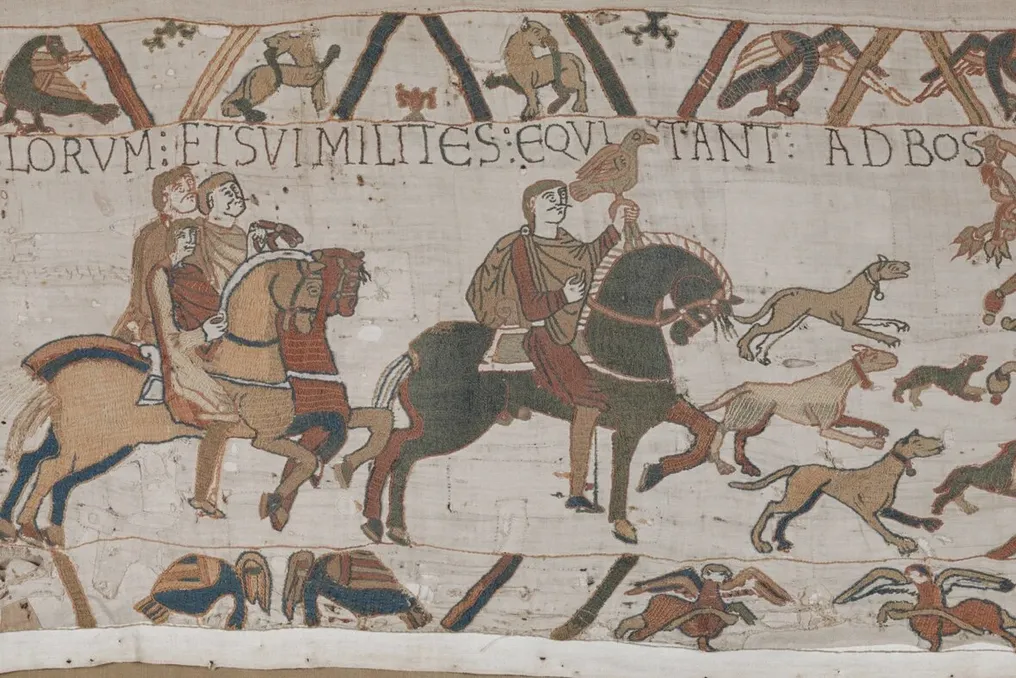
The Bayeux Tapestry demonstrates a hidden legacy of trade networks that extended far beyond Europe into the Islamic world, reflecting the migration of sophisticated Islamic artistic motifs.
Islamic aesthetic solutions were integrated into the framework of English historical chronicles, significantly influencing the visual identity of the Norman nobility. The most obvious examples can be seen in the borders framing the tapestry at the top and bottom, where hundreds of animals are depicted. None of these animals is random; all were deliberately chosen for their meanings, many of which originated from the East.
Medieval monastic scriptoriums preserved visual archives of foreign patterns, enabling the preservation and reproduction of highly complex Islamic and Sasanian silk ornaments across generations. Since the silk fabrics themselves were extremely expensive luxury items, monks and illuminators cataloged and stored these motifs, creating pattern books (Musterbucher).
When high-status Islamic textiles arrived at the monastery—whether as a diplomatic gift, wrapping for holy relics, or royal attire—the master artist carefully transferred the design into the monastery's pattern books. These books were specialized, pocket-sized reference guides filled exclusively with sketches, animal figures, border patterns, and alphabet styles.
Complex Eastern motifs, such as opposing lions or mythical griffins enclosed in roundels, were isolated from the fabric and reproduced. These books functioned like industrial pattern catalogs, allowing monks to use precise mechanical transfer methods to accurately preserve the geometric symmetry taken from woven silk directly onto dense parchment.
The luxury textile items themselves usually never left the monastery's storage. A scribe illuminating a new Gospel book could simply enter the church repository, lay out an imported Abbasid or Fatimid silk fabric on a table, and transfer its border design directly onto the margins of the sacred book he was writing.
Over time, this new Gospel book effectively became a permanent, sacred record of that silk pattern, which was then copied by other scribes.