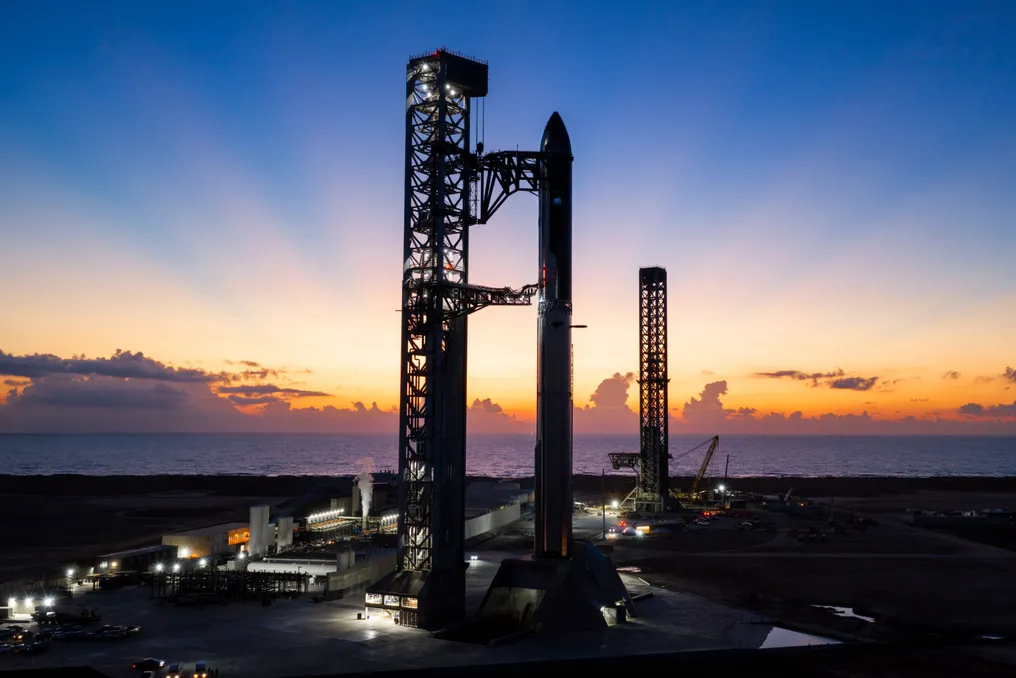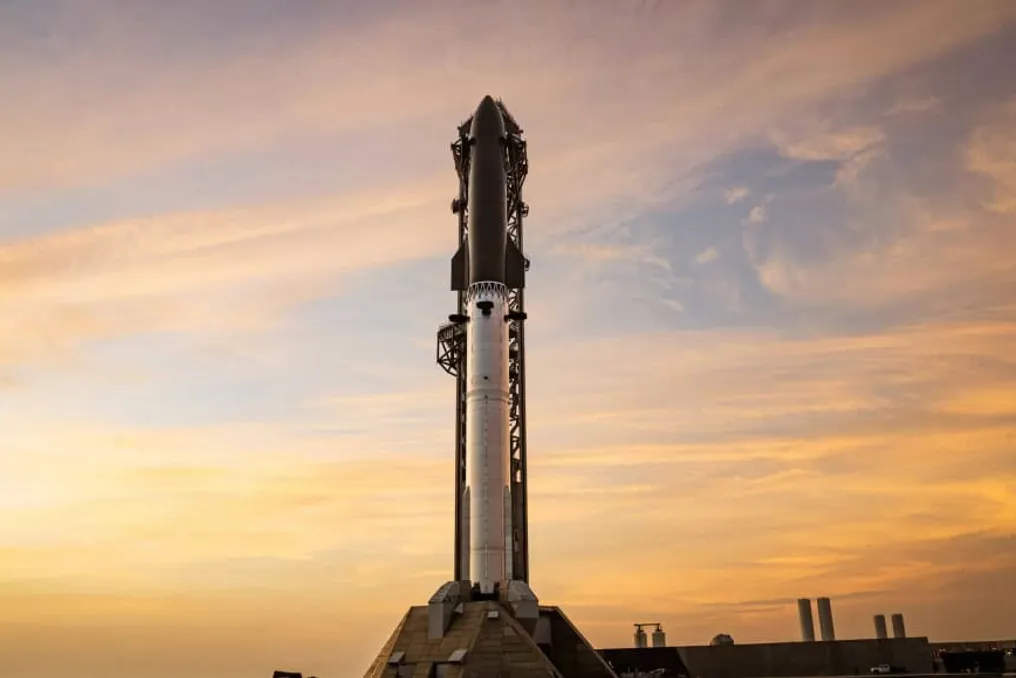
The launch of the 14th test flight of the Starship rocket, developed by SpaceX, has been rescheduled. Initially planned for last Tuesday (22nd), the event was moved to Monday (28th), with live coverage by Olhar Digital.
Unlike previous tests, which focused on suborbital trajectories, this new mission aims to extend the ship's operational time in space to assess its durability in orbit. The 75-minute launch window begins at 9:15 AM Brasília time, requiring takeoff by 10:30 AM, as the necessary route changes due to Earth's rotation. Any technical failure or window closure results in mission cancellation.
To follow this milestone in space exploration, the public can watch the live broadcast on YouTube and Olhar Digital's social media starting at 8:30 AM, featuring Bruno Capozzi, the site's executive editor, and astronomer Marcelo Zurita.
Regarding Mars, data obtained by the NASA Perseverance rover indicated that an area in Jezero Crater has undergone changes caused by water on at least three distinct occasions, each modifying the chemical composition and appearance of the rocks. This discovery was made when the rover reached the inner rim of the crater in September 2023, in the section called 'Margin Unit,' which follows the edge of an ancient Martian lake.
Additionally, the Chinese Space Station, known as Tiangong, received new equipment intended for food preparation in orbit. This device functions like an air fryer, using hot air, following the principle of conventional household technology, and has already been used to cook items such as chicken wings, steak, and cake.
Concerning environmental issues, although carbon dioxide (CO2) is often cited as the main agent of the climate crisis and global warming, it is chemically and biologically an essential component of the Earth's atmosphere, playing a crucial role in the planet's thermal balance. The core of the problem lies in the magnitude and speed of emissions generated by human activities.
The burning of fossil fuels and large-scale industrial processes release a quantity of carbon greater than the Earth's natural absorption capacity. This excess accumulation traps heat in the atmosphere, resulting in global climate change, disruption of rainfall patterns, and damage to agriculture.
In response to this challenge, scientists and governments are investigating solutions located in the Brazilian subsurface, whose unique geological characteristics could transform it into a vast, safe reservoir for carbon, aiding in atmospheric purification and containing global warming.
Projections from the Climate Impact Lab, affiliated with the University of Chicago (USA), warn that a Super El Niño episode could lead to up to 451,000 extra deaths related to extreme heat worldwide in the coming months. Brazil is among the countries with the highest probability of recording additional fatalities, with an estimate of 13,300 extra deaths between September 2026 and February 2027. The study predicts that average global temperatures in land areas may exceed the normal level by about 1.2°C in the coming months, and the number of extreme heat days may increase by 44% compared to a typical year.