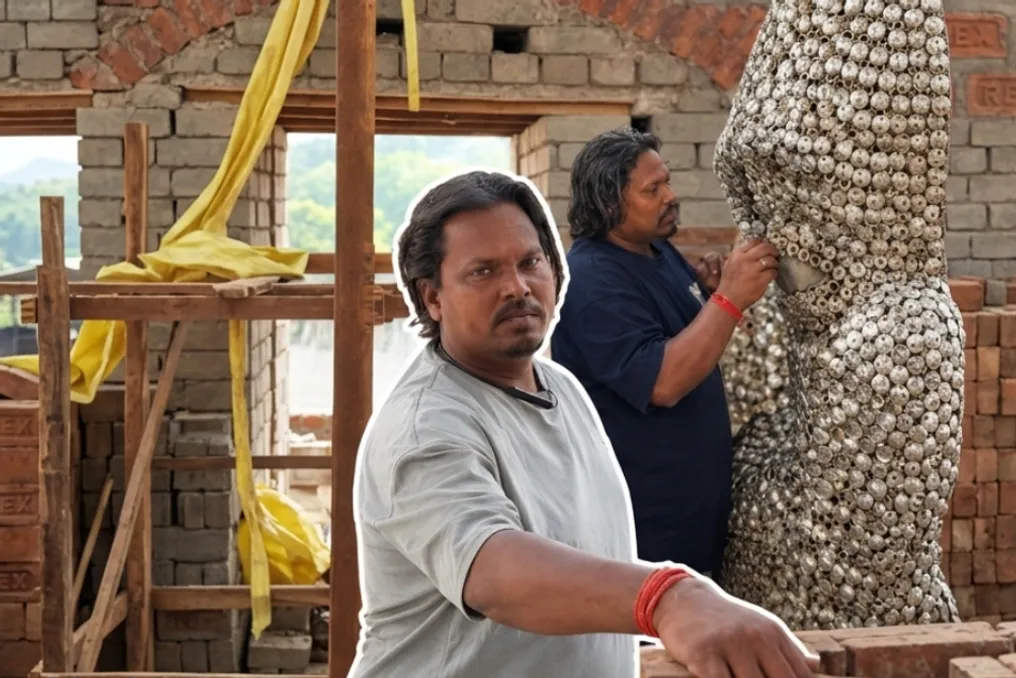
A child standing before the installation examined the curved metal parts and discarded items and asked a question that stuck with the Jharkhand artist Amrit Prakash Sahu: 'Is this made of trash? How can it be so beautiful?'
For an artist who has spent years looking at discarded things in a new light, this question perfectly reflects the goal of his work. Amrit, based in Sahibganj, collects materials that have lost their everyday purpose and transforms them into works of art that prompt people to pause before deciding that something is useless. His work now extends beyond individual sculptures: he is involved in creating the 'Waste to Wonder Park' in Sahibganj, where discarded materials are reimagined as public art. This project places the familiar problem—waste—in a space where people can see it differently.
When waste becomes a canvas
Amrit's interest in discarded objects began with simple curiosity about why things are thrown away after they cease to be useful. Instead of viewing old cans, plastic, wooden parts, and industrial scrap metal as the end of an object's life, he started wondering what else they could become. This instinct places his practice within the broader concept of upcycling, where materials are reused or transformed instead of being sent to a landfill. Previously, Better India highlighted similar approaches, including an example of a Delhi designer turning factory waste into new fashion and an artist using discarded materials to create luxury items.
However, for Amrit, the task is not just conceptual. Scrap metal can be clumsy, fragile, and difficult to work with. Turning disparate parts into a structure capable of standing in a public space requires planning, shaping, and patience. The finished piece must be visually appealing while remaining structurally sound.
His practice has also led him beyond waste installations. In 2025, a report documented an eight-foot sculpture created by him for the Regional CBSE Office in Patna, which was based on the guru-shishya relationship. This work depicted the teacher as a tree and the student as its shadow, demonstrating that his artistic language can move between social ideas, symbolism, and public spaces.
What to do with 1000 tons of scrap metal?
The 'Waste to Wonder Park' gives Amrit's approach a much larger scale. In February 2025, Hindustan reported that the project in Sahibganj is planned for an area of about 22,000 square feet, with over 1000 tons of waste expected to be used. Proposed materials include automotive junk, fans, iron sheets, nuts and bolts, old bicycles and motorcycles, broken tiles and dishes, plastic bottles, old stoves, gas cylinders, and other discarded metal equipment. The local municipal council was supposed to contribute about 200 tons, and some material will be sourced from the Ganges River. The park is planned next to the Ganga Vihar Park on Stadium Road, where sculptures and structures made from scrap, as well as elements for planting, children's playground equipment, and elements designed to stimulate scientific curiosity, will be placed. The stated goal of the park is not just to beautify public space but to encourage recycling and reduce dependence on plastic.
This idea is becoming increasingly visible across India. The Ministry of Housing and Urban Affairs has included 'Waste to Wonder Parks' and waste sculptures in its Swachh Survekshan system, reflecting the potential of transforming discarded materials into part of the public consciousness and civic spaces.
'If it's trash, how can it be so beautiful?'
Nevertheless, perhaps the most telling part of Amrit's work is not the scale of the park or the weight of the scrap metal. It is the reaction of a person encountering art without knowing the process behind it. When a child looked at one of his installations and wondered how something made from trash could be beautiful, that question gave Amrit insight into what his creativity had achieved. The material has changed, but the viewer's perception of it has also changed.
This is the difference between simple reuse of waste and what makes people rethink it. A can can be recycled into another material, but a sculpture can make a person notice an object before it goes into the bin. Thus, Amrit's 'Waste to Wonder Park' is more than just a collection of scrap constructions. It is an invitation to look again at the things we are used to ignoring. If visitors leave with photographs, that is one result. But if they leave with the question of whether the next item they are about to throw away could have a different life, then the artwork has gone much further than the park itself. In this sense, the park transforms the conventional consumption model into a lesson in imagination, responsibility, and possibility for all.