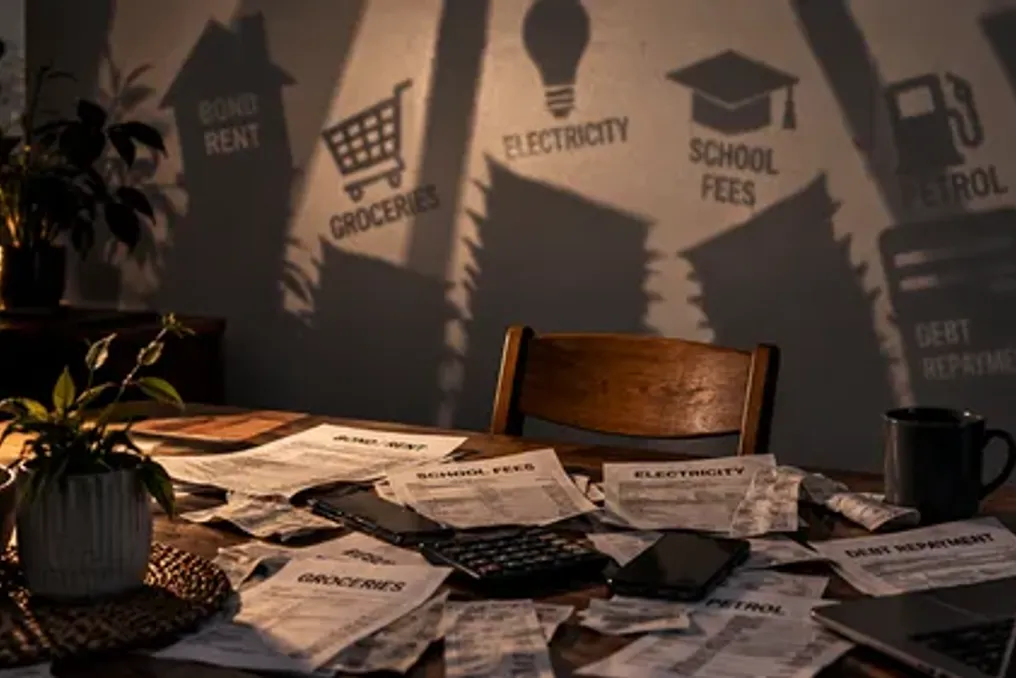
In most South African households, the situation with commodity prices demonstrates the state of the economy more clearly than any news headline. When visiting a grocery store with an amount of 100 rand, a shopper often leaves with fewer goods than they could have bought for the same amount a year earlier.
Issues related to oil have become relevant again. The price of Brent crude has exceeded 100 US dollars per barrel, causing the usual media reaction—a surge, a warning, and an upward graph. However, for a person holding 100 rand, this means not so much drama as the stability of a situation that is more complex than headlines suggest.
The pricing mechanism is relatively simple: since South Africa imports most of its fuel and purchases it in dollars, the price at the pump depends on two factors: the international cost of refined fuel and the rand's exchange rate against the dollar. To this are added taxes and levies, which account for about a third of the final price, as well as regulated markups.
From the gas stations, the price spreads further. Approximately seven out of ten public transport users rely on minibus taxis, and between May and June of this year, the fare in such taxis increased by 11.5 percent in just one month. Since every loaf of bread and bag of maize meal is delivered by trucks running on diesel fuel, fuel is a fundamental component of many expenses.
Much of the confusion arises from the variety of economic indicators: the inflation index in headlines, core inflation, CPI, food inflation, medical inflation, and school fee inflation. These indicators are measured differently and presented as if each one speaks to something separate, although in reality, they all merely reflect price increases, not decreases.
In July, the headline inflation figure was 4.3 percent, lower than the previous 5.0 percent, and food inflation fell below one percent—the lowest figure in sixteen years. While this may seem like a relief, a lower number actually only means a slowdown in the rate of price growth, not a decrease in prices.
There is a simpler way to analyze this: Statistics South Africa publishes a constant price index that tracks the cost of a standard basket of goods over time. Comparing the cost of this basket in 2015 with the current cost shows that it has become approximately seventy percent more expensive, and this happened almost monthly, rather than in most months.
During the same period, oil prices fluctuated: falling from 99 dollars per barrel to 44 dollars, then rising above 100 dollars again, and subsequently dropping to 69 dollars. The rand-to-dollar exchange rate also changed aggressively: it fell from less than 11 rand per dollar to more than 18 rand and back again. Both these indicators moved in both directions, whereas the price level moved only in one direction.
Despite the pressure from high oil prices (above 100 dollars), a strong rand, which reached its highest level since 2022 (trading around 16 rand to the dollar and recently falling below this level), plays to the economy's advantage.
In July, when oil prices dropped, petrol fell by 7.1 percent in a month, and diesel by 11.7 percent, which is a real and significant decrease. Nevertheless, both types of fuel remain significantly more expensive than a year ago. Taxi fares, which rose in June, have not returned to previous levels, and the widely tracked basket of basic foodstuffs, which decreased by about 50 rand in August, is still 100 rand more expensive than a year ago.
Rapid downward steps are accompanied by large upward steps. When oil prices sharply rose in March, the government reduced the general fuel levy by 3 rand per liter starting April 1st, extending this support as the conflict continued, and then gradually reducing it by June. This measure provided real protection and cost about 17 billion rand in lost revenue over three months. However, the full levy was reinstated on July 1st.
The honest answer contradicts the headlines. The situation is not serious because oil is above 100 dollars, as it was above this mark in April. The seriousness lies in the fact that in April there was a barrier of 3 rand per liter between world prices and fuel in the tank, and now that barrier is gone. The sum of 17 billion rand over three months is not something the country can afford to do twice.
The Competition Commission has a term to describe this behavior in its Cost of Living Report: 'rocket and feather behaviour'. Prices rise quickly when raw material costs increase, and then slow down or do not decrease at all when these costs decrease. The Commission warns of legitimate concerns that prices may not begin to fall after fuel prices stabilize. It should be noted that not all studies agree, and the analysis of the maize production chain did not reveal such a pattern, instead pointing to drought and global turmoil.
Furthermore, there is a factor unrelated to oil. Food inflation is at a sixteen-year low, and maize meal and bread have actually become cheaper in July. This is not an act of generosity, but the result of two consecutive good rainy seasons, which ensured a maize harvest of about 16.5 million tons against an annual consumption of about 12 million tons. However, this favorable period is coming to an end.
The meteorological service has warned that El Niño will begin in October, coinciding with planting time. Approximately four out of five hectares of summer grain depend on rain rather than irrigation. The last severe El Niño in 2015 and 2016 reduced the national maize harvest by about a third. If this happens again, the cheapest part of the consumer basket will become the most expensive, and the culprit will not be the price of oil.
Therefore, one should not watch the price of oil, as it will change again. One must observe the same basket of goods: track the cost of buying similar items over three months, monitor whether the fare that increased in June will ever return to its former level, and see how the shelf reacts to the strongest rand in four years. The question was never how high oil would rise; it was whether anything we buy would become cheaper again. Based on data from the last decade, this is not happening. It is getting more expensive, but slower, and that is already considered good news.