For most residents of South Africa, the lack of a direct flight to Mumbai is merely an inconvenience; however, for the Indian community, it is perceived as an insult. Family trips, such as funerals in Gujarat or weddings in Chennai, are not viewed as a logistical problem but as an unfulfilled promise made by three ministers.
The time lost in transit layovers cannot be recovered, unlike money spent. When South African Airways operated a direct Johannesburg–Mumbai flight, it took about nine hours. Today, the same route via Doha or Dubai takes between 14 and 16 hours including layovers, and via Addis Ababa, even longer.
These additional five to seven hours in each direction represent a loss of time for passengers, whether it is a grieving family unable to spend time with a dying relative or working parents who cannot return with their child on time. Although the country can compensate for the ticket cost, neither the president, nor the minister, nor the airline can restore lost time.
The Indian community in South Africa has a deep historical connection to this issue. The first indentured laborers arrived in Durban in November 1860, and today about 1.8 million South Africans have roots tracing back to this arrival, making them the largest population of Indian descent outside of India itself.
President Cyril Ramaphosa acknowledged in 2019 the complaints of Indian businessmen regarding the difficulty of travel between the two countries and agreed that the influence of the Gupta family contributed to the route closure in 2015. Tourism Minister Patricia de Lille has repeatedly confirmed this commitment in December 2024, late 2025, and August 2026, citing negotiations with Air India, IndiGo, and SpiceJet, as well as the upcoming 2027 Cricket World Cup as a new deadline.
Nevertheless, the number of Indian arrivals remains insignificant compared to the scale of connections: in 2025, there were 69,680, against a total of 10.48 million arrivals in South Africa. The department attributes this gap to the absence of direct flights and slow visa procedures.
The community's frustration is compounded not only by the delay but also by the fragmentation of efforts. The Durban Direct organization independently negotiated with IndiGo and Air India, while a delegation from Cape Town held separate discussions with Air India in Bengaluru. Meanwhile, the Gauteng region, which controls the OR Tambo airport and most of the historical traffic from Mumbai, has not initiated similar public measures.
Three branches of government are conducting three separate dialogues toward one common goal, while bilateral trade approaches $19 billion annually, and over 150 Indian companies employing thousands of South Africans generate enough traffic to justify a single coordinated national stance.
There is an encouraging precedent to build upon. In July 2026, the Indian Consul General in Johannesburg, Shri C. Coventan, met with the current SAA executive committee head, Matshele Seshebe, to emphasize the need for direct connectivity as a 'strategic necessity.' Seshebe promised to expedite this proposal.
According to available information, the Indian High Commission office in South Africa, headed by Shri Prabhat Kumar in Pretoria, is interested in the success of this matter and has indicated it will provide assistance. This office is well-positioned to help bring Coventan's initial work to fruition. Similarly, the South African High Commissioner in India, Professor Anil Sukhalal, is reportedly already engaging with Indian business on behalf of the president. His role as BRICS Sherpa gives him direct access to Delhi, which could accelerate the transformation of goodwill among Indian carriers into signed commitments.
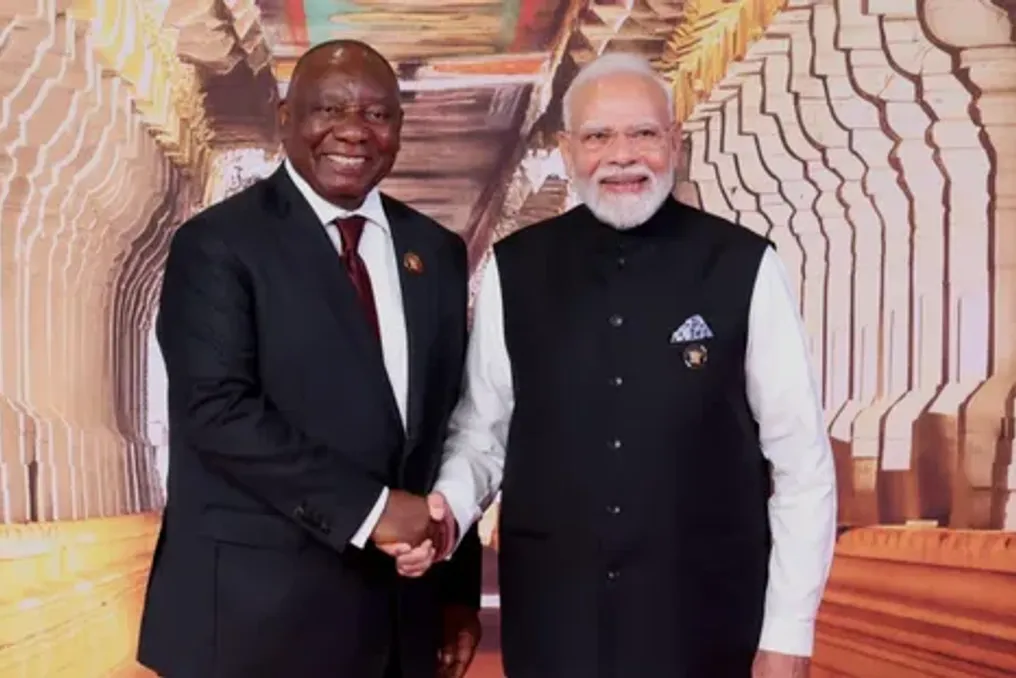
This issue goes beyond mere scheduling, as the community's frustration is ultimately tied to recognition. Indians from South Africa have fought for a century against Group Areas Acts and forced removals to assert their full, not temporary, right to reside here. Watching their most basic connection to their native culture and family be treated as a low priority, while ministers travel to Delhi for photos, revives a sense of neglect that history should have overcome.
Solving the problem does not require a new investigation. The route, airlines, and demand have already been determined by the Department of Tourism. What is missing is coordination: a unified national negotiating position that should be jointly led by the two high commissioners and publicly supported by the Presidency, instead of three provinces, a ministry, and two consulates holding separate talks towards one goal.
President Ramaphosa has shown a propensity for investigative commissions. This same instinct can be applied to a more modest and achievable task: creating a small, time-limited group of representatives from the Ministry of Tourism, Transport, DIRCO, and both high commissioners to determine what is hindering the opening of the route and present a signed agreement by the end of the year, rather than postponing it until 2027.
He himself admitted that he inherited the problem with this route in 2015 from his predecessor's administration. Completing the repair is not a favour to the Indian community, but fulfilling work that his own government has already recognized as necessary.
The President also set a more personal test for himself. At the same BRICS summit where he again promised a direct flight, President Ramaphosa showed Prime Minister Narendra Modi on camera that he had bought books in India and paid for them in rupees, observing the transaction completion in Rand. He stated that this proves that trade in local currency between BRICS partners is already working. If this is true in a shop in Delhi, then there is no reason why South Africans should not pay in rupees here, and Indian guests in Rands, as normal commerce, and not presidential anecdote. This is what BRICS should ensure: not just summits and photos, but a payment system and a route that ordinary citizens can use.
The President does not need additional roundtables in New Delhi to inform South Africans about the imminent launch of flights. The promise has been made publicly multiple times. The task remains for those in authority—the Presidency, the Ministry of Tourism, Transport, and the two high commissioners in Pretoria and New Delhi—to finalize what one consulate meeting in Johannesburg began this year, not next.