Three years ago, while in a pub in Hackney, London, British endurance runner Jack Jarvis was recovering from serious knee surgery. His leg was still in a cast and brace following an aviation incident that resulted in tears of the medial collateral ligament (MCL) and posterior cruciate ligament (PCL), as well as partial tears of the anterior cruciate ligament (ACL) and meniscus.
He spent months contemplating returning to his favorite activities: pushing himself, testing limits, and accepting challenges that seemed slightly unattainable. Jack was no novice in endurance sports; in 2022, he became the first person to swim solo and non-stop from continental Europe to North America, spending 111 days at sea and covering 3601 nautical miles.
However, sitting in that pub, his next challenge remained just an idea. He told a friend George: 'As soon as I finish rehabilitation, I will run from Beijing to London.' This thought came after seeing someone cycling from Bristol to Beijing, and he wondered why he shouldn't make the journey in reverse, finishing on his home soil.
George doubted his chances of success but made a deal with him: if Jack could reach the starting line, his company FourFive would sponsor him.
Realizing the Idea
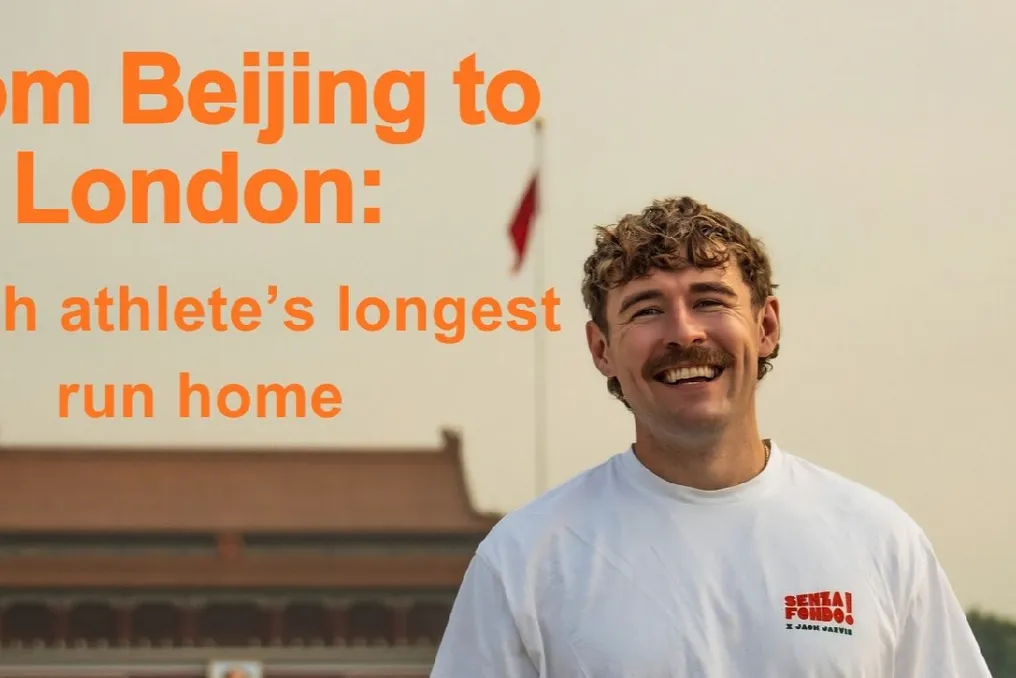
Three years later, on July 20, 2026, Jack stood in Tiananmen Square in Beijing, ready to start his run home. The plan, at least on paper, is quite simple: to run approximately 13,000 kilometers from Tiananmen Square to Trafalgar Square in London, crossing 18 countries and taking about 10 months.
Jack aims to cover about 50 kilometers daily, limiting rest days to zero. This is equivalent to more than 300 consecutive marathons. His accompanying team travels with him in a specially equipped Ford Transit van, which serves as a mobile base for food, fuel, equipment, recovery, and logistics.
The first ten kilometers from Beijing were covered with three people. In an interview with CGTN, he noted: 'At first, it distracted me from how massive this actually is. There was some relief that after 18 months of planning, I was finally on the road.'
However, by the second and third day, that feeling changed. 'I realized how huge this would be.' The early stages already tested the plan: Jack encountered robbery, mechanical problems with the support van, visa difficulties, and route issues. By the tenth day, he had run 572 kilometers and reached Hohhot in Inner Mongolia. These setbacks forced his daily average to approach 60 kilometers.
Then, the support van's axle broke. For an expedition that relies on a vehicle for food, equipment, logistics, and recovery, this problem could have jeopardized the entire journey. Nevertheless, the kilometers kept accumulating. Having now covered over 2500 kilometers in the Chinese section, Jack and his team, including videographer and driver Tommy Denny, are heading into a completely new phase of the journey.
Experiencing China at Running Pace
At running speed, it becomes difficult to ignore the scale of China. Jack observed: 'When you have run 500 kilometers and you are not even at one-fifth of the way, you realize how enormous China is.'
At running pace, the landscape changes slowly enough to be felt rather than just passed by. He ran through forests around the Great Wall of China, across the steppes of Inner Mongolia, and through the deserts of Gansu. Jack added: 'The deserts in Gansu looked like a scene from Star Wars.'
The Great Wall of China was another striking moment, the embodiment of a childhood dream. 'I always wanted to see the Great Wall of China,' he said. But some of the most memorable moments happened far from the sights.
Jack notes that the Chinese people were 'truly friendly,' often offering him water, fruit, and snacks, and sometimes rides. 'In 99% of cases, they tell me and Tommy that we are the first Westerners they have seen.'
Running across the country, rather than traveling through it, creates a different relationship with distance. There is time to notice roadside stops, villages, changing landscapes, and people who would otherwise remain strangers. The long days also made food an important part of life on the road. Jack calculated that he burns about 5000 calories a day, and says he enjoyed the food along the route. 'I love Chinese food,' he stated, often letting his Chinese guide make recommendations. Among his favorites so far are Peking duck and sweet and sour pork.