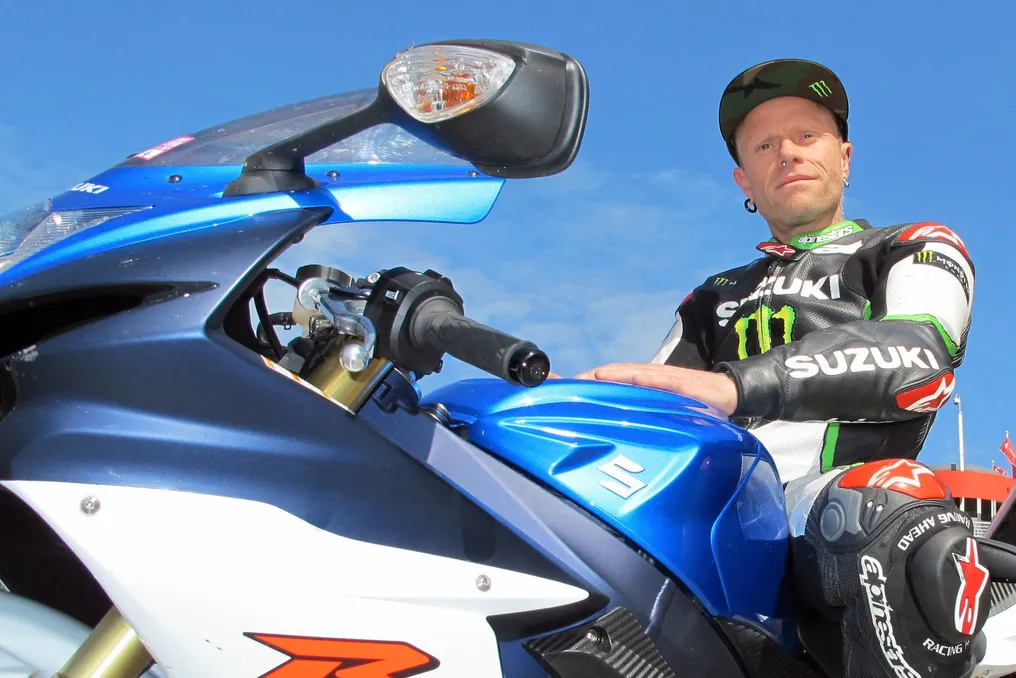
Recently, while discussing Keith Flint's passion for motorcycles in FlatOut, his dual legacy to fans was mentioned: his musical compositions and his appreciation for bikes, including two victories in the renowned Isle of Man Tourist Trophy as a team owner.
Naturally, Ian Hutchinson had to be cited because he was the rider who won races for the Traction Control team, which was established and managed by the Prodigy vocalist. For this reason, the author decided to dedicate an article to Hutchinson, known behind the scenes in motorcycling as Hutchy, and also by the nickname Miracle Man (which can be translated as 'Miracle Man').
This nickname was not given by chance; Hutchinson is at the center of one of the greatest narratives of overcoming adversity—a worn-out but justified term in this case—and stubbornness in the history of motorcycling, which is no exaggeration.
Bingley's Projectile
It might seem strange to use such terms when talking about Ian Hutchinson, giving the impression that he is a legend from the past. However, this is not true: Ian Hutchinson was born on August 12, 1979, meaning that as of the publication date of this text, he had not yet turned 50. His hometown is the quiet Bingley, located in the English countryside, which earned him a third nickname: The Bingley Bullet ('Bingley's Projectile'). It seems these small towns are often breeding grounds for talent in motorsport.
Obtaining detailed and accurate information about Hutchinson's early career requires more than a quick internet search. One source is an old interview the rider gave to the Top Gear website, where he reported that he started riding in 1999, at the age of 20, which would be relatively late compared to other talents, initially participating in regional competitions on closed tracks in the basic categories.
Interestingly, two years earlier, he owned his first car, a Peugeot 205 GTI. The rider commented to the publication: 'I crashed it twice! They are treacherous, aren't they? As soon as you ease off the accelerator mid-corner, the rear slides out.' Later, he had a Peugeot 205 GTI Dimma, an iconic version with an aftermarket widebody kit. In 1999, he acquired a Mitsubishi Lancer Evolution VIII.
Regardless, Hutchinson's focus has always been on two wheels. In 2003, he switched from closed tracks to street circuits, immediately deciding to take on the Tourist Trophy in the Newcomers category, riding a 600cc Honda. He defeated the duo of Jonathan Ralph and Alex Donaldson, both on 750cc Suzukis, marking the beginning of a record-breaking trajectory.
A Meteoric Rise
The Isle of Man Tourist Trophy is not a beginner's race; it is said that the learning curve on the Snaefell Mountain Course takes years. However, Hutchy seemed to have the over 60-kilometer layout engraved in his memory. After an initial scare at the North West 200 in 2004, where he injured his leg in the first meters of training, he made his official debut in the main TT categories that same year, finishing among the top ten riding a Suzuki (never being loyal to a single brand).
His evolution was impressive. In 2006, riding for McAdoo Kawasaki, Hutchinson broke the lap record in the Supersport category at the North West 200, achieving an incredible average speed of 188 km/h, and in that year's TT, he reached the podium twice. However, the highest step came in 2007, when, with HM Plant Honda, he won the Supersport Junior TT, surpassing the legend John McGuinness by a narrow margin of 2.84 seconds. Beating McGuinness on the Isle of Man attracts worldwide attention in motorcycling.
Between 2008 and 2009, Hutchinson switched teams (AIM Yamaha, then Padgett’s Honda), accumulating podiums and breaking records at the Ulster Grand Prix with averages exceeding 214 km/h, solidifying his reputation as one of the fastest and most precise riders in street racing. However, nothing prepared the world of motorcycling for what would happen in 2010.
In motorsport, there is much talk about the 'flow state'—an almost trance-like state where rider and machine unite into a single entity, immune to fear, processing information at a speed difficult to explain scientifically. In June 2010, Ian Hutchinson exemplified one of the best cases of flow state in motorcycling history.
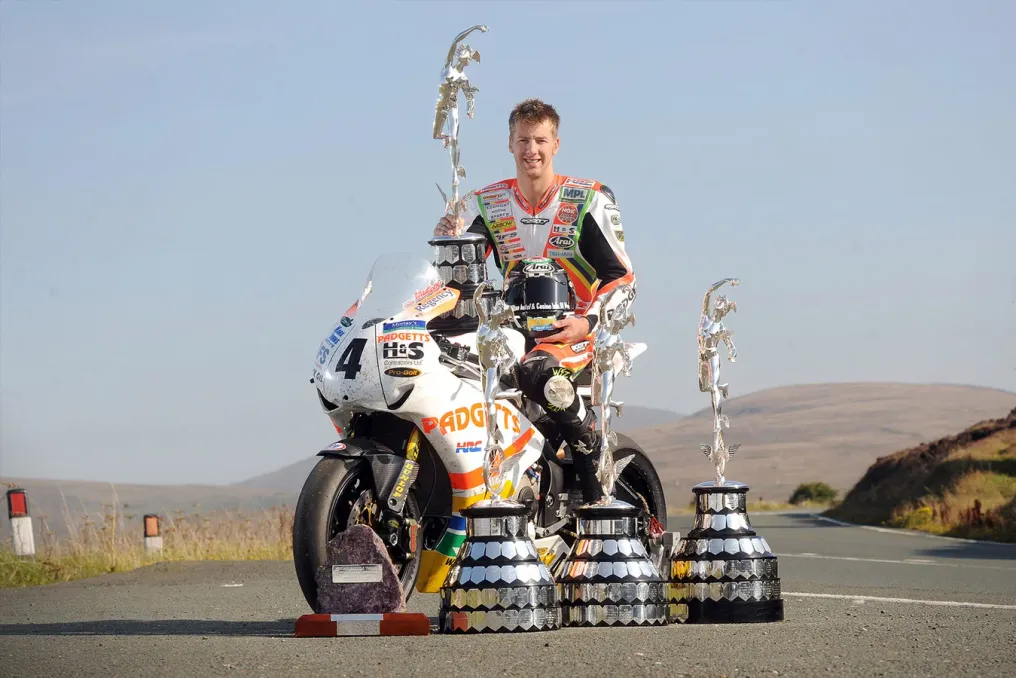
The Isle of Man TT consists of a week of training and a week of grueling races. Winning a race there is the pinnacle of many riders' careers; winning two in the same year is reserved for big names. With Padgett’s Honda, Hutchinson won the Superbike race, followed by Supersport, and also secured Superstock. Three wins in the same week already placed him in an elite group, which did not prevent him from competing again in the second Supersport race and winning once more, equaling Phillip McCallen's historical record from 1996, with four victories in the same edition.
The Senior TT remained, the main event, the longest, most dangerous, and most prestigious on the Island. The initial start was suspended due to an alarming accident involving Guy Martin. On the restart, with remarkable coolness, Hutchinson raced at an extraordinary pace, winning with a 37-second lead over Ryan Farquhar. Five races, five victories. A complete sweep, an unprecedented feat in more than a hundred years of Tourist Trophy history. The 'Bingley Bullet' had redefined street motorcycling in less than ten years of his career.
The Nightmare Begins
Glory on the Manx Mountain often attracts the wrath of the gods of speed.
In September 2010, shortly after making history on the Isle of Man and defeating rivals at the Ulster Grand Prix, Hutchinson was on the grid for the British Supersport Championship (BSB) at Silverstone. Due to heavy rain, the treacherous conditions caused a pile-up with several riders on the first lap. Hutchinson fell—which, until then, was expected in the profession. However, as he slid inertly across the track, the motorcycle of a competitor coming up closely behind failed to swerve and hit him in a devastating impact. His left leg suffered multiple open fractures of the tibia and fibula. The bone was destroyed, tissues torn, and arteries severely damaged, leading paramedics to immediately consider amputation.
On that rainy day in Silverstone, the prodigy phase ended, and the saga of the Miracle Man began. To say that Ian Hutchinson 'recovered' is an almost disrespectful euphemism; what this man achieved was declaring war on his own body. Sixteen initial surgeries and numerous skin grafts were required just to save the limb. He missed the start of the 2011 season, spending days in hospital beds facing external fixation cages screwed into his bones.
Pain was a constant companion, as was the risk of infection. But at the end of 2011, surprisingly, Hutchinson returned to the grid for the Macau Grand Prix and led the race in the opening laps, finishing third.
However, happiness was short-lived. In 2012, after signing with Swan Yamaha, he was undergoing off-road training as preparation for an event in London. Suddenly, with a simple movement, his left leg, still fragile, broke again. Back to external fixators and the operating table. Hutchinson still participated in the 2012 TT with great sacrifice, managing to finish among the top ten in some races, but his body reached its limit. It was at this point that Hutchinson made a decision that demonstrated his determination to continue: if the human body could no longer adapt to the conventional bike, the bike's mechanics should adapt to his will.
His left leg lost strength, range of motion, and sensation, making gear changes on the left side almost impossible. The solution found was to reverse the controls: the gear pedal was redesigned and moved to the right side of the bike, along with the original rear brake. To operate the rear brake, mechanics installed a system activated by the left thumb on the handlebars, a technique already used by Mick Doohan in the 500cc, as he too had suffered an accident and nearly lost his left leg.
In total, Hutchinson would undergo 30 surgeries on his left leg. The thirtieth, and theoretically the last, took place in September 2013, exactly three years after the Silverstone accident. He went through another cycle of painful physiotherapy and went to the Almería circuit to test a Milwaukee Yamaha R1, completing over 200 laps to force his brain to adapt to the new bike setup.
The Projectile's Return
The ultimate test of this new era took place in Macau, at the end of 2013. The Macau GP is undeniably one of the most intense motorcycle races on the planet, surpassed only by the Manx TT, held on a tight street circuit between protective barriers and yellow and black walls, with no escape area.
Ian and the Milwaukee Yamaha registered late, missing the deadline by 24 hours—the organizers initially refused entry but reconsidered days later. With a completely modified bike and a leg that looked like a map of war scars, Hutchinson not only entered the track but also secured another pole position. In the race, he engaged in an epic duel against Michael Rutter—the absolute master of Macau—and veteran John McGuinness. Using the thumb brake and reversed gears, Hutchinson won the race, proving to the skeptics that the Miracle Man had returned to the top of the podium.
Shortly after, his path crossed with Keith Flint's. In 2015, Hutchinson resumed his former form at the Isle of Man TT, winning three races that year—one of them riding the powerful Kawasaki ZX-10R from the PBM team, in the Superstock class. The other two were in the Supersport class, using the meticulously prepared Yamaha YZF-R6 from the Team Traction Control, the Prodigy vocalist's team.
There was no better setting for this collaboration: Flint represented the embodiment of electronic punk and anarchic energy on stage, and provided the ideal machine for Hutchinson, the rider who refused to be intimidated by medical data. This performance earned Hutchinson the 2015 Joey Dunlop trophy.
The definitive consecration came in 2016. Competing for Tyco BMW in the 1000cc category and maintaining the partnership with Team Traction Control in the 600cc, Hutchy once again overcame the competition, winning Superstock and both Supersport stages. As a bonus, during the Superstock practice sessions, he broke the circuit record for street-tire motorcycles.
His victory in the second Supersport race in 2016 marked his 14th triumph at the Isle of Man TT. At this historic moment, the young man from Bingley equaled the number of victories of Mike 'The Bike' Hailwood, considered by many the greatest natural talent in motorcycling. This achievement earned him the rare Torrens Trophy, awarded by the Royal Automobile Club of the United Kingdom, an honor given only to those who demonstrate 'notable determination, courage, and overcoming adversity.'