MediaTek surpasses half of cell phones sold in Brazil in the first semester
Read more
Tecnoblog
tecnoblog.net

MediaTek surpasses half of cell phones sold in Brazil in the first semester

MediaTek is significantly expanding its presence in the Brazilian smartphone market, widening the gap with its main competitors, such as Qualcomm, which maintains overall leadership. According to information provided by the IDC Quarterly Mobile Phone Tracker, the manufacturer was responsible for equipping 51.8% of devices distributed in the country during the first half of this year, an increase compared to the 48.4% recorded in the same period last year.

This progress places MediaTek ahead of its main competitor in Brazil and reflects a similar trend observed in other Latin American regions. In Latin America, the company's share has also grown, jumping from 50% to 51.5%, according to IDC data.

IDC data refers to smartphone shipments, meaning the devices sent to the market by manufacturers and distributors in the analyzed period. The relevance of MediaTek's presence is even more notable when analyzing the best-selling models in Brazil; all five highest-volume selling devices use the company's chips, according to reports from Counterpoint Research released by Mobile Time.

This list of best-sellers consists of three Samsung models and two Motorola models, all belonging to the entry-level segment. Simultaneously, MediaTek is focused on increasing its presence in higher value-added devices, a niche traditionally dominated by Qualcomm.

This strategy is mainly driven by the Dimensity family, which includes chips intended for advanced mid-range smartphones, such as the Motorola Edge 70 Pro, and flagship models, such as the Oppo Find X9 Pro and the Oppo Find X10 Pro Max, which may soon be launched in Brazil. The company has diversified its chip offerings for these higher categories.

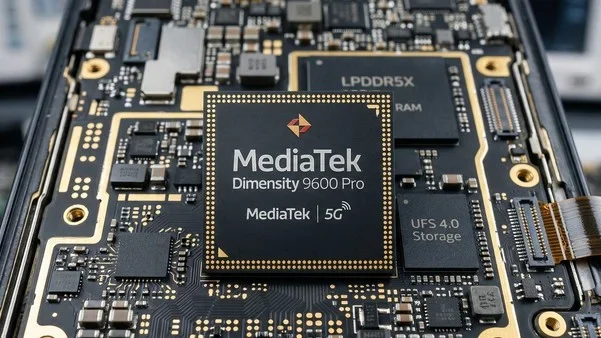
This year, platforms such as the Dimensity 9600 Pro, the company's first chip produced using the 2-nanometer process, and the Dimensity 8500 series were introduced, both incorporating artificial intelligence (AI) processing functionalities.

Additionally, IDC figures indicate that MediaTek's share in smartphone shipments in Latin America rose from 50% to 51.5% between the first half of 2025 and the same period of 2026. Samir Vani, MediaTek's Director of Business Development for Latin America, commented on this performance in an official statement by the manufacturer, attributing the success to the strategy of making technological features accessible across various product classes.
Similar stories

MediaTek launches Dimensity 9600 Pro, its first 2-nanometer chip for smartphones
Read more
tecnoblog.net

MediaTek launches Dimensity 9600 Pro, its first 2-nanometer chip for smartphones

MediaTek announced the Dimensity 9600 Pro on Tuesday, September 15th, marking the launch of the company's first chip produced using the 2-nanometer process. This component, intended for the next generation of high-end smartphones, promises to boost raw performance and optimize power consumption.

The company's strategy is to provide processing power for demanding applications, including artificial intelligence assistants that operate locally in the background on the device. A notable aspect of the Dimensity 9600 Pro is its Central Processing Unit (CPU), which consists exclusively of eight high-performance cores, distributed across two Arm C2-Ultra processors, three Arm C2-Pro, and three more Arm C2-Pro.

In practical terms, the company claims that this configuration results in 17% superior single-core performance and 37% greater energy efficiency compared to the previous generation. Furthermore, the platform stands out for being pioneering in supporting UFS 5.0 storage and the new LPDDR6 RAM, which provides higher transmission speed and agility in data reading.

In the field of Artificial Intelligence, the SoC incorporates a dual Neural Processing Unit (NPU) architecture. One of these units is dedicated to generative AI processing directly on the device, while the other operates in the background. This division, according to MediaTek, ensures that virtual assistants can operate without excessively draining the device's battery.

Graphics processing is managed by the newly introduced Arm Mali-G2 Ultra NX GPU. This mobile graphics card offers hardware-accelerated ray tracing features and significant visual improvements. The chip supports native gaming at over 185 frames per second while reducing power consumption by 24% during peak performance.

For photography-focused users, the Image Signal Processor (ISP) is capable of handling sensors up to 200 megapixels and introduces a novel feature: the ability to record slow-motion videos in 4K resolution at 240 frames per second. In multimedia functionalities, the Dimensity 9600 Pro is the first chip for mobile phones to perform hardware decoding of the H.266 video format and already has native support for new tri-fold foldable screens.

Regarding connectivity, the chip integrates a 5G Advanced modem, Wi-Fi 7 network support, and Bluetooth 6.2. The new processor has already established important collaborations; the Chinese manufacturer Oppo confirmed that the future Find X10 Pro Max and Vivo X500 Pro will be equipped with the Dimensity 9600 Pro. It is worth mentioning that in Brazil, the Vivo brand is marketed under the name Jovi.

Popular