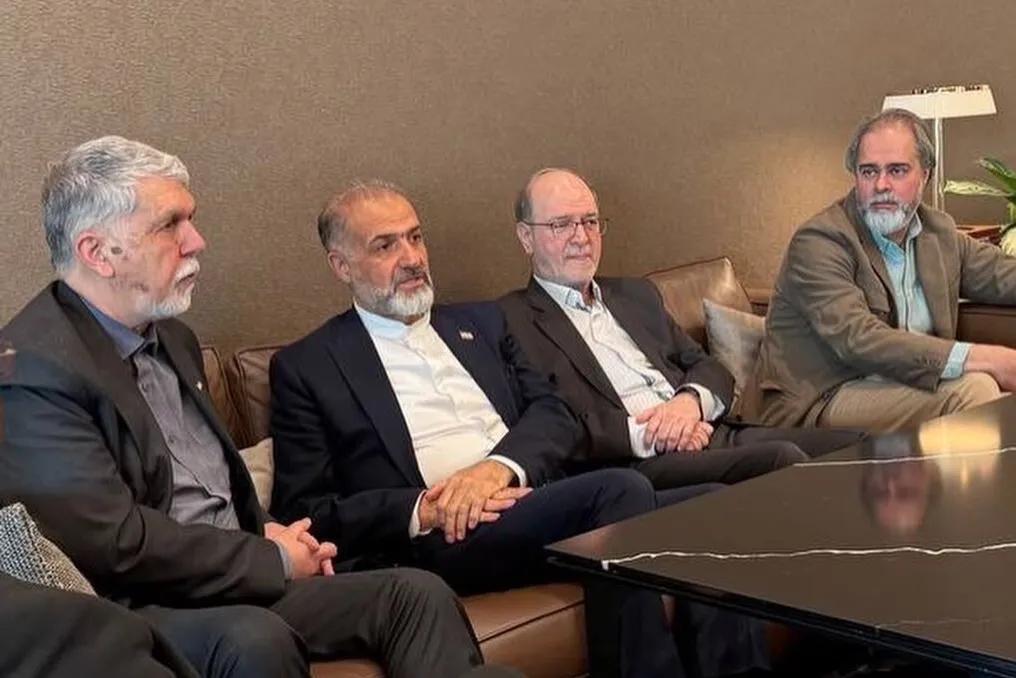
The Minister of Culture and Islamic Guidance, Seyyed Abbas Salehi, arrived in Russia with the aim of participating in the XII International Forum of United Cultures and the development of joint cultural projects between Iran and Russia.
According to an ISNA report, the trip began in St. Petersburg and will continue with a meeting of the joint cultural committee of the two countries, as well as the opening of Iranian Cultural Week in four Russian cities.
Salehi arrived in Russia on Thursday and, after a brief stop in Moscow, traveled to St. Petersburg to participate in the XII International Forum of United Cultures. The event was held under the slogan 'United Cultures, Shared Values' and gathered high-ranking officials and prominent figures from the arts and culture of about 70 countries, including 44 official delegations.
This year's forum theme focused on the protection of cultural heritage, expanding international humanitarian cooperation, and the influence of new technologies and artificial intelligence on culture and creative industries.
Upon arriving in St. Petersburg, the minister emphasized that culture is one of the key foundations of relations between states and governments. He stated: 'Culture is the foundation and anchor of long-term relations between peoples and governments. Governmental relations may have their ups and downs, but culture provides the point of support, stability, and continuity.'
Regarding Iranian-Russian ties, Salehi noted: 'We have had and continue to have good relations with the government and people of Russia.' He added that ties between the two countries have been strengthening and expanding in recent years, and culture has played a significant role in giving these relations greater stability, consistency, and breadth.
Salehi also called the planning of Iranian Cultural Week in Russia one of the most important initiatives for developing cultural ties between the two states. He recalled that various cultural weeks have been held between Iran and Russia over the past two decades. 'Last year, Iran hosted a Russian delegation of 130 people, including the Russian Minister of Culture and artists. This year's Iranian Cultural Week in Russia will include more than 120 Iranian artists and production staff,' he noted.
Highlighting the difference between the current program and previous ones, Salehi explained: 'Previously, we have not held a cultural week of this kind, with such a range of topics.' He specified that the program will include specialized forums, exhibitions, musical performances, and a film week. The minister stressed that the events are not limited to holding several cultural activities; strengthening long-term ties between the two countries is also a priority.
As part of the visit, the Iranian Minister of Culture will meet with his Russian counterpart in St. Petersburg on Saturday. They will then hold a meeting of the joint cultural committee. Before the committee meeting, three working groups—dedicated to culture, art, and tourism—will meet with representatives of the relevant departments of both countries. The results of their discussions will be presented at the meeting of the two ministers of culture.
Salehi announced that the joint committee will exchange and sign various documents on cooperation in culture and art, including agreements related to cinematography.
He also pointed to the broader geographical scope of the current Cultural Week, calling it another distinguishing feature. 'Previously, cultural week programs were usually concentrated in capitals and held in no more than two cities. This year, the event will take place in four cities: Moscow, St. Petersburg, Kazan, and Astrakhan,' he emphasized. According to Salehi, holding events in a larger number of cities will help expand the reach and goals of Iranian Cultural Week in Russia.
Another item on Salehi's agenda is a meeting with teachers, students, and cultural and intellectual figures at Saint Petersburg State University. He will speak about the role of culture in relations and the cultural position of the Islamic Republic of Iran in its civilizational sphere.
After the first part of the trip, the culture minister will return to Moscow on Sunday to open special events marking Iranian Cultural Week in Russia. On Monday, an exhibition of visual works by Iranian artists will open at the Moscow Museum of Decorative and Folk Art, and the official opening ceremony of Iranian Cultural Week in Russia will take place, attended by the culture ministers of both countries. The Iranian National Orchestra will perform for the Russian public at the ceremony.
After Moscow, the Iranian cultural program will continue in Kazan. Iranian visual artists will present their works and conduct specialized master classes at the Kazan Kremlin complex, and the Pahlavank troupe will also perform. A performance by a 60-member Iranian musical ensemble is scheduled for Wednesday evening at the Kazan Opera Theatre.
During Iranian Cultural Week in Moscow, Kazan, and Astrakhan, fourteen Iranian films will be shown. Discussions on the film industry and Iran's progress in this field will take place in Kazan.
Next Saturday, October 3rd, a concert featuring Iranian instruments will take place in Astrakhan. Film screenings and an exhibition of photographs and posters are also planned.
Parallel to these events, specialized forums will address topics such as commemorating Nizami Ganjavi, written diplomacy, the potential of the Persian language, and the role of Iranianologists in strengthening cultural ties. Iranian and Russian professors of Persian language and literature will also discuss ways to improve the teaching of Persian and preserve it in Russia.
In another part of his statements, Salehi mentioned Iran's circumstances following the recent war and described cultural diplomacy as an effective approach for Iran to interact with the world. He stated that Iran can use it to convey its identity, marked by epic traditions, to audiences worldwide.